Contact Info

 Zoho CRM
What does a Zoho CRM consultant do?
A Zoho CRM consultant designs and configures Zoho CRM around how a business actually sells and serves customers: modules, fields, pipelines, Blueprints, assignment rules, automation, reports and integrations. As an independent Zoho CRM consultant, I map your lead-to-cash process first, then build a CRM your sales team uses daily, connected to marketing, finance and service data so managers can trust the pipeline.
Last reviewed by Vikas Saroj
Zoho CRM is flexible enough to model almost any sales or service process. That flexibility is also why so many Zoho CRM accounts end up with dozens of unused fields, overlapping workflows and pipelines that do not match how deals actually move. Sales reps then keep their real notes elsewhere, and the CRM stops being the source of truth.
As an independent Zoho CRM consultant, I start with the process: how leads arrive, who qualifies them, what happens at each deal stage, when finance gets involved and what managers need to see. Only then do I design modules, layouts, Blueprints and automation, keeping the setup as simple as the process allows.
Because my second area of work is SEO, paid media and lead generation, I also connect the CRM to where leads come from. That means source and campaign data captured properly, so you can see which channels produce revenue, not just form fills.
 What I Do
I cover the full Zoho CRM lifecycle, from first design to cleanup of an account that has drifted over time.

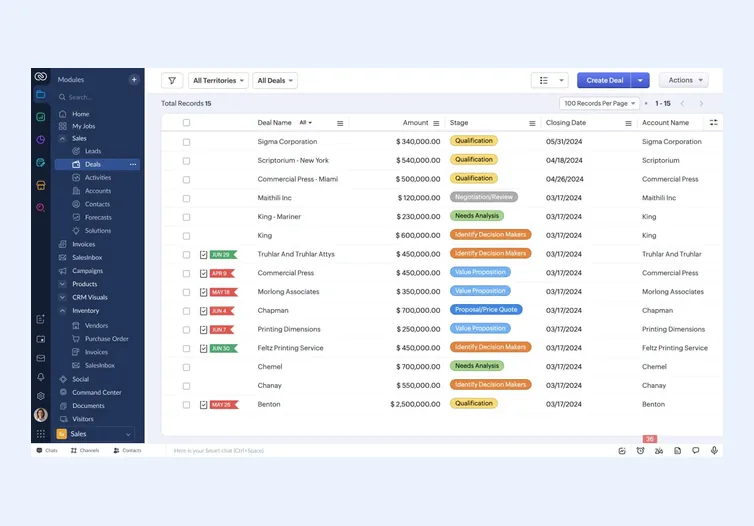
Lead and deal stages defined with clear entry and exit criteria, mapped to one or more pipelines, so every rep moves deals the same way and forecasts mean something.

Zoho CRM Blueprints that enforce required steps, fields and approvals at each stage, such as discount approval or credit checks, without turning the CRM into paperwork.

Web forms, chat, email and ad leads captured with source data, deduplicated, scored and assigned by territory, product or round-robin rules so no lead waits unanswered.

Custom modules, layouts, related lists, buttons and Deluge functions for requirements that standard modules do not cover, documented so they stay maintainable.

UTM and campaign data carried from Google Ads, Meta or LinkedIn into lead and deal records, so revenue reports show which channels and campaigns produce closed business.

Quotes, sales orders and invoices connected to Zoho Books or another accounting system, so sales sees payment status and finance gets clean customer data.

Pipeline, activity, conversion and forecast dashboards designed around the questions sales managers and leadership actually ask in weekly reviews.

A review of an existing Zoho CRM account covering data quality, unused fields, conflicting workflows, permissions and adoption, with a prioritized fix list.
How I Work
Understand how you really sell
 Sales and service walkthroughs
Lead-to-cash process map
Stage definitions and criteria
Reporting questions list
Data sources inventory
Sales and service walkthroughs
Lead-to-cash process map
Stage definitions and criteria
Reporting questions list
Data sources inventory
Build the CRM around the map
Modules, fields and layouts
Pipelines and Blueprints
Routing and automation rules
Integrations and attribution
Data migration and UAT
Make it part of daily work
Role-based training sessions
Manager dashboard reviews
Adoption and data checks
Post-launch refinements
Zoho CRM suits a wide range of B2B and B2C businesses, from a small sales team replacing spreadsheets to a multi-team operation with territories, approvals and several pipelines. It is particularly strong when you want a configurable CRM that can grow into a wider Zoho setup without changing vendors.
Zoho CRM usually fits when:
Consider alternatives when:
For side-by-side views, see Zoho CRM vs HubSpot and Zoho CRM vs Salesforce. If you are still deciding whether you need a CRM, an ERP or both, my ERP vs CRM article explains the difference.
Zoho CRM has a long feature list. In practice, a handful of capabilities decide whether an implementation works. These are the ones I spend most design time on.
Zoho also adds AI features through its Zia assistant, such as predictions and data enrichment. I treat these as useful extras once the data is clean, not as a substitute for a clear process. Feature availability differs between editions, so I confirm what your plan includes before designing around it.
A CRM is only as useful as the data flowing into and out of it. Two connections matter most: where leads come from and what happens after a deal is won.
Marketing side. Leads arrive from website forms, live chat, ad platforms, events and referrals. I make sure each lead carries its source, campaign and, where possible, UTM parameters into Zoho CRM, and that this data survives conversion from lead to contact and deal. That lets you report revenue by channel instead of guessing. It connects directly to my work on Google Ads management and B2B lead generation, where offline conversion data from the CRM helps ad platforms optimize for real customers.
Finance side. When a deal is won, someone needs a quote, sales order or invoice. Zoho CRM integrates natively with Zoho Books and Zoho Inventory, so quotes and orders can flow into finance with the right customer and item data. If you use another accounting or ERP system, I design the integration through Zoho Flow, middleware or the Zoho CRM API, depending on volume and reliability needs.
Other common connections include telephony, email and calendar, e-signature, Zoho Desk for support tickets and Zoho Campaigns for email marketing. I keep a simple integration register that lists every connection, its direction and its owner. The broader method is on my CRM consulting page.
Most Zoho CRM projects involve moving data from spreadsheets, an older CRM or a mix of both. The migration is where a lot of CRM projects quietly fail: records arrive duplicated, ownership is wrong and reps lose trust in the system in the first week.
My migration approach:
Moving from HubSpot, Salesforce, Pipedrive or a custom CRM each has its own quirks around custom objects, picklists and activity history. I plan cutover so reps stop using the old system on a specific date and nothing is lost in between. The Zoho CRM implementation guide covers the wider rollout steps.
Zoho CRM is a capable product, and it is fair to be clear about where it needs care.
These limitations rarely rule Zoho CRM out. They shape the design. When they do matter, an ERP and CRM evaluation compares the realistic options against your requirements.
I am an independent Zoho CRM consultant. I do not resell Zoho licenses or represent Zoho, so my advice is about what fits your sales process, including when that means a simpler setup or a different product.
Common engagements include:
Industry context matters in CRM design:a real estate pipeline looks nothing like a professional services one. A representative example is the services CRM automation case study.
Whatever the starting point, the design, automation and custom code are documented so your team owns the system. If you want an outside view on your CRM, contact me to talk it through.

Tell me about your business and current systems. I’ll suggest the most sensible first step.
Book a Consultation
Not sure which ERP you need?
Share your business requirements with me and I will help you understand the right process, architecture and platform before implementation.
Platforms
 By Country
Pages written for each market: local tax, e-invoicing, data hosting, migration sources and how the work runs remotely there.
FAQ
It depends on the number of teams, pipelines, integrations and the state of the data you are migrating. A single sales team with clean data is a much smaller project than several teams with territories, approvals and finance integration. I scope the work after a short discovery and phase it so a usable CRM goes live early and more advanced features follow.
Usually, yes. I audit data quality, fields, layouts, workflows, Blueprints, permissions and integrations, then propose a prioritized cleanup. Many accounts can be brought back into shape by removing unused elements, fixing stage definitions and repairing automation. A rebuild is only recommended when the structure cannot support how the team needs to sell.
It depends on where your priorities lie. Zoho CRM tends to suit teams that want deep configuration and a path into a wider business suite, while HubSpot is often chosen by marketing-led teams that value its inbound marketing tools. I compare both against your actual sales and marketing processes. My Zoho CRM vs HubSpot comparison covers the main trade-offs.
Yes, if it is set up for it. Lead source, campaign and UTM data need to be captured on the lead and carried through conversion to deals. With that in place, you can report revenue by channel and campaign, and send offline conversions back to ad platforms. This is one of the areas where my CRM and paid media work overlap.
Where it is needed, yes. I use Deluge functions, custom buttons and client scripts for calculations, validations and integrations that configuration cannot handle. I always try standard features first, keep custom logic small and document every function so your team or a future consultant can maintain it.
Every business is different. Share where you are today and what you want to fix, and I’ll tell you honestly whether and how I can help.
Book a Consultation
Insights
 Book a Consultation
Book a consultation to talk through your processes, systems and goals. I’ll reply with practical next steps - no obligation.