Contact Info

 Zoho CRM in Kuwait
What does Zoho CRM need to handle for a Kuwaiti company?
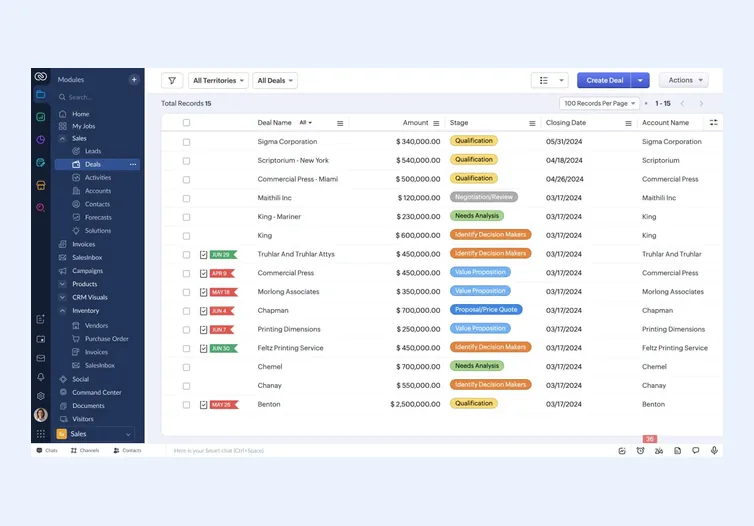
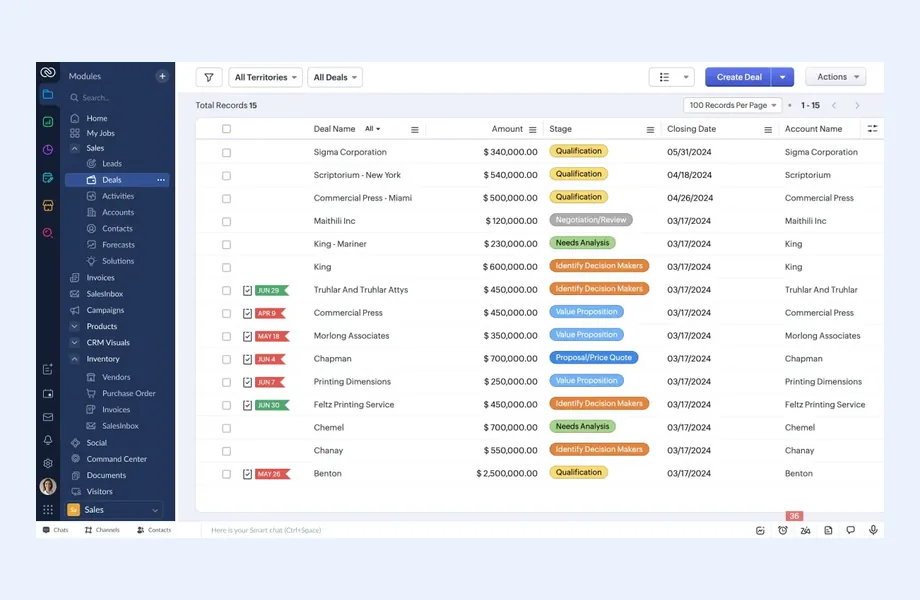
Kuwaiti sales often run through agencies for international brands, showrooms with walk-in buyers, ministry and public-sector tenders, and group companies that share the same clients. Zoho CRM must separate brands and companies while showing owners the full picture, work for staff who prefer Arabic, quote in dinars to three decimals, and pass orders to Zoho Books. I design that structure as an independent consultant.
Last reviewed by Vikas Saroj
I work remotely with Kuwaiti trading houses, brand agencies, showrooms, contractors and service companies, many of them part of family-owned groups. Their sales teams often represent several international principals at once, and their owners want to see every customer relationship across the group.
That creates tension in a CRM. A brand manager needs a focused pipeline for one principal. A group director needs to see that the same ministry or developer is buying from three sister companies. A showroom manager needs to know which walk-in visitors came back.
My work is to design Zoho CRM so each of those people gets the view they need, without duplicating customers or exposing data that should stay separate.
 What I Do
Kuwaiti CRM projects tend to start with structure: which companies, which brands, and who sees what.

Separate pipelines or layouts for each principal or product line, so brand managers track their own targets while customers stay in one shared list.

Quick capture of walk-in visitors, test drives or product demonstrations, with follow-up tasks so interest shown in the showroom is not lost after the visit.

Sharing and role settings that let group leadership see across sister companies while sales staff see only their own company or brand.

Stages for public-sector and oil-sector bids, from registration and document purchase to technical review, price opening and award, with deadlines that trigger reminders.

Dashboards and exports that answer the questions principals ask, such as pipeline by product, customer segment and region, without rebuilding spreadsheets each month.

Dinar quotations with three-decimal precision, discount approvals, and conversion into sales orders and invoices in Zoho Books for each group company.
How I Work
Map companies, brands and owners
 Group company inventory
Brands and principals list
Shared customer review
Access needs by role
Group company inventory
Brands and principals list
Shared customer review
Access needs by role
Configure pipelines and permissions
Brand and tender pipelines
Showroom capture forms
Sharing rules and roles
Arabic user walkthroughs
Zoho Books connection
Start small, then expand
Pilot with one company
Principal report check
Adjust and document
Roll out to sister companies
A notable share of Kuwaiti trade runs through local companies that hold agency or distribution rights for international brands: vehicles, electronics, building products, medical equipment, food and consumer goods. One sales organization may carry many brands, each with its own targets, pricing and reporting obligations to the principal.
In Zoho CRM, the question is how far to separate them. I usually work through these choices with you:
Principals often ask for pipeline and sell-through information. When it comes from a CRM that reps actually use, the report is quick to produce and easy to defend. When it comes from a spreadsheet assembled at month end, it is neither. The global feature set behind this design is on my Zoho CRM consulting page.
Kuwaiti family groups frequently include a trading company, a contracting arm, a facilities business and sometimes retail or food service. The same developer, ministry or large private client may buy from several of them. Owners want to see that full relationship; managers of each company often prefer to keep their pipeline to themselves.
Zoho CRM can handle both, but only with a deliberate design. The main options are:
The right choice depends on how much the companies genuinely cooperate and how sensitive their pricing is. I write the decision down as an access matrix, tested with real users before go-live. I also recommend piloting with one company before bringing in the others, so the structure is proven on a smaller scale. How the rest of the suite suits a Kuwaiti group is discussed under Zoho consulting in Kuwait.
Two very different sales motions sit side by side in many Kuwaiti companies.
The first is the showroom. Car dealers, furniture stores, electronics retailers and kitchen suppliers see visitors who browse, ask for a price and leave. Without a quick way to capture them, that interest is gone. I set up a short form, usable on a tablet or phone, that records the visitor, their interest and the salesperson, then creates a follow-up task. Consent to be contacted is recorded at the same time.
The second is the public sector. Ministries and state entities buy through formal tenders, and the oil sector runs its own supplier qualification and bidding. These cycles are long and paperwork-heavy. In Zoho CRM I create a tender record with stages for registration, purchase of tender documents, site visit, clarifications, technical submission, price opening and award, each with a deadline and an owner. Reminders go out before deadlines, not after.
Both motions share customers and products, so they live in the same CRM with different layouts. Managers then see showroom conversion and tender win rates in one place, rather than comparing two unrelated spreadsheets.
In many Kuwaiti companies, Arabic is the working language of salespeople and managers, not only of customers. Before committing, I ask a few of those users to complete real tasks in Zoho CRM's Arabic interface: create an account, log a visit, prepare a quote. Their experience decides whether the design works, and which templates must be Arabic-first.
Since Kuwait has not brought in VAT to my knowledge, domestic quotations usually carry no tax line. Confirm the position with your tax advisor, and note that group companies selling into other GCC states may face VAT there. The dinar's three decimals are the practical risk: I check currency precision on quotes, discounts and totals, and again wherever amounts pass to Zoho Books or a payment link. KNET and card collections are recorded in finance, not in the CRM.
On personal data, Kuwait's rules are less consolidated than in some neighboring countries, with specific regulations applying to certain sectors and providers. Ask your legal advisor which obligations apply to you. I then configure what they recommend: consent fields, export limits, role-based access and retention of inactive leads. Zoho's data center options should be checked when the account is created, and WhatsApp connections confirmed for your region before they are built into the design.
Zoho CRM fits many Kuwaiti trading, agency and service businesses. These are the situations where I suggest another tool, or a tool alongside it:
If the decision is really about the ERP behind your sales, begin with my ERP consulting for Kuwait. The Kuwait page explains how remote engagements with Kuwaiti groups work, and the broader method is on CRM consulting.

Tell me about your business and current systems. I’ll suggest the most sensible first step.
Book a Consultation
Not sure which ERP you need?
Share your business requirements with me and I will help you understand the right process, architecture and platform before implementation.
FAQ
Yes. A shared CRM with separate layouts, pipelines and sharing rules lets each company work on its own deals while leadership sees the whole group. Where pricing is sensitive or the companies rarely overlap, separate CRMs with a group report can be safer. I help you choose based on how the companies actually work together.
Yes. Products can be tagged by principal and pipelines or fields used to separate brands, while each customer stays as a single account. That makes it possible to give each principal the reporting they ask for without exposing the other brands you represent.
As far as I know Kuwait has not implemented VAT, so domestic quotes usually show no tax. Confirm this with your tax advisor. If a group company sells into another GCC country, tax on those sales should be handled in Zoho Books under advice.
Zoho CRM offers an Arabic interface, but the right test is your own users. I ask Arabic-speaking staff to complete everyday tasks during design, then adjust layouts, field labels and templates based on what they find awkward. Field labels can also be adjusted where translations feel unnatural.
Remotely, through online workshops, configuration reviews on a shared screen and written design notes, scheduled in the Kuwaiti working week. I do not normally travel for these projects, though a visit can be agreed separately. My advice is independent of Zoho.
Every business is different. Share where you are today and what you want to fix, and I’ll tell you honestly whether and how I can help.
Book a Consultation
Insights
 Book a Consultation
Book a consultation to talk through your processes, systems and goals. I’ll reply with practical next steps - no obligation.