Contact Info

 Zoho CRM in KSA
What does a Zoho CRM consultant do for a Saudi company?
In Saudi Arabia, a Zoho CRM consultant designs the CRM for Arabic-first customer data, field sales teams spread across the Kingdom's regions, and long project and tender pipelines with government and private developers. The work includes duplicate control for Arabic and transliterated names, WhatsApp follow-up, consent and access rules shaped by the Personal Data Protection Law, and a handoff from quotation to a compliant tax invoice issued in Zoho Books.
Last reviewed by Vikas Saroj
I work remotely with Saudi distributors, building material suppliers, contractors, service companies and family groups that want one view of their customers across Riyadh, the Western region and the Eastern Province. Their sales teams spend most of the day on the road, talk to customers in Arabic, and follow up on WhatsApp.
A CRM designed in English for a desk-based team will not survive that reality. Customer names arrive in Arabic and in several Latin spellings, project opportunities run for many months, and the sales manager needs to know which rep visited which contractor this week without asking.
My work is to design Zoho CRM for those conditions, then test it with the people who will carry it in their pocket.
 What I Do
Saudi CRM projects tend to fail on data quality and field adoption rather than features. These are the areas I focus on.

Arabic and English names on accounts and contacts, a standard transliteration rule, and duplicate checks that catch the same customer entered under different spellings.

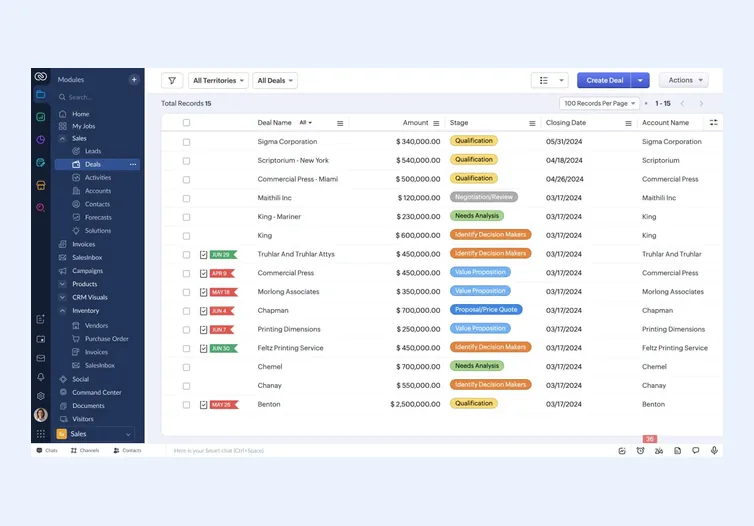
Visit planning by region and city, check-ins from the Zoho CRM mobile app, visit outcomes and next actions, so managers see coverage without collecting daily reports by message.

Opportunities tied to construction or infrastructure projects, tracking the owner, consultant and contractor, specification status and the long gap between approval and supply.

Records for each tender invitation with issuing entity, closing date, bid bond and document checklist, plus a Blueprint for the go or no-go decision and approvals.

Fields for how contact details were collected and what the person agreed to, role-based access to sensitive records, and retention rules agreed with your legal advisor.

Bilingual quotations in riyals with VAT shown, approval steps for discounts, and sales orders passed to Zoho Books, where the tax invoice is generated under the e-invoicing rules.
How I Work
Understand regions, teams and data
 Field route and visit review
Customer data quality sample
Project and tender flow map
Language and template needs
Personal data questions list
Field route and visit review
Customer data quality sample
Project and tender flow map
Language and template needs
Personal data questions list
Configure for mobile and Arabic
Account model with CR and VAT
Duplicate and merge rules
Visit and pipeline layouts
WhatsApp and quote templates
UAT with field reps
Keep reps using it daily
Arabic training recordings
Regional manager dashboards
Duplicate review routine
Quarterly pipeline cleanup
The most common data problem I find in Saudi CRM accounts is not missing information. It is the same customer recorded several times. One rep enters a contractor in Arabic, another types a Latin spelling from a business card, a third uses the commercial name instead of the legal name. Personal names have the same issue, with several accepted spellings for common names. Reports then split one customer's history across records, and two reps chase the same buyer.
The fixes are partly technical and partly agreed rules:
Clean identity data also matters for finance. When a deal turns into an invoice, the buyer's legal name, address and VAT number flow into the tax invoice, so mistakes in the CRM become mistakes in a document the authority sees.
Saudi sales teams cover large distances. A building materials supplier may have reps in Riyadh, Jeddah, Dammam and smaller cities, each visiting contractors, consultants and retailers. Managers want to know who was visited, what was discussed and what happens next, without relying on WhatsApp voice notes at the end of the day.
In Zoho CRM I set up:
Project selling needs a different structure. On a large development, the owner, the design consultant and several contractors all influence what gets specified and bought. I model the project as its own record linked to every account involved, with stages such as design, specification, approval, tender, award and supply. These pipelines can run for a long time, so I keep probability and expected date honest by asking reps to confirm them at set intervals.
Tenders from government entities and large developers sit in their own pipeline, with closing dates, bid bonds and document checklists. Zoho CRM becomes the record of why you bid, what you offered and why you won or lost, which is useful knowledge for the next tender. The construction industry page covers the delivery side.
Saudi Arabia's Personal Data Protection Law sets expectations for how organizations collect, use, share and keep personal data, with oversight by the national data authority. What it requires of your company, including any rules on transferring data outside the Kingdom, is a question for your legal advisor. Inside the CRM, my role is to make those decisions practical.
Typical design choices:
WhatsApp is the main follow-up channel for most Saudi reps. Connecting WhatsApp Business to Zoho CRM through a supported integration keeps messages against the customer record and allows approved Arabic templates. Calling works the same way: a cloud telephony integration logs calls and outcomes automatically. Check that any provider you choose is licensed to operate in the Kingdom.
Where your data is hosted is a separate decision, made when the Zoho account is created, and is covered on my Zoho consultant Saudi Arabia page.
In the Kingdom, the tax invoice has to meet ZATCA's e-invoicing requirements, which govern the structured format, QR code and, for many businesses, integration with the authority. A quotation from Zoho CRM is not that invoice and should never be presented as one. The cleanest design keeps commercial negotiation in the CRM and invoice issuance in Zoho Books or your ERP.
How the handoff works:
Advance payments and retention on project supply often complicate this, so I agree with finance how down payments, progress invoices and final invoices relate to a single CRM deal. For businesses on another ERP, the same ownership rules apply through an integration. My ERP integration page explains the method.
Zoho CRM fits many Saudi SMEs and mid-sized groups well. It is not always the right answer:
I work remotely within the Sunday to Thursday week and provide recorded Arabic-friendly walkthroughs for field teams. On-site workshops are possible by arrangement. For the full systems picture, including ERP, read my Saudi ERP consultant page and the Saudi Arabia overview, and the product itself is described on my Zoho CRM consultant page.

Tell me about your business and current systems. I’ll suggest the most sensible first step.
Book a Consultation
Not sure which ERP you need?
Share your business requirements with me and I will help you understand the right process, architecture and platform before implementation.
FAQ
Zoho CRM supports Arabic for data and in its interface, and Arabic quotation and email templates are possible. Coverage can differ between screens, reports and the mobile app, so I test the specific flows your team uses, especially for field reps, before go-live.
The CRM is not where invoices should be issued. I design Zoho CRM to prepare quotations and sales orders, then pass them to Zoho Books or your ERP, which generates the tax invoice under the e-invoicing rules. Your advisor confirms your obligations, and the invoicing system carries them.
By relying on stronger identifiers than names. Commercial registration and VAT numbers on accounts, normalized mobile numbers on contacts, a transliteration rule for English names and a regular merge routine together keep duplicates under control.
Yes. I work remotely with Saudi companies within the Sunday to Thursday week, running workshops over video and recording training for field staff. On-site sessions can be arranged when a specific workshop needs them.
Every business is different. Share where you are today and what you want to fix, and I’ll tell you honestly whether and how I can help.
Book a Consultation
Insights
 Book a Consultation
Book a consultation to talk through your processes, systems and goals. I’ll reply with practical next steps - no obligation.