ERP vs CRM: Differences, Overlaps and Which You Need First
By Vikas Saroj, ERP, Digital Transformation & Growth Consultant
Key takeaways
- CRM manages everything before and around a sale, such as leads, pipeline, marketing and service, while ERP manages orders, inventory, purchasing, production, projects and accounting after the sale.
- Start with CRM if leads slip through the cracks and pipeline visibility is weak; start with ERP if orders, stock and invoices live in disconnected spreadsheets and month-end is slow.
- Decide which system masters each data type before integrating: CRM usually owns leads and contacts, while ERP owns billing details, credit terms, products, prices, orders and invoices.
- An integrated suite such as Zoho One, Odoo or ERPNext offers a shared data model, while best-of-breed gives depth in each area at the cost of building and maintaining integration.
- Avoid using the CRM as a makeshift ERP or the ERP as a makeshift CRM, and plan the integration during design rather than after both systems are live.

CRM (customer relationship management) manages everything before and around a sale: leads, opportunities, customer communication, marketing and service. ERP (enterprise resource planning) manages everything that happens once a sale is made and behind the scenes: orders, inventory, purchasing, production, projects and accounting. Most growing businesses eventually need both, connected so customer and order data flow between them without re-keying.
The question I get most often is not "which is better?" but "which one do we need first, and how should they work together?" This article answers both.
What a CRM does
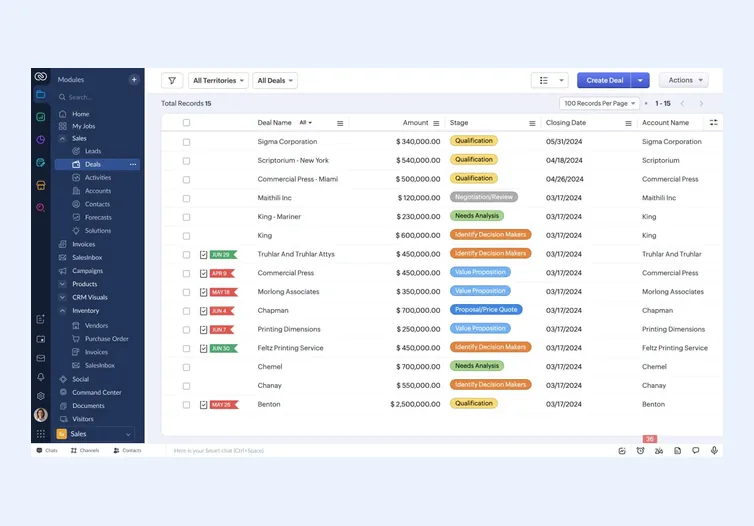
A CRM is built around the customer and the people who interact with them: sales, marketing and customer service. Its job is to help you win and keep customers.
- Lead and contact management: capture leads from your website, campaigns, events and referrals, and keep a full history of each contact.
- Sales pipeline: track opportunities through stages, forecast revenue and see where deals stall.
- Activity tracking: calls, emails, meetings and follow-up tasks in one timeline.
- Marketing: segmentation, email campaigns and attribution of leads to sources.
- Customer service: tickets, service requests and support history.
- Sales automation: assignment rules, reminders and follow-up sequences.
Common CRM platforms include Zoho CRM, Salesforce and HubSpot, among many others. If you are rolling one out, my Zoho CRM implementation guide walks through the process.
What an ERP does
An ERP is built around transactions and resources: money, stock, materials, people and time. Its job is to help you deliver efficiently and account for it accurately.
- Finance and accounting: ledger, receivables, payables, tax and financial reporting.
- Order management: sales orders, deliveries, invoices and returns.
- Purchasing and inventory: suppliers, purchase orders, stock levels and valuation.
- Manufacturing or projects: production orders, bills of materials, project costing and billing.
- HR and payroll in many platforms.
For a fuller introduction, see what is ERP.
ERP vs CRM: side-by-side comparison
| Aspect | CRM | ERP |
|---|---|---|
| Main purpose | Win, grow and retain customers | Run operations and finance efficiently |
| Focus | Front office: customer-facing activity | Back office: transactions and resources |
| Primary users | Sales, marketing, customer service | Finance, purchasing, warehouse, production, projects, HR |
| Core records | Leads, contacts, accounts, opportunities, cases | Items, orders, invoices, bills, stock, journals |
| Key questions it answers | Who are our prospects? What is in the pipeline? How are customers being served? | What did we sell, deliver and earn? What do we owe and own? What does it cost? |
| Typical outputs | Pipeline forecasts, campaign results, service metrics | Financial statements, stock reports, margin and cost analysis |
| Data precision | Flexible; estimates and probabilities are normal | Exact; every transaction must balance and be auditable |
| Implementation complexity | Usually lighter and faster to start | Usually broader, touching more departments and data |
| Where it starts and stops | From first contact to signed deal, then ongoing relationship | From confirmed order to delivery, invoice, payment and reporting |
Where CRM and ERP overlap
The boundary is not always clean. Some areas show up in both:
- Customer records. CRM holds the relationship; ERP holds billing details, credit terms and transaction history. They must stay in sync.
- Quotes. Many teams quote in the CRM, but pricing, stock availability and margins live in the ERP.
- Products and price lists. Usually mastered in the ERP and pushed to the CRM.
- Invoices and payment status. Generated in the ERP, but salespeople want to see them in the CRM before calling a customer.
Deciding which system is the "master" for each type of data is one of the most important design decisions you will make. Get it wrong and you end up with two versions of the customer.
Which do you need first?
It depends on where your biggest constraint is.
Start with CRM if:
- Leads are slipping through the cracks or follow-up depends on individual salespeople's memory
- You have no reliable view of the sales pipeline or forecast
- Marketing cannot tell which campaigns produce customers
- Your operations are simple and accounting software handles the back office well
Start with ERP if:
- Orders, stock and invoices are managed across disconnected spreadsheets and tools
- Month-end close is slow and depends on manual reconciliation
- You cannot see real-time stock, production status or project costs
- Growth is creating operational errors faster than sales problems
Many businesses need both at roughly the same time. In that case, plan them together, even if you implement them in sequence, so the data model and integration are designed once.
All-in-one suite or best-of-breed?
There are two broad approaches:
- Integrated suite. CRM and ERP from the same platform. Zoho One, Odoo and ERPNext all include CRM and ERP capabilities in one ecosystem. Benefits: a shared data model, fewer integrations and one vendor. Trade-off: one module may be less deep than a specialist product.
- Best-of-breed. A specialist CRM such as Salesforce or HubSpot connected to a separate ERP. Benefits: depth in each area. Trade-off: you must build and maintain integration, and manage two vendors.
Neither is universally right. If your sales process is complex and central to the business, a specialist CRM may be worth the integration effort. If operations are the complex part and sales is straightforward, a suite with a solid built-in CRM often makes more sense.
Who owns which data
A simple ownership table, agreed before any integration is built, prevents most sync problems. A typical starting point:
| Data | Usually mastered in | Shared with |
|---|---|---|
| Leads, opportunities, activities | CRM | Not usually needed in ERP |
| Customer name and contacts | CRM | ERP, once the customer places a first order |
| Billing details, credit limit, payment terms | ERP | CRM, read-only |
| Products, price lists, stock availability | ERP | CRM, read-only |
| Sales orders, invoices, payments | ERP | CRM, read-only for visibility |
| Support tickets and service history | CRM or service desk | ERP if billable |
Adjust it to your business, but write it down. When two systems both believe they own the customer address, someone will eventually invoice the wrong one.
How to connect CRM and ERP
A well-designed integration usually works like this:
- Leads and opportunities are managed in the CRM.
- When a deal is won, the customer and order are created in the ERP, with no re-typing.
- The ERP handles fulfillment, invoicing and payment.
- Order status, invoices and payment status flow back to the CRM so sales and service can see them.
- Products, price lists and stock availability flow from the ERP to the CRM.
Agree the master system for each data type, define what happens when records conflict, and set up monitoring so failed syncs are noticed. I cover this kind of work under system integration and CRM consulting.
Common mistakes
- Using the CRM as a makeshift ERP. Tracking stock or invoices in custom CRM fields works until it doesn't, usually at the worst moment.
- Using the ERP as a makeshift CRM. Sales teams avoid systems that feel like accounting software, so pipeline data goes back into spreadsheets.
- Duplicate customer masters. Without a clear owner, the same customer ends up with different names, addresses and terms in each system.
- Integration as an afterthought. Plan it in the design, not after both systems are live.
Next steps
If you are deciding between CRM and ERP, or need the two to finally work together, I can help you map the processes, decide what lives where and choose the right platforms. Explore my ERP consulting services or book a consultation.
Frequently Asked Questions
What is the main difference between ERP and CRM?
CRM manages customer-facing activity such as leads, sales pipeline, marketing and service. ERP manages operations and finance, including orders, inventory, purchasing, production, projects and accounting. CRM helps you win customers; ERP helps you deliver and account for what you sell.
Can an ERP replace a CRM?
Some ERP platforms include a CRM module that is sufficient for straightforward sales processes. If your sales process is complex, involves long cycles or heavy marketing automation, a dedicated CRM is usually a better fit, integrated with the ERP.
Should I implement CRM or ERP first?
Start where your biggest constraint is. If leads and pipeline visibility are the problem, start with CRM. If orders, stock, invoicing and month-end close are the problem, start with ERP. If you need both, design them together even if you implement them in sequence.
How do CRM and ERP share data?
Through an integration that syncs customers, products, prices, orders, invoices and payment status. The key is deciding which system is the master for each data type, handling conflicts, and monitoring the sync so errors are caught quickly.

Written by Vikas Saroj
Independent ERP, digital transformation & growth consultant helping businesses map processes, implement Zoho, Odoo and ERPNext, automate operations and grow online. · LinkedIn
 Insights