Contact Info

 Zoho CRM in Oman
How is Zoho CRM adapted for Omani sales teams?
Omani companies often sell through dealers spread across the governorates, bid for public and energy-sector work, and quote in rials with three decimal places. Adapting Zoho CRM means territory rules by region, separate pipelines for tenders and dealer orders, bilingual customer records, consent handling shaped by Oman's data protection law, and quotes that pass cleanly to Zoho Books, where VAT is calculated.
Last reviewed by Vikas Saroj
I work remotely with Omani importers, distributors, building suppliers, engineering firms and service companies. Their customers are spread from Muscat and the Batinah coast to the interior and Dhofar, and much of their revenue arrives through dealers, sub-distributors and formal bids rather than inbound leads.
Those businesses usually already know their customers well. What they lack is a shared record: visit notes sit in notebooks, dealer orders arrive by phone, and the status of a bid lives with whoever prepared it.
I design Zoho CRM to collect that knowledge in one place, then connect it to quoting and invoicing so the numbers agree down to the last baisa.
 What I Do
Most Omani projects combine dealer management, bidding and quotation, so I usually design all three together.

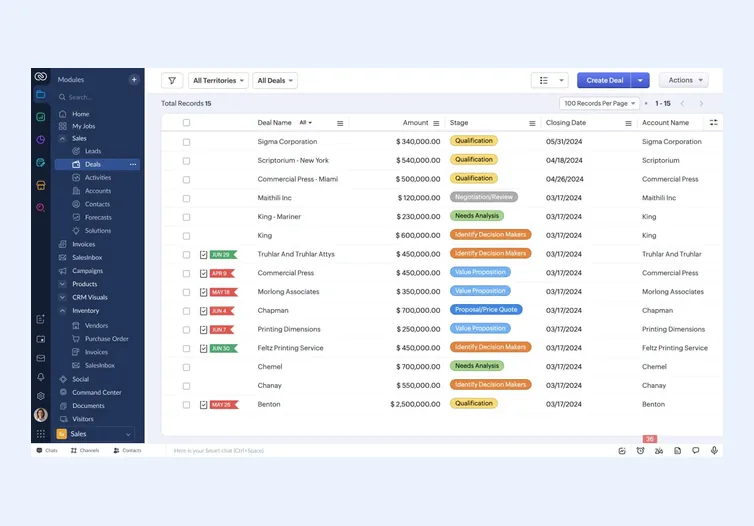
Assignment rules by governorate or sales region, so leads and visit tasks reach the rep who covers Sohar, Nizwa or Salalah instead of piling up with the Muscat team.

Dealers, sub-dealers and the end users they serve held as linked accounts, so you can see which projects a dealer is pursuing and which customers buy from you directly.

Separate stages for public tenders, energy-sector inquiries and private projects, including supplier registration, technical submission and commercial award.

Currency and price precision checked so quotes keep three decimals, with discount approvals and validity periods that match how your managers actually authorize prices.

Arabic and English names stored side by side with a naming standard, so the same ministry, contractor or family business is not created twice under different spellings.

Accepted quotes converted into sales orders or invoices in Zoho Books, where VAT codes and invoice formats are controlled by finance rather than by sales.
How I Work
Learn the routes to each customer
 Dealer and territory review
Recent bids walked through
Quote approval habits
Customer data sample check
Dealer and territory review
Recent bids walked through
Quote approval habits
Customer data sample check
Turn those routes into CRM structure
Territory and assignment rules
Bid and dealer pipelines
Three-decimal quote tests
Consent and access fields
Zoho Books handoff
Make the CRM part of the week
Cleaned data import
Field rep mobile training
Manager dashboards
Monthly usage review
Oman is a large country with a small population spread along long coastlines and inland towns. Many distributors cover it through a mix of their own reps and local dealers in places such as Sohar, Ibri, Nizwa, Sur and Salalah. Head office knows the dealers but rarely sees the end customers they serve.
That makes the account model the first design decision in Zoho CRM. I typically set up:
Territory rules matter more than in a compact city market. Assignment by governorate or a custom region field sends each inquiry to the right person immediately, and managers can compare regions without asking each rep for a spreadsheet. Field visits are logged on the Zoho CRM mobile app; I test it on the routes your reps actually drive, including areas with weak signal, before rollout. The global feature view is on my Zoho CRM page.
Government entities in Oman buy through a formal tender process, and large state-linked and energy-sector companies keep their own supplier registration and qualification requirements. Some of those buyers also ask suppliers to show how their bid supports in-country value, such as local employment or local sourcing. The exact rules belong to each buyer and change over time, so I treat their published requirements as the source.
In Zoho CRM, I separate the long administrative work from the actual bids:
Expiring registrations trigger reminders weeks ahead, because missing a renewal can exclude you from bids you never see. When a bid is won and turns into a project, the delivery side moves to project and finance systems; my Zoho page for Oman covers how the wider suite fits.
Two Omani facts shape every quotation: sales are subject to VAT under the Oman Tax Authority, and each rial splits into a thousand baisa. Both affect quotations, but in different places.
Precision is a CRM concern. Zoho CRM quotes calculate unit prices, discounts and line totals, and the currency and decimal settings must be checked so three decimals survive every step. I test quotes with fractional unit prices, percentage discounts and large quantities, then compare each line against a manual calculation. The same test runs again after any integration or custom function is added.
Tax treatment is a finance concern. I prefer quotes in the CRM to show indicative tax only where your finance team agrees, and the binding VAT calculation to happen once the accepted quote is converted in Zoho Books, under rules your tax advisor has confirmed. That way a sales rep cannot override a tax code to win a deal.
The Oman Tax Authority is also introducing e-invoicing. Its scope and timing are for the authority to set, but clean customer data helps whatever the final model: VAT numbers in the proper field, legal names spelled consistently, and no duplicate accounts. Those fields start in the CRM and flow into finance, which is why I fix them here first. For the accounting side, read my notes on Zoho Books in Oman.
Omani customer data arrives in two scripts. A ministry, a contractor or a family business may be known by its Arabic name on official documents and by a transliterated English name in emails, with several spellings in between. Without a rule, the CRM collects duplicates that sales reps quietly work around.
I keep separate Arabic and English name fields, agree a transliteration standard, and set duplicate checks on phone numbers and registration details rather than names alone. Quotation and letter templates are prepared in both languages where customers expect Arabic, and checked in print.
Much follow-up happens on WhatsApp. WhatsApp Business can be linked to Zoho CRM through Zoho's own options or add-ons from other vendors; what is offered and the rules around it change, so I verify the current options for your account before including them in the design.
Oman has a personal data protection law that sets conditions on collecting and processing personal data, including for marketing. Your legal advisor interprets it for your business. I then build what they specify: consent and source fields, limits on who can export contact lists, retention rules for old leads, and role-based access for dealers or agents who use the CRM. Data center options for your Zoho account are worth confirming at sign-up.
Zoho CRM is a strong place to manage customers, dealers, bids and quotes. A few Omani requirements belong elsewhere:
I help you draw those lines before building, so the CRM stays focused. If you are still choosing the ERP that will sit behind the CRM, start with my ERP consulting for Oman. How remote engagements with Omani firms run is set out on the Oman page, and the method behind CRM projects is on my CRM consulting page.

Tell me about your business and current systems. I’ll suggest the most sensible first step.
Book a Consultation
Not sure which ERP you need?
Share your business requirements with me and I will help you understand the right process, architecture and platform before implementation.
FAQ
Currency and decimal settings in Zoho CRM need to be configured and tested for rials. I check unit prices, discounts and totals at three decimals, and repeat the test after integrations are added, because rounding errors usually appear where systems pass amounts to each other.
I recommend that the binding VAT calculation happens in Zoho Books, under rules your tax advisor confirms. The CRM quote can show an indicative figure if finance agrees, but invoices, tax codes and returns stay with the finance team. Sales still sees the final total once finance confirms it.
Dealers can be given limited access through portal features or restricted user profiles, depending on your plan and how much you want them to see. I design what each dealer can view and update, and record the decision alongside your data protection policy.
E-invoicing itself is handled on the finance side, and the Oman Tax Authority sets its scope. The CRM contributes clean customer data: legal names, VAT numbers and addresses that flow into Zoho Books. I fix those fields early so the finance setup has reliable inputs.
The work is delivered remotely, with workshops and configuration reviews held online during the Omani working week. Visits in person can be discussed only by arrangement. I am independent of Zoho and do not sell its subscriptions. Field teams outside Muscat receive recorded walkthroughs.
Every business is different. Share where you are today and what you want to fix, and I’ll tell you honestly whether and how I can help.
Book a Consultation
Insights
 Book a Consultation
Book a consultation to talk through your processes, systems and goals. I’ll reply with practical next steps - no obligation.