Contact Info

 Zoho CRM in the Philippines
How should a Philippine company set up Zoho CRM?
Philippine companies get value from Zoho CRM when it is set up around how their deals are really won: outsourcing and IT services contracts pursued with overseas buyers over many months, distributor and corporate accounts at home, and conversations spread across email, calls and chat apps. The work includes consent records that respect the Data Privacy Act, and quotes that pass cleanly to the accounting system that issues BIR-compliant invoices.
Last reviewed by Vikas Saroj
Selling outsourced services from the Philippines looks nothing like selling a product off a shelf. A contact center or IT services firm may court a prospect in North America or Australia for many months, run a pilot program, answer a security questionnaire and negotiate a master agreement before a single seat goes live.
I work remotely with Philippine sales and account management teams who need Zoho CRM to follow that path. Many already have the licenses but run the real pipeline in a shared spreadsheet, because the default deal stages never matched how outsourcing contracts move.
My job is to redraw the process with your team and then configure the CRM to carry it.
 What I Do
The pieces below come up again and again when Philippine firms sell services abroad or supply customers at home.

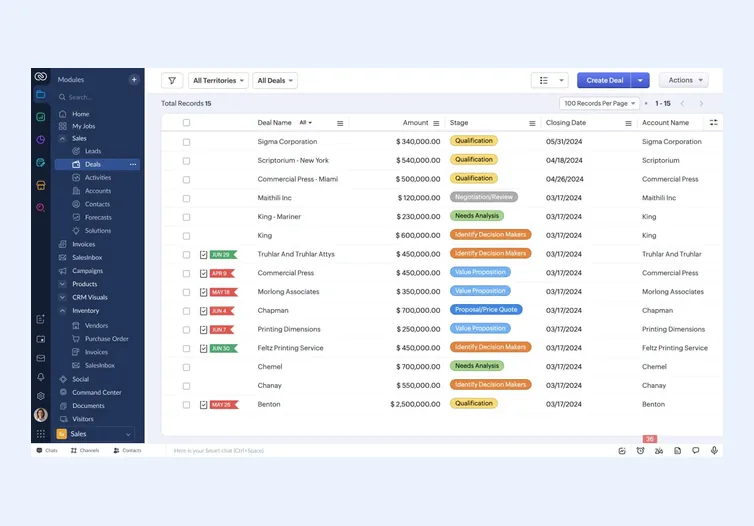
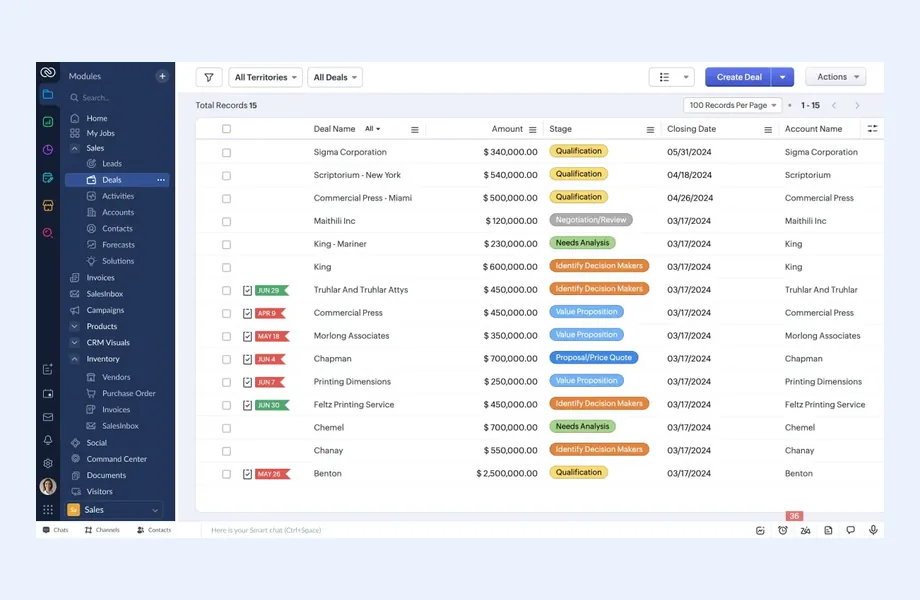
Stages that mirror discovery, solution design, pricing, pilot, contracting and ramp-up, with required fields at each gate so a forecast reflects contracts that are truly progressing rather than optimistic notes.

Existing clients modeled with programs, headcount scope, contract terms and renewal windows, so account managers see expansion opportunities and churn risk before a renewal conversation starts.

Requests for proposal, security questionnaires and solution documents logged against each deal with owners and due dates, so bid teams stop chasing status through email threads.

Lawful basis, consent source and opt-out status held on each contact, field-level access for sensitive data, and retention rules that your data protection officer can review and approve.

Email sync, call logging through a supported telephony provider, and messaging conversations attached to records where a connector you have vetted exists, so client history is not trapped on phones.

Approved quotes and won deals flow into Zoho Books or another ledger with clean customer tax details, so the invoice that carries BIR requirements is issued in the ledger, not in CRM.
How I Work
How your deals really progress
 Interview sellers and account managers
Trace a recent won deal
List lead sources and channels
Review consent and data handling
Interview sellers and account managers
Trace a recent won deal
List lead sources and channels
Review consent and data handling
Configure stages, fields and links
Deal stages with entry rules
Account and program layouts
Email, call and chat connectors
Quote templates and approvals
Handoff to the ledger tested
Make the CRM the only pipeline
Role-based training sessions
Weekly pipeline review dashboard
Spreadsheet retired on agreed date
Data quality checks each month
A Philippine BPO or IT services company usually sells to buyers abroad who compare several delivery locations before shortlisting a vendor. The deal moves through recognizable steps: first contact, discovery calls, a solution and staffing design, pricing per seat or per full-time equivalent, often a site tour or virtual walkthrough, a pilot, legal review and a phased ramp. Each step has different people involved on both sides.
I design Zoho CRM so those steps are explicit:
The outcome is a pipeline your leadership can read without asking each seller for an update. The general method sits on my CRM consulting page, while the Zoho CRM page describes the product itself.
The Philippines has a data privacy law, overseen by the National Privacy Commission, that sets expectations for how personal information is collected, used, secured and kept. Outsourcing companies often carry further obligations written into client contracts. A CRM full of prospect contacts, call recordings and email history falls squarely within that picture, so it deserves deliberate design rather than default settings.
Your data protection officer and legal advisors decide what the law requires for your business. I make the CRM capable of following their decisions:
Where you sell into overseas markets, buyers may also ask how your CRM handles their own privacy rules. A documented configuration makes those security questionnaires faster to answer. Data center choice and wider Zoho administration are discussed on my Zoho consultant Philippines page.
Philippine sellers working the domestic market, such as distributors, equipment suppliers and corporate service providers, often talk to customers through chat apps and mobile calls more than through formal email. Buyers send photos, ask for prices and confirm orders in a thread that only one salesperson can see. When that person leaves, the history leaves with them.
I look at which channels your customers really use and then decide what belongs in Zoho CRM:
Teams working night shifts for overseas clients need the same discipline, so I set reminders and dashboards that work across shifts. For acquisition channels feeding the CRM, see B2B lead generation.
Quotes and contracts live in the CRM, but invoices in the Philippines carry requirements set by the Bureau of Internal Revenue, including specific content and controlled numbering. Those belong in the accounting system your company has registered, not in a CRM template. Mixing the two is a common source of rework for finance.
How I connect the pieces:
Tax treatment of each item is decided by your tax advisor; I make sure the data that reaches the ledger is complete enough for them to apply it. See ERP integration for how I specify these links.
I am not tied to Zoho, so I also point out when it is the wrong choice:
Engagements run remotely in English, with workshops placed inside the long overlap between Philippine office hours and mine, and recorded walkthroughs for night-shift teams. If you are still deciding on your wider systems, start with my Philippines ERP consultant page or the Philippines overview.

Tell me about your business and current systems. I’ll suggest the most sensible first step.
Book a Consultation
Not sure which ERP you need?
Share your business requirements with me and I will help you understand the right process, architecture and platform before implementation.
FAQ
Yes, with the right design. I set up products or price books for seat rates, hourly rates, setup fees and pass-through costs, and capture expected headcount by ramp phase on the deal. That lets sales forecast both contract value and staffing need, and lets finance invoice from the same commercial terms once the deal is won.
It provides tools such as field permissions, audit logs and data export controls, but whether you comply rests on your own policies and how faithfully the system reflects them. Your data protection officer decides what is required. I set up consent source, opt-out handling, access rules and retention reviews so the CRM can follow those decisions consistently.
Often, through a Zoho or third-party connector for the messaging platform your customers use. Availability and terms vary by provider, so I test the connector with your own accounts before recommending it. Where no dependable option exists, I set up a quick way for sellers to log conversation summaries on the record.
No. Philippine invoices need specific content and controlled numbering that belong in your registered accounting system. Zoho CRM should hold quotes, contracts and sales orders, then pass clean customer and pricing data to Zoho Books or your ledger, where the invoice is issued and recorded.
Through video workshops, shared design documents and a single tracker for decisions. Philippine office hours overlap well with my working day, so live sessions fit your normal schedule. Teams on night shifts serving overseas clients can follow recorded sessions and add comments in writing.
Every business is different. Share where you are today and what you want to fix, and I’ll tell you honestly whether and how I can help.
Book a Consultation
Insights
 Book a Consultation
Book a consultation to talk through your processes, systems and goals. I’ll reply with practical next steps - no obligation.