Contact Info

 Zoho CRM in Spain
Why would a Spanish company hire a Zoho CRM consultant?
A Zoho CRM consultant in Spain builds the CRM around the way Spanish companies sell: field reps and independent agents, public tenders, distributors abroad and hotel contracts with tour operators. I design account data that flags the tax territory and identifiers your invoicing program needs, keep invoice issuing out of the CRM, record consent for GDPR, and run the whole engagement remotely, with no tie to Zoho.
Last reviewed by Vikas Saroj
Spanish B2B sales teams tend to mix several motions at once. Field reps visit customers in their province, independent agents cover other regions, a small export team handles distributors, and someone tracks public tenders on the side. Each motion produces its own spreadsheet, and the sales director spends Monday morning reconciling them.
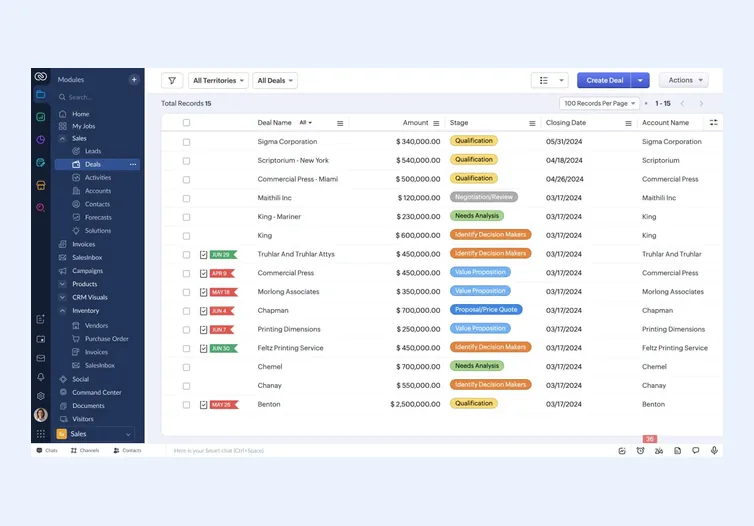
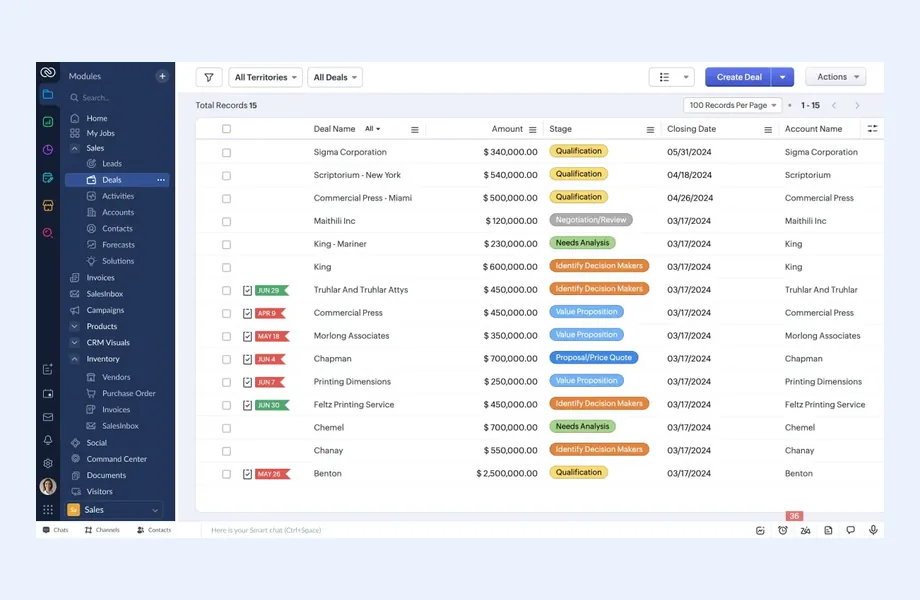
Zoho CRM can bring those motions together, but the structure has to reflect them, and the CRM has to stay on the right side of the line between quoting and invoicing. In Spain that line matters more than it used to.
I design and oversee that structure remotely, with no reseller interest in Zoho, and I keep every decision in writing so your sales managers can revisit the reasoning when the business changes.
 What I Do
These pieces come up in almost every Spanish Zoho CRM project I am asked to shape or repair.

Field reps, independent agents, export staff and inside sales each get the stages, views and assignment rules that match how they actually win business, sharing one customer database.

A dedicated pipeline for public tenders with publication, clarification, submission and award dates, document links and a go or no-go decision recorded before effort is spent.

For hotel groups, contracts with tour operators and agencies tracked as deals: rate periods, allotments, release dates and renewal reminders ahead of each contracting round.

NIF or EU VAT number, tax territory and customer type stored on every account, so quotes show the right tax wording and the invoicing program receives complete data.

Source, channel permissions and objection flags kept per contact, with campaigns in Zoho that respect them and a documented routine for access and erasure requests.

Accepted quotes and orders passed to Zoho Books or your Spanish invoicing program, with invoice references and payment status returned so reps know who owes what.
How I Work
See how each team really sells
 Ride-along calls with reps
Agent and distributor terms
Tender and contract calendars
Data sources and permissions
Ride-along calls with reps
Agent and distributor terms
Tender and contract calendars
Data sources and permissions
Build, then test with live deals
Pipelines per sales motion
Account tax and territory fields
Quote templates per language
Invoicing program handoff
Make the CRM the daily habit
Weekly pipeline meeting from CRM
Spanish guides by key users
Data quality checks
Quarterly design review
A Spanish manufacturer or wholesaler may employ a few sales reps, contract independent commercial agents for regions it does not cover directly, and sell abroad through distributors. Each group needs a different relationship with the CRM, and trying to give everyone the same screens usually means nobody uses them.
I set up Zoho CRM so the differences are deliberate:
Agent contracts in Spain carry legal terms on commission, exclusivity and termination that your lawyer and asesor should interpret; the CRM simply records what was agreed and applies it consistently. For the product itself, without the Spanish detail, see Zoho CRM.
Two Spanish selling patterns break a standard sales pipeline. The first is public procurement. Companies selling to municipalities, regional governments and public health bodies follow tender timetables, prepare formal documentation and sometimes win framework agreements that only produce revenue when individual orders follow. I give tenders their own pipeline with milestone dates, a recorded go or no-go decision, links to the bid file and a way to track orders under each awarded framework.
The second is hotel contracting. Hotels and hotel groups negotiate contracts with tour operators, wholesalers and travel agencies ahead of each season. A deal here is a contract with rate periods, room allotments, release dates and marketing contributions, not a single sale. In Zoho CRM I model:
Live availability and rates stay in the property and channel systems; the CRM holds the commercial relationship. My ERP consultant in Spain page covers the wider systems picture for hotel groups.
A Spanish customer is not simply a Spanish customer. A buyer in the Canary Islands falls under the islands' indirect tax rather than VAT, Ceuta and Melilla have their own regime, and companies registered in the Basque Country or Navarre answer to separate tax administrations. EU business customers need a valid VAT number, and some retail customers may fall under a special surcharge scheme your advisor will explain.
The CRM does not apply any of these rules, but it is usually where the customer record starts. If the territory and identifiers are wrong there, the quote misleads the customer and the invoice has to be corrected later. So I add:
Which tax applies is your advisor's call. The CRM's job is to hand clean, complete data to whichever program issues the invoice, as described on Zoho Books in Spain.
Spanish companies apply GDPR alongside national data protection legislation, and the practical questions land in the CRM: where each contact came from, what they agreed to, and how an objection or erasure request is honored across every tool. Your data protection lead, or delegado, decides the legal position. I turn it into configuration.
In practice that means:
If your team markets by phone or post to people who have not dealt with you before, ask your advisor whether contacts must be screened against the advertising exclusion list first; if so, I build the check into the workflow. My CRM consulting page explains how I keep these controls practical for busy reps.
Spain's rules for invoicing software concern the program that issues invoices: how records are generated, chained and kept, and in some cases sent to the tax agency. That is a strong reason to keep Zoho CRM on the quoting side of the line. The CRM produces quotes and order confirmations; Zoho Books or your Spanish invoicing program issues the invoice. I define the trigger, the system that owns customers and items, and how the invoice reference and the payment status return to the account record.
Zoho CRM is not my first suggestion when:
Workshops run remotely during the Spanish working morning, with written decisions after each session. See Zoho in Spain and the Spain hub for the broader context.

Tell me about your business and current systems. I’ll suggest the most sensible first step.
Book a Consultation
Not sure which ERP you need?
Share your business requirements with me and I will help you understand the right process, architecture and platform before implementation.
FAQ
Yes. Agents can work through a portal or restricted profiles that show only their own customers, visits and orders. Commission figures and other agents' data stay hidden. I design those permissions with your sales director and test them with an agent account before anyone outside the company logs in.
I advise against it in Spain. Invoices belong in the program that meets the invoicing software rules your asesor fiscal says apply to you, whether that is Zoho Books or a Spanish package. Zoho CRM prepares quotes and orders and passes them on, then shows the invoice reference and payment status back on the account.
The CRM can store the tax territory and show suitable wording on quotes, so island customers are not quoted as if they were on the mainland. The tax itself is applied by the invoicing program. I design the fields and templates with your advisor and test sample quotes for each territory you sell into.
Each user can choose the Zoho interface language, and quote and email templates can be prepared in several languages. Your team writes or checks the Spanish, Catalan or other local text, while the engagement runs in English with written decisions after every session.
Every business is different. Share where you are today and what you want to fix, and I’ll tell you honestly whether and how I can help.
Book a Consultation
Insights
 Book a Consultation
Book a consultation to talk through your processes, systems and goals. I’ll reply with practical next steps - no obligation.