Contact Info

 Odoo CRM in Nigeria
Why would a Nigerian seller hire an Odoo CRM consultant?
For a Nigerian manufacturer or distributor, an Odoo CRM consultant places the trade pipeline in the same Odoo database that holds stock, price lists and invoices, so a won trade deal becomes an order without retyping. The work covers distributor and key-account teams, naira quotations that expire when prices are revised, lead consent under data protection law, and which CRM features survive a self-hosted Community setup. I do this remotely and independently.
Last reviewed by Vikas Saroj
Nigerian manufacturers and importers selling to distributors, supermarkets, hotels and institutional buyers face a pricing problem that a standalone CRM handles badly. When the naira moves, the price list changes, and a quotation sent last week may no longer be one the business wants to honor. Keeping the pipeline inside Odoo means the salesperson quotes from the live price list and the current stock position, not from memory.
I work as a remote, freelance Odoo consultant with no reseller interest. I map how your trade sales actually run, decide with your sales and finance leads how Odoo CRM should record it, write the specification your implementer builds from, and check the result before your sales team depends on it.
 What I Do
Each item below deals with a decision Nigerian sellers have to make before Odoo CRM is switched on for the whole sales force.

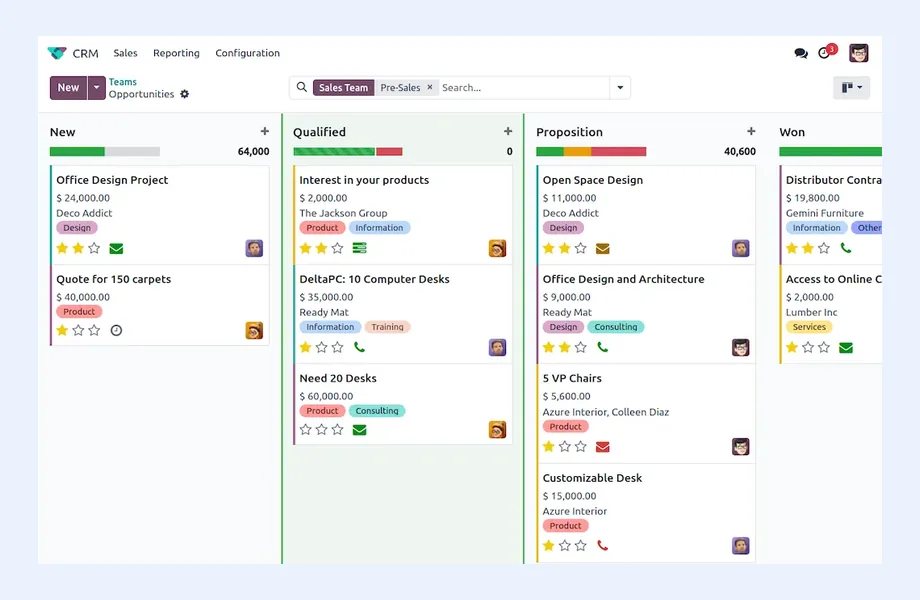
Separate sales teams for distributors, modern trade, institutional buyers and export inquiries, each with its own stages, email alias and pipeline view, so managers review the channel they own.

Quotation validity, price list versions and an approval step for quotes issued against an older list, agreed with finance so a revised price is not undercut by a stale quotation.

Customer credit limits and outstanding balances visible on the opportunity and quotation, with a rule for who may confirm an order for an account already over its agreed limit.

Website forms, email aliases, trade fair imports and WhatsApp handoffs tagged with source and consent status, so marketing lists respect what each contact agreed to receive.

A list of CRM features that depend on Enterprise, paid credits or outbound internet, tested on the hosting model you plan, before the sales team builds habits around them.

Pipeline, win rate and quotation-to-order views per channel and per salesperson, built from fields the team actually fills in, with a weekly review routine for sales managers.
How I Work
How each channel sells today
 Channels and buyer types listed
Quote and approval path drawn
Credit rules written down
Lead sources and consent reviewed
Channels and buyer types listed
Quote and approval path drawn
Credit rules written down
Lead sources and consent reviewed
Odoo CRM design for the implementer
Teams, stages and stage criteria
Price list and validity rules
Edition and hosting dependencies
Reports per channel defined
Test with real deals first
Sample quotes after price revision
Credit block scenarios run
Lead import tested with consent
Sales managers sign off
A separate CRM makes sense when sales is mostly marketing-led: long nurture sequences, content scoring and campaigns aimed at many small buyers. Nigerian manufacturers and distributors selling cartons, crates and pallets to trade customers tend to work the other way. The sale depends on what is in stock at which depot, what the customer still owes and which price list applies this week. Those facts already live in Odoo Inventory, Sales and Accounting.
Running CRM inside the same database gives the salesperson three things a disconnected tool cannot:
The trade-off is that Odoo CRM is lighter on marketing automation and forecasting than dedicated CRM products. If your business also runs heavy consumer campaigns, the marketing side may sit elsewhere while trade selling stays in Odoo. The Zoho CRM in Nigeria page looks at the separate-CRM route, and the global Odoo CRM page explains the product in general terms.
Where imported inputs drive cost, a Nigerian seller may revise selling prices whenever the exchange rate moves enough to hurt margin. The CRM risk is simple: a salesperson reopens an older quotation, the customer accepts it, and the order is confirmed at a price the business has already withdrawn.
Odoo gives you the tools to control this, but they need deliberate setup:
Dollar-linked items can be priced in a foreign currency list where your finance team agrees that is appropriate, with the conversion into naira handled on the invoice by Odoo Accounting. Which approach is acceptable for local sales is a question for your accountant and legal advisor, not a CRM setting. I test the chosen design by revising a list mid-cycle and checking what happens to every open quotation.
Nigerian FMCG and food manufacturers often sell through several layers at once: appointed distributors, direct key accounts such as supermarket chains and hotels, institutional buyers and walk-in trade customers at the factory gate. Each layer needs a different pipeline, because a distributor relationship is renewed and expanded rather than won once.
In Odoo CRM, I set this up with sales teams per channel, each with stages that mean something for that channel. A distributor pipeline might track onboarding, first order, territory review and renewal. A key-account pipeline tracks listing, trial order and contract. Opportunities carry the expected volume, not only value, so production and purchasing can see demand forming.
Credit exposure is the other half. Trade buyers frequently order on account, and the salesperson needs to know whether a new order pushes the customer past the limit finance agreed. Odoo can show outstanding balances on the customer and, depending on version and settings, warn or block when a credit limit is exceeded. I write down who may override that warning and test the flow with real customer balances. The credit terms themselves are a commercial decision for your directors; my role is to make the system enforce what they decide. The Odoo Inventory in Nigeria page covers how those confirmed orders then move through depots.
Trade inquiries in Nigeria arrive through many routes: website forms, phone calls to the sales office, WhatsApp messages to an individual salesperson, contacts collected at trade fairs and referrals from existing distributors. If each route lands in a different inbox, the business cannot tell which sources produce orders.
Odoo CRM can receive leads from its own website forms and from email aliases per sales team, and imports handle event lists. WhatsApp is harder. Odoo offers WhatsApp messaging in some editions through the official business platform, and third-party modules exist, but what your version supports should be confirmed with Odoo or your implementer. Where no integration is in place, I define a manual handoff: the salesperson creates the lead in Odoo with the source recorded before replying further.
Every lead record also carries consent information. Under the Nigeria Data Protection Act, collecting personal data and using it for marketing carries obligations. How those rules apply to your contact lists, and what consent wording you need, should be confirmed with your legal advisor. In Odoo, I add fields for consent source and date, set mailing lists so unsubscribed contacts drop out, and restrict exports of contact data to named roles. These are configuration choices, not legal advice, and they follow the policy your advisor approves.
Many Nigerian companies prefer self-hosting Odoo, either on a local server that keeps working through internet cuts or on a cloud server they control. That choice affects CRM more than it first appears, because several CRM conveniences depend on edition, on paid service credits or on outbound connections to Odoo's servers.
Before the design is final, I list each CRM feature your team expects and confirm three things with Odoo or your implementer:
A local server also changes the mobile picture. Salespeople visiting trade customers need to reach the database from outside the building, which means a secure remote access route that someone maintains. When the office loses power, that route goes down with it, so I write a fallback for field sales during outages. The Odoo consultant Nigeria page compares hosting models more broadly, and my CRM consultant Nigeria page covers platform-neutral CRM work.

Tell me about your business and current systems. I’ll suggest the most sensible first step.
Book a Consultation
Not sure which ERP you need?
Share your business requirements with me and I will help you understand the right process, architecture and platform before implementation.
FAQ
If your selling depends on stock by depot, customer balances and a price list finance controls, keeping the pipeline in Odoo removes double entry and stale data. If your sales are campaign-led with many small consumer contacts, a dedicated CRM may suit the marketing side better. I weigh the two routes against how your trade sales really work before any license is bought.
Set an expiry on every quotation template, use price list versions with validity dates and require a price update before any reopened quote is resent. An approval step catches confirmations below the current list. I test the design by revising a list while quotes are open and checking each one.
Odoo offers WhatsApp features in some editions, and third-party modules exist, but coverage for your version should be confirmed with Odoo or your implementer. Without an integration, a documented handoff works: the salesperson creates the lead in Odoo, records the source and then continues the conversation.
It can. Some features rely on Enterprise, paid credits or a connection to Odoo's services, and email aliases need your own mail setup. Field access also depends on a remote access route that survives outages. I list the features you need and confirm each one on your planned hosting before go-live.
Every business is different. Share where you are today and what you want to fix, and I’ll tell you honestly whether and how I can help.
Book a Consultation
Insights
 Book a Consultation
Book a consultation to talk through your processes, systems and goals. I’ll reply with practical next steps - no obligation.