Contact Info

 Odoo CRM in KSA
What does an Odoo CRM consultant do for a Saudi company?
In the Kingdom, an Odoo CRM consultant designs the pipeline so that the buyer details a compliant e-invoice depends on are collected while the deal is still open, and a won opportunity becomes an Arabic and English quotation, a sales order, a delivery and a ZATCA-ready invoice inside Odoo. The work covers project and tender pipelines, branch sales teams, records matched on VAT and commercial registration numbers, and CRM coexistence.
Last reviewed by Vikas Saroj
Saudi businesses usually feel e-invoicing in finance first. Invoices are rejected or delayed because the customer's VAT number is missing, the address is incomplete or the legal name does not match the registration. Almost every one of those problems started in sales, when someone created a customer in a hurry to send a quotation.
I work remotely with Saudi contractors' suppliers, distributors, industrial firms and service companies that run, or plan to run, their sales inside Odoo. I design Odoo CRM so the opportunity collects what the invoice will need, then hands a clean customer and a correct quotation to Sales, Inventory and Accounting.
I am independent of Odoo and of every Saudi implementer, and I hold no reseller agreement. I work within the Sunday to Thursday week and represent the business throughout, from the first sales workshop to the point where finance confirms that invoices from CRM-created customers go through cleanly.
 What I Do
These are the decisions that make Odoo CRM support compliance and project selling in Saudi Arabia instead of creating rework for finance.

Required fields when a lead becomes a quoting customer: legal name in Arabic, VAT number where registered, commercial registration and a structured national address, checked against what your tax advisor confirms you need.

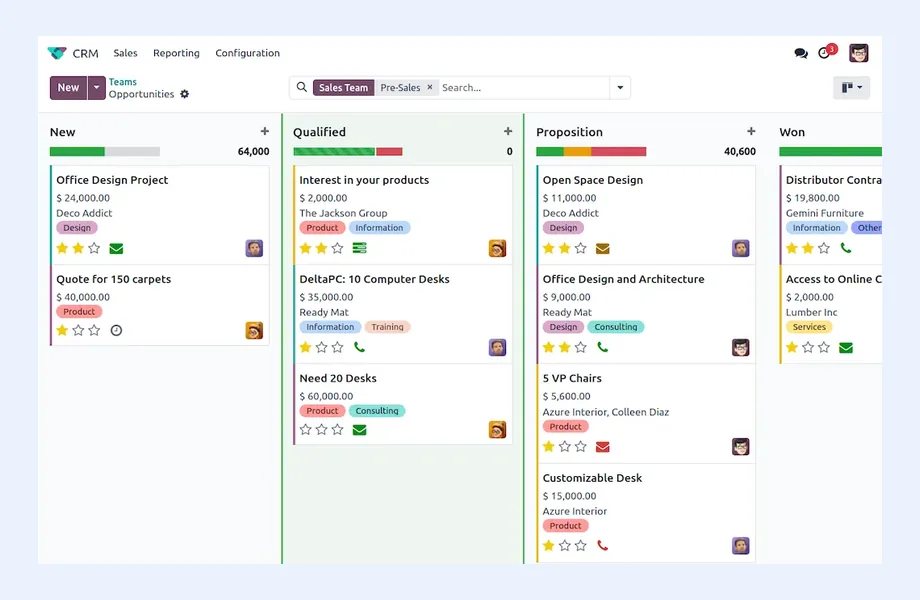
Opportunities linked to the project, the contractor and the consultant who approves materials, with stages for specification, submittal approval and order, so long project deals are forecast honestly.

A separate pipeline for public and private tenders with submission deadlines, bid bond and document checklists as activities, and lost reasons that tell you why bids fail.

Sales teams by region or branch, linked to the warehouse that ships and the analytic account that measures margin, with managers seeing their region and leadership seeing the Kingdom.

Quotation layouts printed in Arabic and English from the customer's language setting, with Arabic product names and legal names tested on real documents before go-live.

Where Salesforce, Zoho CRM or another tool remains, an agreed boundary for leads, customers, quotations and orders, and a sync tested so reps see order and payment status.
How I Work
Follow deals into finance
 Rejected or corrected invoices
Customer data gaps
Project and tender flow
Branch and region map
Rejected or corrected invoices
Customer data gaps
Project and tender flow
Branch and region map
CRM tied to compliant invoicing
Conversion required fields
Project and tender pipelines
Fiscal positions on quotes
Arabic quotation layouts
Test before payment milestones
End to end deal tests
E-invoice checks with finance
Rep training by region
Data owner and routine
Under Saudi e-invoicing, a business-to-business tax invoice carries structured information about the buyer as well as the seller. Exactly which fields are mandatory for your transactions is a question for your tax advisor, but in practice it includes identifiers and address details that sales teams often do not bother to collect. When they are missing, finance either chases the customer after the sale or the invoice cannot be issued as intended.
Odoo CRM is the right place to fix this, because it is where the customer is born. What I build:
The e-invoicing connector itself sits in accounting and depends on edition and version; my Odoo Accounting Saudi Arabia page covers that side.
For many Saudi suppliers, revenue is tied to projects. A building materials, MEP or industrial supplier rarely wins an order from one conversation. The consultant has to approve the product, the main contractor or subcontractor has to choose the supplier, and delivery follows site progress. A pipeline built for simple transactional sales hides all of that.
How I structure it in Odoo CRM:
Opportunities from government entities often arrive through the official procurement platform. Odoo does not connect to it out of the box as far as I know, so I design a short manual routine for logging invitations rather than promising an integration. For the industry context see construction ERP.
Saudi distributors and suppliers commonly sell through regional branches, each with its own warehouse and salespeople. In Odoo, I give each region a sales team, link it to the warehouse that will deliver and to an analytic account, and let managers see their own pipeline while leadership sees the whole country. Assignment rules route inquiries by city or customer segment.
Quotations are mostly in riyals, with dollar price lists for imported project items or export buyers in neighboring markets. Fiscal positions handle VAT treatment for local, export and any special cases your tax advisor confirms, so the quoted total matches the invoice that follows.
Groups with a Saudi company and a sister company elsewhere in the GCC need a decision on which entity quotes which customer. Odoo supports multiple companies in one database, with each sales team belonging to a company; intercompany automation is an Enterprise feature in many versions, so check yours.
Arabic matters throughout. Odoo prints quotations in the customer's chosen language, so I make sure Arabic product names, legal names and terms are prepared, and I review printed output with the sales team before go-live. Field reps who visit contractors and retailers can use Odoo on mobile; test it in Arabic on their devices.
Saudi customer lists collect duplicates in predictable ways: the same company created by two branches, a project entity recorded separately from its parent, or a buyer entered under its trading name instead of its registered name. In an ERP-linked CRM this is costly, because each duplicate carries its own receivable and credit limit.
Instead of relying on names, I use official identifiers:
Migration from a previous CRM or from spreadsheets is the best moment to clean this. I deduplicate on these identifiers before import rather than after. See ERP data migration for the method.
Saudi subsidiaries of international groups often run Salesforce, and some local companies already use Zoho CRM. Keeping that CRM is sensible when group reporting or marketing depends on it. In that case Odoo owns customers, quotations, orders and invoices from an agreed stage, and the CRM receives order status and balances back. If the CRM is mainly a contact list, moving sales into Odoo removes an integration.
The core CRM app is part of Odoo Community. VoIP, WhatsApp messaging, Studio and some automation may need Enterprise or paid services, and the Saudi e-invoicing connector is typically tied to edition, so I check yours against requirements first.
Odoo CRM is not the right tool when:
Read the global Odoo CRM page, my Odoo consultant Saudi Arabia page, CRM consulting, the ERP consultant Saudi Arabia page and the Saudi Arabia hub.

Tell me about your business and current systems. I’ll suggest the most sensible first step.
Book a Consultation
Not sure which ERP you need?
Share your business requirements with me and I will help you understand the right process, architecture and platform before implementation.
FAQ
Because the customer record is created in the CRM. If the VAT number, legal name or structured address is missing when the lead converts, the invoice issued later from that order may be incomplete. Making those fields required at conversion, as confirmed by your tax advisor, prevents rework in finance.
Yes, with some design. I link opportunities to the project, record the consultant and contractor roles, add stages for specification and approval, and allow several opportunities per project when different contractors bid. That gives an honest forecast instead of a single deal that sits open for a very long time.
Odoo supports an Arabic interface and right-to-left documents, and it prints quotations in the language set on each customer. Quality depends on translated product and customer data and on tested layouts. I review real quotations and mobile screens with your team in Arabic before go-live.
Yes. I work remotely with businesses across the Kingdom, scheduling live sessions in the Saudi working week and recording training for branch teams in different regions. If a workshop genuinely benefits from being in person, such as a cross-department design session, a visit can be discussed by arrangement.
Every business is different. Share where you are today and what you want to fix, and I’ll tell you honestly whether and how I can help.
Book a Consultation
Insights
 Book a Consultation
Book a consultation to talk through your processes, systems and goals. I’ll reply with practical next steps - no obligation.