Contact Info

 Odoo Accounting in Nigeria
Why bring in an Odoo accounting consultant in Nigeria?
An Odoo accounting consultant in Nigeria confirms what the fiscal localization for your version provides, then builds or completes the chart of accounts, VAT and withholding taxes and report lines with your accountant. The work also covers intercompany rules between related companies, the Community or Enterprise decision from a finance view, bank statement imports and reconciliation models, and the questions to ask about e-invoicing. I do this remotely and independently.
Last reviewed by Vikas Saroj
Nigerian companies adopting Odoo usually focus on stock, production and sales first, and the accounting design gets whatever time is left. The result shows up at the first month end: taxes that do not map to the return, withholding sitting in suspense, intercompany balances that never agree and bank lines reconciled by hand.
I work remotely as a freelance Odoo consultant on the finance side of these projects. I sit with your finance lead and external accountant, decide how Odoo Accounting should record each situation, check what the implementer configures against that design and run the first closes with your team until the routine holds.
 What I Do
These services address the accounting decisions that Nigerian Odoo projects most often leave until too late.

I check what the fiscal package for your planned version actually installs, list what is missing for your business and agree with your accountant how each gap is filled before posting begins.

VAT and withholding taxes, tax groups and report lines built so Odoo's tax report produces the figures your accountant needs, with fiscal positions for exempt or foreign customers.

Deductions on supplier payments and short payments from customers designed as repeatable flows, with dedicated accounts and reconciliation so withheld amounts are traceable to remittance or credit evidence.

Multi-company structure, intercompany accounts and rules that mirror sales and purchase documents between related entities, so balances agree and your accountant can eliminate them confidently.

Statement import formats per bank and reconciliation models for charges, levies, transfers and recurring receipts, so bank lines are matched in batches instead of one at a time.

A month-end checklist covering bank reconciliations, revaluation, withholding balances, intercompany agreement and the tax report review, finishing with lock dates under your finance lead's control.
How I Work
Agree treatments with the accountant
 Localization contents listed
Tax and withholding cases written
Entity and intercompany map
Bank formats collected
Localization contents listed
Tax and withholding cases written
Entity and intercompany map
Bank formats collected
Test the implementer's setup
Tax report against sample data
Withholding flows run end to end
Intercompany documents mirrored
Opening balances reconciled
First month ends run together
Reconciliation models tuned
Revaluation posted and checked
Tax report reviewed
Lock dates applied
Odoo ships fiscal localizations that install a chart of accounts, taxes and sometimes report formats for a country. Coverage varies by country and version, so the first step for a Nigerian company is to install the package in a test database for the exact version you plan to run and list what it gives you. Do not assume a localization exists, or that it matches how your accountant reports, until you have seen it.
Where the package is missing or thin, I build the foundation with your accountant:
Each element is tested with a batch of real invoices and bills before go-live. Tax treatments are your advisor's decisions, and current rules should be checked with them because Nigerian tax administration has been changing. My role is to make Odoo record those decisions the same way every time.
Withholding is where Nigerian Odoo setups most often fail quietly. On the payables side, your company deducts tax from certain supplier payments and remits it. On the receivables side, customers deduct tax from what they pay you and send evidence later. Odoo's standard tax engine is built around invoices, so withholding at payment time needs a deliberate approach.
The options depend on version and localization: dedicated withholding taxes applied on payments where available, a maintained module, or reconciliation models that split a payment into its settled and withheld parts. I choose with your accountant after testing, then design the full trail:
The Odoo consultant Nigeria page covers the wider platform decisions; this flow is where the accounting detail lives.
Many Nigerian groups run more than one company: a manufacturing entity, a trading or distribution entity, perhaps a logistics or services company, sometimes with a related company abroad. Goods, services, staff costs and cash move between them, and at year end someone has to prove that every intercompany balance agrees on both sides.
A single Odoo database can run several legal entities side by side, keeping separate ledgers, taxes, currencies and journals for each. The design work is in how they interact:
Consolidation and eliminations remain with your accountant, whether in Odoo's reporting or outside it. The design simply makes their job mechanical rather than investigative. My multi-company ERP page discusses group structures more generally.
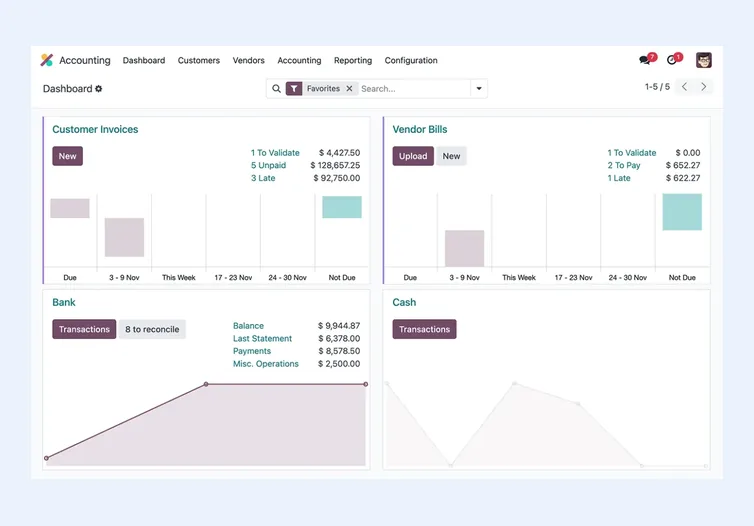
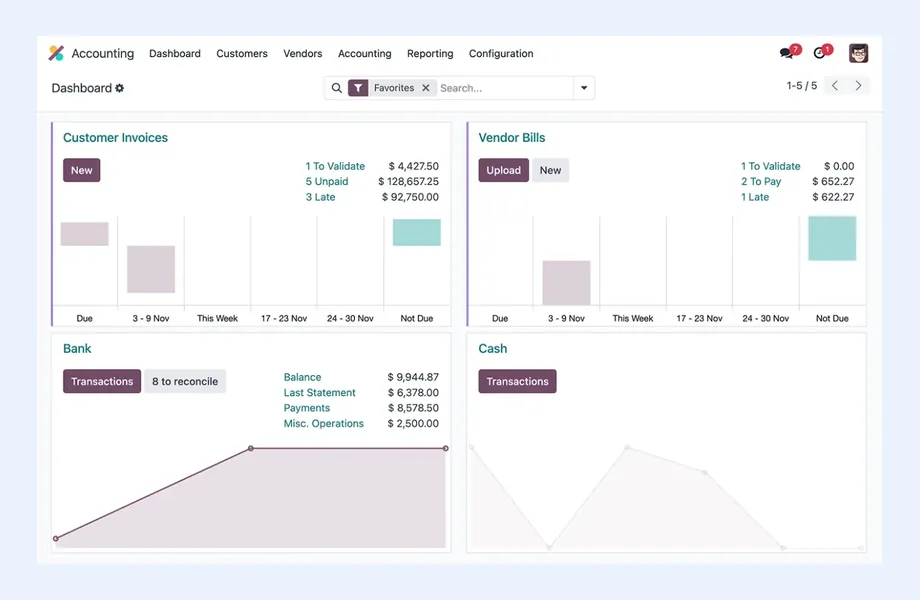
The Community versus Enterprise decision is usually argued on licensing cost and operational apps. Finance should have its own say, because the difference is significant for accounting. In Enterprise, the full Accounting app brings the reconciliation interface, financial reports, asset management, deferred revenue and expenses, budgets and customer follow-up tools. Community provides invoicing and core journals, with many of these accounting features supplied by third-party or community modules when needed.
From the finance view, the questions I work through with you are:
Features move between editions over time, so I verify them in the version you plan to use. Subscription cost is a cost driver to weigh against maintenance risk, not a figure I quote. The global Odoo Accounting page covers the editions in general terms.
Odoo offers online bank synchronization in some editions and regions, but coverage for Nigerian banks should be checked rather than assumed. Statement imports in a standard file format are the dependable route. I agree a format per bank, then build reconciliation models for transfer charges, levies, recurring receipts and payment gateway settlements, so most lines are proposed automatically and the accountant reviews exceptions.
The federal tax authority is phasing in electronic invoicing; ask your tax advisor how and when it reaches your company. For Odoo, I ask your implementer or Odoo how invoices from your version and edition would be transmitted, who maintains that code, and how rejected or failed submissions appear in Accounting. Until a route has been demonstrated with your own documents, I keep invoice data clean so the eventual connector has something reliable to send.
The close then follows a fixed sequence: banks reconciled, withholding balances matched, intercompany agreed, foreign currency revalued under your accountant's method, tax report reviewed and lock dates set. Migration of opening balances follows my ERP data migration approach. Odoo Accounting is a weaker fit for a small service firm that only needs invoicing; there, lighter tools may serve. Broader context sits on my ERP consulting page for Nigeria and the Nigeria overview.

Tell me about your business and current systems. I’ll suggest the most sensible first step.
Book a Consultation
Not sure which ERP you need?
Share your business requirements with me and I will help you understand the right process, architecture and platform before implementation.
FAQ
Check by installing the package for your exact version in a test database, because coverage varies between releases. If a package is there, I compare its contents with your reporting needs. If coverage is weak, your accountant and I define accounts, taxes and report lines ourselves and prove them on sample transactions first.
The short payment is matched to the invoice, and the withheld part posts to a withholding receivable account instead of staying open. When the customer's credit evidence arrives, it is recorded against that balance. An aged report shows evidence still outstanding, so the credit is not lost.
Yes. Each company keeps its own chart of accounts, taxes and currency, and intercompany rules can create mirrored documents when one company bills another. I add dedicated intercompany accounts and a monthly agreement check, leaving consolidation and eliminations to your accountant.
Often, if your finance team relies on reconciliation tools, financial reports, assets and follow-ups. Community can work with additional modules, but someone must maintain them through upgrades. I list your monthly finance workload and show which edition covers each part before you decide.
Every business is different. Share where you are today and what you want to fix, and I’ll tell you honestly whether and how I can help.
Book a Consultation
Insights
 Book a Consultation
Book a consultation to talk through your processes, systems and goals. I’ll reply with practical next steps - no obligation.