Contact Info

 Odoo Accounting Qatar
What does an Odoo accounting consultant do for a Qatar company?
In Qatar, Odoo accounting work centers less on filing an indirect tax return and more on ledger control: dated checks followed through to the bank, contract advances and retention held in the right accounts, sister companies posting to each other cleanly, and opening balances that agree with the old books. I work remotely and independently, and tax questions stay with your advisor.
Last reviewed by Vikas Saroj
Qatari finance teams moving to Odoo often expect tax to be the hard part. Since Qatar does not run a general VAT, to my knowledge, the harder part is usually daily control: dated checks sitting in a drawer, contract advances that are never fully recovered, retention nobody can reconcile and group balances that disagree between two sets of books.
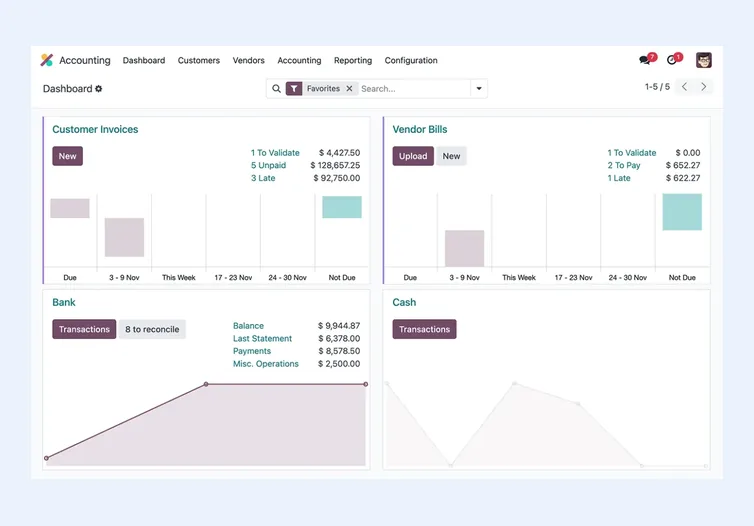
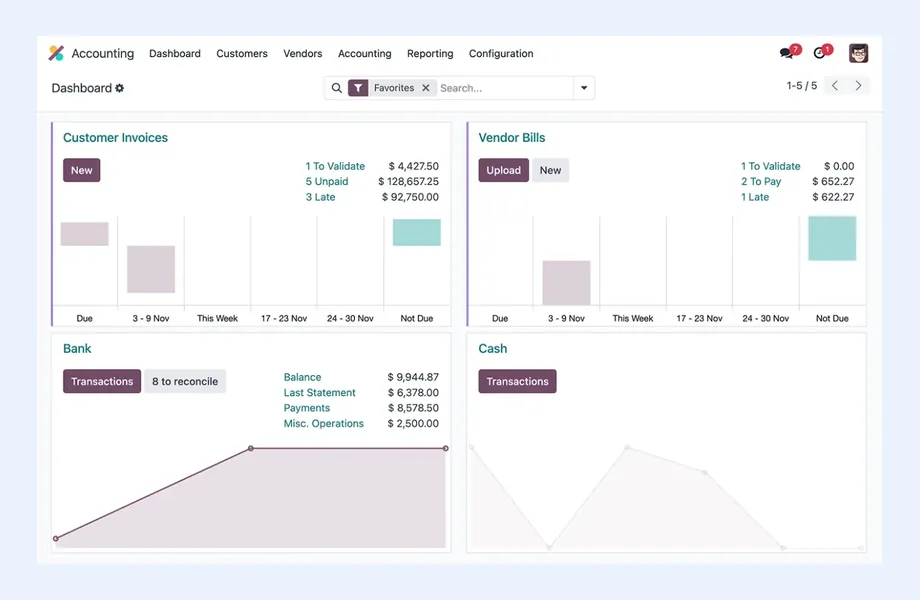
I design and review the Odoo Accounting setup behind those routines: the chart of accounts, journals, reconciliation models, analytic plans and lock dates. Where your corporate tax or withholding position needs particular detail, I agree the structure with your advisor instead of guessing at the rules.
Everything is delivered remotely. I can configure the ledger alongside your finance lead, or review what an implementer has already built and give you a clear list of corrections before you go live, while there is still time to change the design cheaply.
 What I Do
Each item is a piece of ledger design I agree with your finance lead and, wherever tax is involved, with your advisor.

I adapt the starting chart so contract balances, related-party accounts, staff advances and end-of-service provisions sit in their own accounts, giving your auditor and tax advisor balances they can use without reclassifying them.

Every dated check, in or out, is recorded with its maturity date, held in clearing accounts until deposit or presentation, and matched once the bank statement shows them. Returned checks follow a defined reversal routine.

Mobilization advances, their recovery against progress invoices and retention held by clients or withheld from subcontractors each get dedicated accounts, so balances per contract can be listed and agreed at any time.

Statement imports from your Qatari banks, plus reconciliation models for recurring lines such as card settlements, bank charges and salary debits made through the Wage Protection System, so genuine exceptions stand out.

Trading, contracting or manpower entities set up as separate companies in one database, with recharges and loans posted on both sides and a monthly routine confirming that the two balances agree.

Trial balance, open invoices, dated checks, advances and retention carried over from Tally or QuickBooks and reconciled line by line to the old reports before live posting begins.
How I Work
Entities, instruments and contract balances
 Legal entities and ownership
Check and payment practices
Contract advance terms
Advisor reporting needs
Edition and version check
Legal entities and ownership
Check and payment practices
Contract advance terms
Advisor reporting needs
Edition and version check
Accounts, journals and matching rules
Chart adapted for audit
Clearing accounts for checks
Reconciliation models tested
Intercompany flows trialed
Cutover and the first month-end
Opening balances agreed
First bank reconciliation reviewed
Lock dates applied
Close checklist handed over
Dated checks still carry real commercial weight in Qatar, from rent and supplier settlements to security for customers on credit terms. If they are booked as cash on the day they arrive, the bank balance in Odoo is overstated and customers appear to have paid early. Finance then keeps a check register in a spreadsheet, and the register and the ledger slowly drift apart.
Odoo does not treat a dated check as a distinct instrument in every version, so I design the flow explicitly:
Some businesses add a third-party check management module for richer tracking. I review its upkeep and its fit with your version before recommending it, because a payment module that breaks at upgrade time does more harm than a careful manual routine. The general bank configuration is described on Odoo Accounting.
Contracting, fit-out and MEP firms in Qatar live on contract balances. A client pays a mobilization advance, each progress invoice recovers part of it, a share of every certified amount is retained until handover, and the same pattern runs in reverse with subcontractors. Project tools can follow the commercial side, but the ledger has to hold the result.
In Odoo I usually give each balance its own account, with an analytic tag per contract:
The aim is that any contract can be listed with advance outstanding, retention held and retention owed, straight from Odoo, and agreed with the commercial team each month. How progress billing is produced upstream belongs to the project setup, covered on construction ERP in Qatar; the ledger design here makes sure those numbers land where your auditor expects them.
My understanding is that no broad VAT applies in Qatar at present, but GCC tax policy does move, so check the current position with your advisor before treating that as settled. In Odoo this means sales and purchase taxes stay minimal, and the effort goes into making the ledger answer what your advisor will ask about corporate income tax and payments to non-residents. I do not decide what is taxable. I make sure the data is captured at the source, for example a supplier tag for non-resident vendors and separate accounts for costs that commonly need adjustment in a tax computation.
Edition matters more for accounting than for most Odoo apps. In Community the finance app is generally Invoicing, while the full Accounting app with its reconciliation interface, financial reports, follow-ups, assets and intercompany rules has historically sat in Enterprise. Feature lines shift between versions, so I confirm yours before designing around any feature.
For a Qatari group the practical test is whether the controls you rely on, such as reconciliation models, asset depreciation and intercompany posting, exist in the edition you plan to buy or would come from third-party modules. Where a module fills the gap, I document who maintains it and what happens to it at upgrade time.
Qatari owners commonly run a trading company, a contracting company and sometimes a manpower supplier side by side, occasionally with a QFC entity as well. Odoo models every legal entity as a separate company inside one database, with its own journals and document numbering, while contacts and products are shared where that makes sense.
What breaks group books is rarely the initial setup. It is the traffic between companies: labor supplied by the manpower company to the contracting company, materials sold from the trading arm to a project, shared office costs and funding through shareholder accounts. Each needs an agreed rule. Where intercompany rules are available in your edition, Odoo can raise the matching document in the receiving company automatically. Where they are not, I define a posting routine and a monthly check that both sides agree before reports reach the owners.
Close discipline completes the picture. I set a short month-end checklist: bank and check clearing accounts reconciled, intercompany balances confirmed, advances and retention reviewed by contract, accruals posted, then a lock date applied so nobody posts into a closed period. Wider design options are compared on multi-company ERP.
Many Qatari finance teams I speak with keep their books in Tally, with QuickBooks or spreadsheets in smaller entities. The ledger can move into Odoo cleanly, provided the cutover is planned around the balances that matter in this market:
Each load is reconciled to the old system's reports and signed off by your finance lead, following my ERP data migration method. If your needs lean toward heavy consolidation or vendor-backed finance tooling, I compare Business Central in Qatar fairly. Hosting and implementer choice sit on Odoo in Qatar, the open-source alternative on ERPNext Accounting in Qatar, and my wider work on ERP consultant in Qatar and the Qatar hub.

Tell me about your business and current systems. I’ll suggest the most sensible first step.
Book a Consultation
Not sure which ERP you need?
Share your business requirements with me and I will help you understand the right process, architecture and platform before implementation.
FAQ
Very little indirect tax setup is needed today, as far as I know, but confirm the current position with your advisor. The more useful work is structural: accounts and tags that help your advisor prepare the corporate tax computation and identify payments to non-residents. I keep tax objects simple so they can be extended later without rebuilding history.
Record them as payments into an outstanding receipts or payments account with the maturity date captured, deposit them on that date and reconcile when the bank statement shows them. Returned checks need a reversal routine. Some businesses prefer a third-party module instead; I check its maintenance record and fit with your version first.
Sometimes, for a small single company. Full accounting features such as the reconciliation interface, financial reports and intercompany rules have generally sat in Enterprise, and Community relies on third-party modules to fill gaps, each of which needs an owner. I check your version's feature list against the controls you need before you decide.
Yes. I review the chart, journals, check handling, contract balance accounts, reconciliation models and intercompany postings, then rank the fixes by risk and explain why each matters. Your implementer can apply them, or I can guide the changes remotely with your finance lead.
Every business is different. Share where you are today and what you want to fix, and I’ll tell you honestly whether and how I can help.
Book a Consultation
Insights
 Book a Consultation
Book a consultation to talk through your processes, systems and goals. I’ll reply with practical next steps - no obligation.