Contact Info

 ERPNext Accounting Qatar
What should a Qatar business expect from an ERPNext accounting consultant?
For Qatari contractors, traders and service companies, I shape ERPNext finance around management questions: profit by contract and division, spend against budget before it happens, payroll costs landing in the right cost centers, banks reconciled weekly and periods closed on time. Delivery is remote and independent, with corporate tax and any other levies left to your advisor.
Last reviewed by Vikas Saroj
Owners of Qatari contracting and trading firms usually ask the same few questions: which contracts are making money, where costs are running ahead of plan, and how much cash will really be in the bank next month. ERPNext can answer those from the ledger, but only if cost centers, dimensions and budgets are designed with intent.
My role is to design that finance layer, test it with your accountant and leave your team with a close routine they can repeat every month. I represent the business, whether a Frappe implementer is configuring the system or your own staff are.
 What I Do
The focus is decision-making information from the ledger, with controls that stop problems before they are posted.

Cost centers for divisions, plus accounting dimensions for contract and site, made mandatory on the expense and revenue accounts where an untagged entry would leave a hole in management reports.

Budgets set per cost center or project, with ERPNext configured to warn or stop when a material request, purchase order or expense would exceed the approved amount for that period.

Whether salaries run in Frappe HR or a separate WPS-ready payroll product, I map salary components to expense accounts and cost centers so labor cost reaches each contract correctly.

Salary advances, loans to employees and end-of-service provisions held in separate accounts per employee or in total, with recovery through payroll recorded consistently each month.

Bank statements imported as bank transactions, matched to payment entries, with dated checks tracked by reference date and customer statements sent through ERPNext on a regular cycle.

Opening balances from QuickBooks or spreadsheets, an agreed month-end checklist and a period closing voucher at year end so prior periods stay protected from late postings.
How I Work
The reports owners and banks need
 Management report mockups
Contract and division list
Budget owners named
Payroll source confirmed
Management report mockups
Contract and division list
Budget owners named
Payroll source confirmed
Dimensions, budgets and bank flows
Mandatory dimensions set
Budget actions tested
Payroll mapping trialed
Bank import templates ready
Check reference dates used
Live months with a repeatable close
Opening balances reconciled
First close walked through
Variance report reviewed
Accounting periods locked
In ERPNext every ledger line can carry a cost center and any number of accounting dimensions. That flexibility is useful and dangerous in equal measure. A Qatari contractor that tags some site costs to the contract, some to the division and some to nothing at all ends up with a profit and loss by contract that nobody believes.
I start from the reports rather than the configuration. With your finance lead and owners, I sketch the handful of views they look at each month, then design backward:
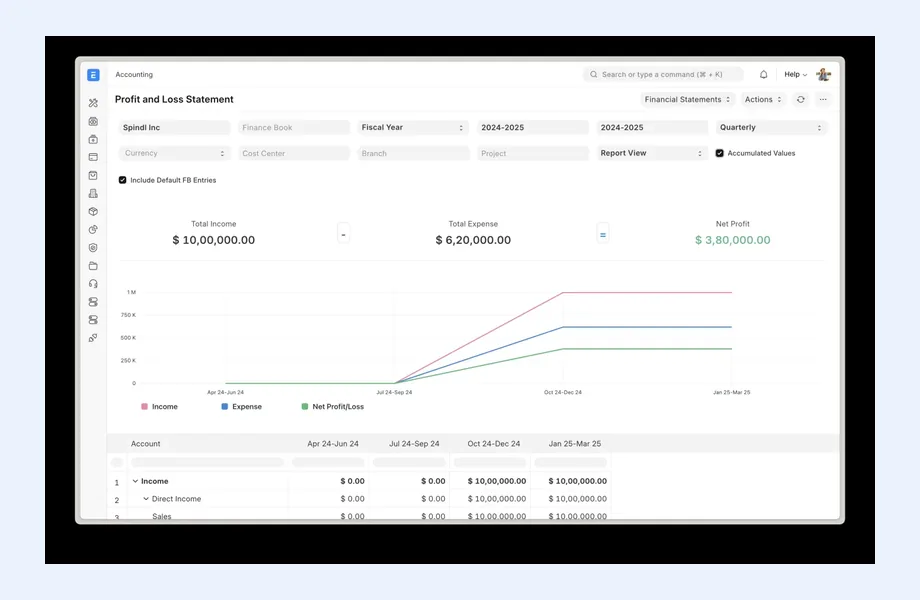
Shared overheads, such as camp costs, vehicles and head office salaries, are then distributed through a monthly allocation journal with an agreed basis. The result is a contract profitability view straight from the general ledger. The project side of the same story is described on construction ERP in Qatar.
Many Qatari firms prepare a budget for the bank or the board and then never look at it in the system. ERPNext can hold budgets against a cost center or project, by account and period, and act on them at the point of commitment. For each budget you choose what happens when a material request, purchase order or actual expense would push spending past the approved amount: stop the transaction, show a warning or do nothing.
The design choices I work through with your finance team:
Budget variance reports then compare plan and actual by cost center or project each month. Cost to complete still belongs with the quantity surveyor, but the ledger stops being a surprise. Related controls are discussed under ERP approval workflows.
Labor is often the largest cost for a Qatari contractor or manpower supplier, so the way payroll reaches the ledger decides whether contract margins are believable. Salaries may run inside Frappe HR or in a dedicated payroll product that produces the Wage Protection System file. Either way, the accounting design is mine to settle with your finance team.
If Frappe HR is used, salary components map to expense and liability accounts, and payroll entries can split cost by cost center or dimension based on the employee's assignment or timesheets. If an external product runs payroll, I define a monthly journal template that brings in totals by component, cost center and contract, with a control total agreed to the payroll register.
Staff balances need equal care:
On the bank side, the salary debit for the WPS transfer is matched against the net pay liability, not posted straight to expense. That keeps net pay, deductions and the bank in agreement every month.
Few Qatari banks connect directly to ERPNext, so statements are usually downloaded and imported as bank transactions. The Bank Reconciliation Tool then matches each line to payment entries or journal entries, and recurring items such as charges can be cleared quickly. A weekly rhythm keeps the backlog small.
For dated checks, ERPNext payment entries carry a reference number and a reference date separate from the posting date. I use that to report checks by maturity and to keep checks not yet presented visible, instead of relying on a separate register. Customers on credit receive statements of account generated from ERPNext on a set cycle, which shortens disputes.
On tax, my understanding is that Qatar has not introduced a general VAT; please confirm that with your advisor before it shapes the design. Tax templates therefore stay light. Corporate income tax and any withholding on payments to non-residents are matters for your advisor; in ERPNext I make sure supplier residency, related-party flags and the accounts that typically need adjustment are captured, so the advisor's work starts from clean data. The ERPNext in Qatar page covers tax templates and hosting at platform level.
Qatari companies arriving at ERPNext often come from QuickBooks with job costs kept in spreadsheets, or from Tally with contract data held entirely outside the books. The cutover plan has to rebuild contract balances as well as the ledger:
After go-live, I set a close checklist with your accountant and use accounting periods to stop postings into finished months. At year end a period closing voucher transfers profit to retained earnings. My ERP data migration and QuickBooks migration pages describe the reconciliation steps.
For the platform view see ERPNext Accounting; for the Odoo alternative, Odoo Accounting in Qatar. Broader Qatar advisory is summarized on the Qatar hub and my Qatar ERP consultant page.

Tell me about your business and current systems. I’ll suggest the most sensible first step.
Book a Consultation
Not sure which ERP you need?
Share your business requirements with me and I will help you understand the right process, architecture and platform before implementation.
FAQ
Yes. Budgets can be set against a cost center or project by account, and ERPNext can stop or warn when a material request, purchase order or expense would exceed the approved amount. I help you decide which accounts to control and whether a warning or a hard stop suits each type of spend.
Not at all. Many Qatari firms keep payroll outside ERPNext. I define a monthly journal that brings in totals by salary component, cost center and contract, agreed to the payroll register, and the bank debit is matched against the net pay liability. Labor cost still reaches each contract correctly.
Payment entries hold a reference number and a reference date in addition to the posting date. I use those fields to list checks by maturity and to keep unpresented checks visible until the bank statement clears them, so a separate spreadsheet register is no longer needed.
No. That computation belongs to your advisor. What I do is make sure the ledger captures what they need: supplier residency, related-party balances and separate accounts for costs that are commonly adjusted. The advisor then starts from a clean trial balance rather than rebuilding figures from invoices.
No. Some Qatari clients ask me to review an ERPNext system that is already live but producing reports nobody trusts. I check dimensions, budgets, payroll postings and bank routines, then agree a correction plan with your finance team and whoever supports the system.
Every business is different. Share where you are today and what you want to fix, and I’ll tell you honestly whether and how I can help.
Book a Consultation
Insights
 Book a Consultation
Book a consultation to talk through your processes, systems and goals. I’ll reply with practical next steps - no obligation.