Contact Info

 ERPNext Accounting USA
What does an ERPNext accounting consultant do for a US company?
For an American business, an ERPNext accounting consultant designs the ledger so the controller can close each month and hand the CPA a trial balance that needs no rework. That covers account structure and dimensions, state-by-state tax liability accounts, payment and bank matching, LLC groups and opening balances from QuickBooks. I do this remotely and independently, while tax positions stay with your CPA.
Last reviewed by Vikas Saroj
When a US company moves its finance function into ERPNext, the hard questions are rarely about features. They are about structure: what replaces the QuickBooks class list, how tax collected in each state lands in an account the filing can be tied to, and what the outside CPA receives when the year ends.
This page stays inside the ledger. My view of ERPNext for American businesses in general, including hosting, payroll providers and the implementer market, is on a separate page. Here the subject is the daily and monthly work of the finance team: posting rules, payment entries, reconciliation, sister LLCs and the close.
I work remotely with controllers, fractional CFOs and outsourced bookkeepers in every US time zone. Your CPA keeps responsibility for tax and audit judgments. My job is to make ERPNext record transactions in the shape they need, whether I lead the finance design myself or review the work of an implementer you already use.
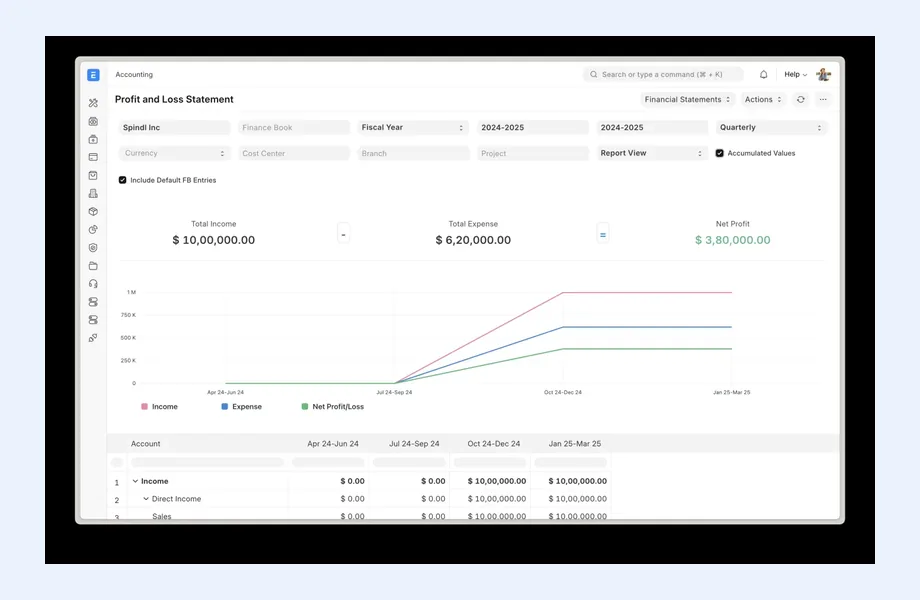
 What I Do
These are the accounting areas American controllers ask me to design, test or repair in ERPNext.

A numbered account tree that keeps the codes your team already knows, groups accounts the way your CPA maps them to the return and drops accounts that only existed to imitate departments or locations.

QuickBooks classes and locations reborn as cost centers or custom accounting dimensions, with rules on which accounts must carry them so departmental profit reports stay complete.

Tax templates, tax categories and tax rules arranged so each state you collect in posts to its own liability account, giving whoever files a balance to tie each return to.

Payment entries for ACH, wires, checks and card deposits, processor clearing accounts for net settlements and a bank reconciliation routine that leaves only true exceptions for review.

Separate ERPNext companies for each LLC, internal customers and suppliers for inter-company billing, and a consolidated view your CPA can work from at year end.

A close checklist ending in a period closing voucher and locked period, plus a repeatable year-end package of reports and schedules your outside accountant can rely on.
How I Work
Understand books, states and entities
 Current chart and class list
States where tax is collected
Entities and inter-company flows
CPA review points agreed
Current chart and class list
States where tax is collected
Entities and inter-company flows
CPA review points agreed
Configure and load opening data
Account tree and dimensions
Tax rules and liability accounts
Bank and processor accounts
Trial migration reconciled
Run real periods together
First month closed in ERPNext
Reconciliations signed off
Period locked after review
Close checklist handed over
Most American finance teams arrive with a chart of accounts that has grown sideways. A separate revenue account per sales channel, a payroll expense account per department, a rent account per location. QuickBooks classes were meant to handle that, but over time both approaches end up mixed together.
ERPNext gives you cleaner tools, and I use them deliberately:
I agree the mapping in a short worksheet first: old account and class on the left, new account, cost center and dimension on the right. Your controller and CPA review it before anything is built, because this decision shapes every report you will run. The ERPNext accounting overview explains the general model; the worksheet is what makes it fit an American ledger.
Whatever calculates US sales tax for you, the ledger has to make filing and review straightforward. In ERPNext, three objects decide how tax posts: sales tax templates hold the tax rows and the account each row credits, tax categories label customers such as resellers or exempt organizations, and tax rules choose a template from the category and shipping state.
The design choice I care most about is the account. When every state shares one sales tax payable account, nobody can tell whether the amount filed for a given state agrees with what was collected there. A liability account per state, or a dimension that tags state on every tax row, solves that.
If you use an external tax calculation service through a connector, I check with your team and CPA:
Year-end reporting on payments to independent contractors is another item to verify: some ERPNext versions have included a US report for it, but confirm what your installed version and apps provide before relying on it. Which states you owe tax in, and how, is a question for your CPA. The broader ERPNext picture for US businesses covers connector options.
Daily finance in ERPNext runs through the Payment Entry. It records a customer receipt or supplier payment against one or more invoices, handles advances and partial payments, and posts exchange differences if a foreign currency is involved. Journal entries remain available for everything else, but a team that pays bills with journals instead of payment entries loses its aging reports quickly.
Three US habits need specific design:
Bank statements come in through statement import, or through a bank feed integration if one supports your banks; ERPNext has included a Plaid connection in some versions, but test it with your institutions first. The bank reconciliation tool then matches transactions to payment entries, and the payment reconciliation tool cleans up unallocated receipts. That pairing is the heart of finance automation in practice.
Plenty of US businesses are legally several companies: an operating LLC, a real estate holding entity, a separate company for a second brand or state. In QuickBooks that usually means separate files and a spreadsheet of due-to and due-from balances that never quite agree.
In ERPNext, each LLC becomes its own company on the same site, with its own account tree, fiscal year settings, default accounts and bank accounts. Customers, suppliers and items can be shared. For trade between them, I mark each sister company as an internal customer and internal supplier, so a sales invoice in one company can generate the matching purchase invoice in the other. Management fees and loans between entities can go through inter-company journal entries, which create linked entries on both sides.
Consolidation is where I am careful with expectations. ERPNext has a consolidated financial statement report that combines companies, which works for many owner-managed groups. Eliminating inter-company balances, handling minority interests or producing audited consolidated statements is usually done by your CPA from the entity trial balances, not inside ERPNext.
Payroll from your outside provider fits here too: each pay run posts as a journal per company, split by cost center, so labor cost lands in the right entity. My multi-company ERP page covers the design questions in more depth.
For the move from QuickBooks, I prefer a clean cutover at a month or quarter end rather than replaying history. ERPNext has the pieces to do it properly:
After go-live, the month-end routine is written down and shared. Bank and card clearing accounts reconciled, accruals and prepaids booked, depreciation posted, exchange revaluation run if you hold foreign balances, then the trial balance reviewed. Once a month is approved, an accounting period or a frozen-accounts date stops back-dated changes.
At year end, a period closing voucher moves profit and loss into retained earnings. The CPA package I set up typically includes the trial balance, general ledger detail, aging reports, the fixed asset register, tax liability reconciliations and inter-company balances, exported in the same layout each year. The QuickBooks migration page and the data migration service describe the wider method.
I would rather say this early than after a failed close. These are the American finance situations where ERPNext Accounting tends to fall short:
Where one of these describes you, the sensible next step is a side-by-side test against your own transactions rather than a debate about features. For a US ledger, I usually benchmark against Odoo Accounting for American firms or the finance-led route in ERPNext versus Dynamics 365. How I keep that selection neutral is set out on the US ERP consultant page, and remote delivery for American teams on the USA hub.

Tell me about your business and current systems. I’ll suggest the most sensible first step.
Book a Consultation
Not sure which ERP you need?
Share your business requirements with me and I will help you understand the right process, architecture and platform before implementation.
FAQ
They usually become cost centers or custom accounting dimensions rather than extra accounts. Departments and branches that carry budgets suit cost centers; channels, locations or segments suit dimensions. I map each class in a worksheet your controller and CPA approve before setup, and I can make dimensions mandatory on income and expense accounts so reports stay complete.
Yes, if the ledger is designed for it. Tax rules choose a template from the customer's tax category and shipping state, and each template row posts to a liability account you choose. Giving each state its own liability account, or tagging state as a dimension, lets the filed amount be tied back to the ledger. Taxability and nexus decisions belong with your CPA.
I use a clearing account. Customer invoices are paid into it, and the payout, processor fees and refunds are recorded against it, so it should return to zero after each settlement. The bank reconciliation tool then matches the actual deposit. If the clearing balance drifts, it points straight to a missing fee or refund.
Yes. I usually create a dedicated role with read access to accounting reports and, if agreed, permission to post adjusting journals in open periods. Many CPAs prefer an exported year-end package instead, so I set up a consistent set of reports and schedules for that as well.
Often, yes. Each LLC becomes a company on one site, inter-company invoices and journals post on both sides, and a consolidated report combines the entities. Groups that need audited consolidated statements with formal eliminations usually still rely on their CPA or a separate consolidation tool for that step.
Every business is different. Share where you are today and what you want to fix, and I’ll tell you honestly whether and how I can help.
Book a Consultation
Insights
 Book a Consultation
Book a consultation to talk through your processes, systems and goals. I’ll reply with practical next steps - no obligation.