Contact Info

 United States
What does a CRM consultant do for a US company?
A CRM consultant for a US company maps how revenue is really won, across inside sales, field reps, independent rep agencies and distributors, then turns that into pipeline stages, routing rules and a clean handoff to the ERP. I stay neutral between Zoho CRM, HubSpot, Salesforce, Odoo CRM and Dynamics 365, flag consent and privacy questions for your counsel, and work remote across US time zones.
Last reviewed by Vikas Saroj
American revenue rarely flows through one channel. A single company may run an inside team working inbound demos, territory managers on the road, independent manufacturers' reps paid on commission and a distributor network that never tells you who the end customer is. A CRM bought before those routes are mapped tends to fit one of them and frustrate the rest.
I work remotely as a platform-neutral CRM consultant for US businesses. I start with the routes to revenue, write down how a lead becomes a deal on each one, and only then compare products. No vendor pays me for a recommendation, so the shortlist follows your sales motion and the skills of whoever will administer it after launch.
The CRM also has to hand clean orders to finance. I design the point where a won deal becomes a sales order, which data the ERP needs at that moment and what flows back, so reps can see invoice and payment status without asking accounting.
 What I Do
Each item produces a written artifact your team keeps, whichever CRM you end up running.

A plain map of every route to revenue, from inbound demo requests to outside reps, rep agencies, distributors and marketplace sellers, showing who owns the customer relationship on each route.

Territory design by state, region, vertical or named account, plus rules for house accounts, split credit and what happens to a deal when a rep leaves the company.

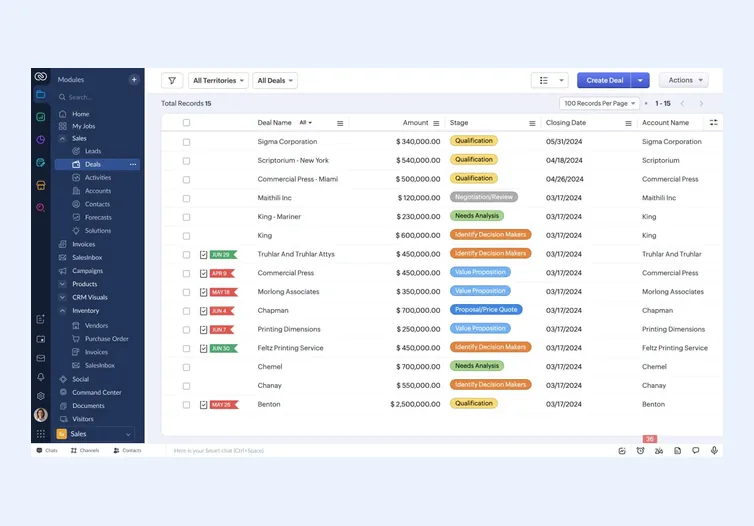
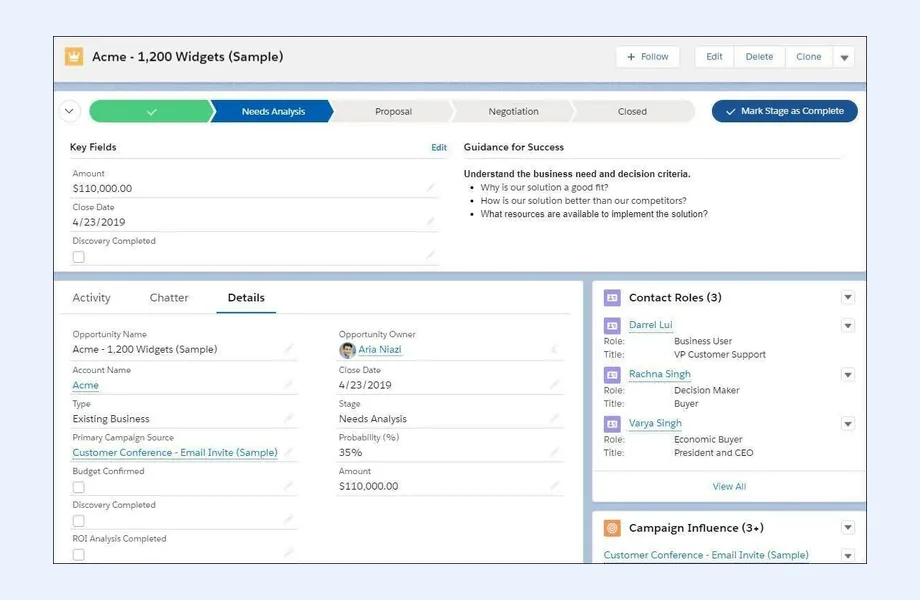
Stages defined by buyer actions such as a signed NDA, a site visit or a budget confirmed, so a forecast call compares the same thing across every rep and region.

Rules for web forms, paid search, trade show badge scans and partner referrals: deduplication, enrichment, round-robin or territory assignment, and a response target for each lead type.

The design of how an approved quote becomes an ERP sales order, including ship-to details, tax exemption status and payment terms, and which statuses return to the CRM.

Zoho CRM, HubSpot, Salesforce, Odoo CRM, Dynamics 365 Sales or something else, each scored against your own scenarios for fit, admin effort and long-term cost drivers.
How I Work
Trace every route a deal takes
 Interview sales, marketing and finance
Document channels and ownership
Review current pipeline data
List reports leadership needs
Interview sales, marketing and finance
Document channels and ownership
Review current pipeline data
List reports leadership needs
Write the CRM blueprint
Stages, fields and territories
Routing and consent rules
ERP handoff specification
Shortlist and scripted demos
Guide the build and adoption
Oversee configuration and migration
Test with real deals
Train reps and managers
Review usage after launch
The first workshop is not about features. It is about how a dollar of revenue actually reaches you. For most US companies the honest answer has several branches, and each branch needs something different from a CRM:
I write each branch as a short process map: who creates the record, what qualifies it, which stages it passes through and who closes it. That map becomes the requirement set for the CRM and stops a single vendor demo from defining how your whole company sells. It also exposes conflicts early, such as two channels claiming the same account, which are far cheaper to settle on paper than in a live system.
American sales organizations argue about territories more than about almost anything else, and a CRM either settles those arguments or makes them worse. Before configuration, I write ownership rules that leadership signs off:
Commission calculations themselves usually live in payroll, a dedicated tool or a finance spreadsheet, not in the CRM. The CRM's job is to hold trustworthy data about who owned and influenced each deal, so the calculation downstream is not disputed. I design the fields and stage rules that make that data reliable, and I keep the logic simple enough that a sales operations person can maintain it without a developer.
For rep agencies, I also decide how much of the CRM they touch. Some companies give agencies a partner portal or limited licenses; others ask for a weekly report and enter it internally. Both can work if the rule is written down.
Many US pipelines look healthy until a won deal reaches finance. The ship-to address is incomplete, the customer's tax-exempt status was never collected, the payment terms differ from the credit limit, or the product on the quote no longer matches an item in the ERP. Each gap means a phone call and a delay before anything ships.
I design the handoff as a specification rather than a hope. It covers:
Where developers or an implementation partner build the connection, I write the field mapping and test cases, then check the results against real deals. The wider method is described on my system integration page and on the sales and CRM integration solution page, and the sibling page on system integration in the USA covers the other connections around your ERP.
A US CRM holds phone numbers, emails and notes about real people, so the design has to reflect rules that your counsel interprets. Federal rules on calls and texts, often discussed under the TCPA, commercial email rules and a growing set of state privacy laws can all touch how contacts are captured and used. Legal interpretation stays with counsel; my part is to turn your counsel's position into something the CRM enforces rather than something staff are expected to remember.
At the platform-neutral level, that means checking during selection whether each candidate can:
Hosting is a related question. Some buyers, especially those selling to government or regulated industries, ask where data is stored and which security reports the vendor can share. I put those questions to every shortlisted vendor in writing. For the field-level detail of how this works on one product, see my Zoho CRM consultant USA page or the Odoo CRM USA page.
Once the routes, territories and handoff are written down, the selection becomes a test rather than a beauty contest. I shortlist from Zoho, HubSpot, Salesforce, Odoo, Dynamics 365 or another product, then ask each vendor or partner to demo your own scenarios: a territory reassignment, an agency-sourced deal, a won quote passing into the ERP. Admin effort after launch gets as much weight as features, because many US teams have no full-time CRM administrator.
Reporting is designed at the same time. Leadership usually wants a short list of numbers they can rely on: pipeline by stage and territory, forecast against target, win rate by channel, sales cycle length and lead response time. I define each one in writing, including which deals count, so the weekly forecast call stops being a debate about data. Because acquisition is my second specialty, I also connect paid search and LinkedIn campaigns to closed revenue where that matters, as described under B2B lead generation.
All of this runs remotely, with video workshops booked so that East Coast and West Coast managers can both attend. On-site sessions are possible by arrangement. Vendors and partners pay me nothing, whichever product wins. For the general method see CRM consulting; for ERP advice in the US, see my ERP consultant work in the USA or start from the US hub.

Tell me about your business and current systems. I’ll suggest the most sensible first step.
Book a Consultation
Not sure which ERP you need?
Share your business requirements with me and I will help you understand the right process, architecture and platform before implementation.
FAQ
No. The recommendation follows your channels, deal sizes, admin capacity and the ERP the CRM must talk to. Zoho CRM, HubSpot, Salesforce, Odoo CRM and Dynamics 365 Sales can each be right in different situations. I score them against your own written scenarios and explain the trade-offs, and no vendor pays me for the result.
Some CRMs can, but the safer design usually keeps the calculation in payroll, a dedicated tool or finance, and uses the CRM as the trusted source of who owned and influenced each deal. I design the ownership fields, split credit rules and reports so that the downstream calculation is based on data nobody disputes.
Your counsel decides what applies to your business. I translate that position into CRM design: consent captured per channel with its source, one opt-out respected by every sending tool, restricted access to sensitive notes and a tested way to answer data requests. I also check during selection whether each candidate CRM supports those rules.
Not always. Many failing CRMs suffer from unclear stages, missing ownership rules or poor data, and a new product would inherit the same problems. I review the current setup against how you actually sell, fix the design first and recommend replacement only when the platform itself is the obstacle.
That depends on the platform and your team. The design document can be handed to your internal administrator, to a vendor's services team or to an implementation partner. I stay involved to answer design questions, review configuration against the blueprint, run testing with real deals and support training and adoption.
Every business is different. Share where you are today and what you want to fix, and I’ll tell you honestly whether and how I can help.
Book a Consultation
Insights
 Book a Consultation
Book a consultation to talk through your processes, systems and goals. I’ll reply with practical next steps - no obligation.