Contact Info

 Odoo Accounting
What does an Odoo accounting consultant do?
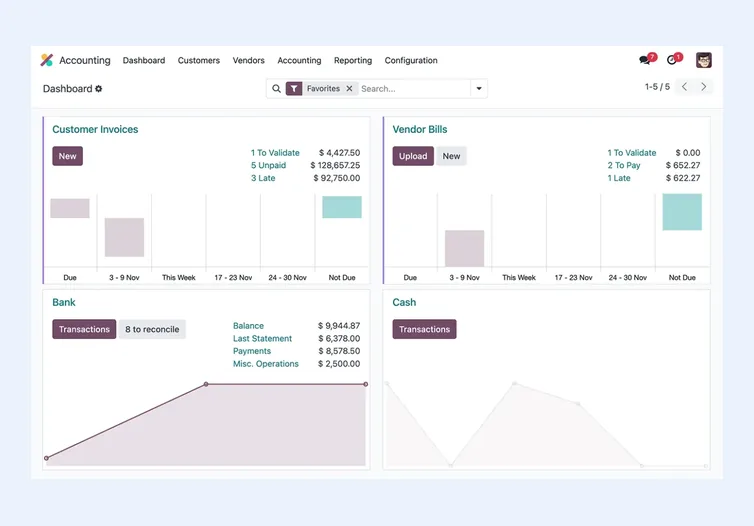
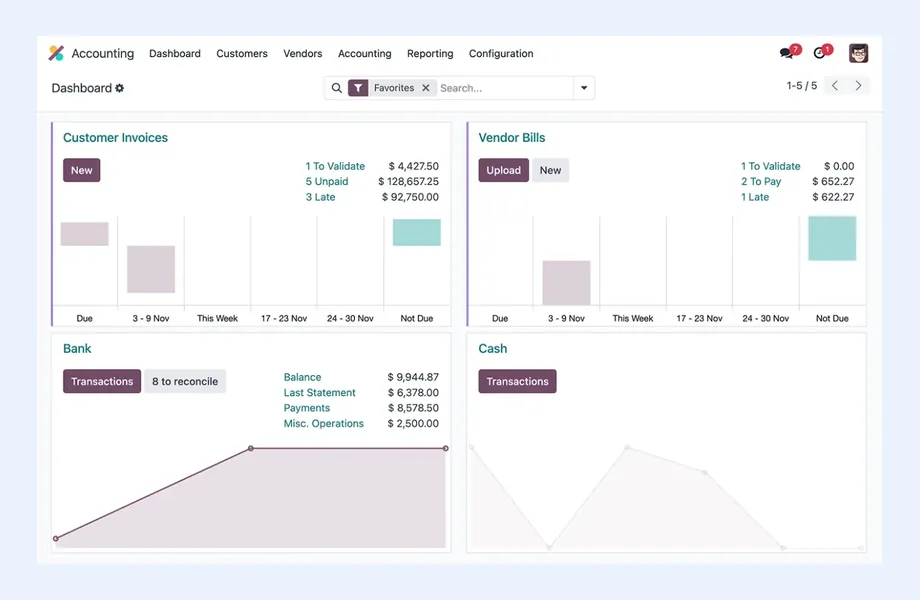
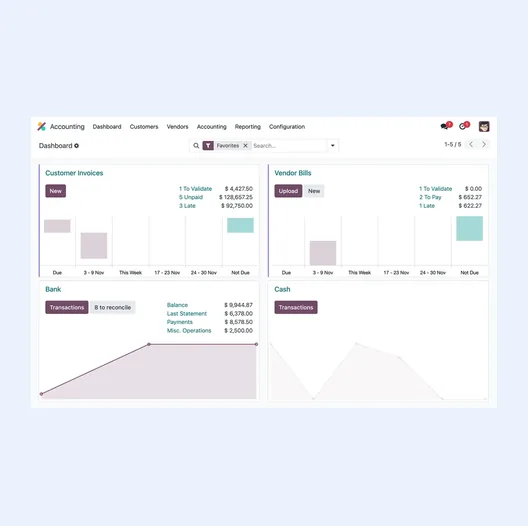
An Odoo accounting consultant sets up Odoo so finance can close the books with confidence: the right fiscal localization, chart of accounts, taxes, bank reconciliation, multi-company and multi-currency rules, and reports that match how you actually report. As an independent Odoo accounting consultant, I start from your record-to-report process and your accountant's requirements, then configure Odoo around them and test with real transactions before go-live.
Last reviewed by Vikas Saroj
Most Odoo accounting problems are not software bugs. They come from a localization package installed without review, taxes copied from the old system, bank feeds nobody reconciles, or inter-company flows that were never designed. The result is a finance team that exports everything to spreadsheets at month-end.
As an independent Odoo accounting consultant, I begin with your record-to-report process: how invoices are raised, how payments arrive, how you reconcile, how you consolidate and what your auditors and tax filings need. Only then do I decide how the fiscal localization, journals, taxes, fiscal positions and analytic structure should be configured.
I work remotely with finance heads, CFOs and controllers worldwide, alongside your external accountant where you have one. I do not replace your accountant or tax advisor; I make sure Odoo produces the numbers they need, in the structure they expect, without manual rework.
 What I Do
I focus on the finance side of Odoo: structure, controls, reconciliation and reporting, so the numbers in Odoo are the numbers you trust.

I check which fiscal localization package applies to each company, what it installs (chart of accounts, taxes, tax reports) and what still needs adjusting for your business and your accountant's conventions.

A chart of accounts that supports statutory reporting and management reporting at the same time, with analytic accounts or plans for departments, projects or branches instead of duplicating GL accounts.

Tax definitions, tax groups and fiscal positions that map taxes automatically for domestic, export, reverse-charge or exempt customers and vendors, tested against real invoices before go-live.

Bank journals, statement import or bank synchronization where your edition and bank support it, and reconciliation models that match recurring transactions so the team only reviews exceptions.

Company structure, shared or separate charts, inter-company invoicing rules and access rights designed so each entity keeps clean books while group reporting stays possible.

Foreign currency customers, vendors and bank accounts, exchange rate updates, and realized and unrealized exchange differences handled consistently so revaluation is not a spreadsheet exercise.

Clean cut-over from QuickBooks, Xero, Tally, Sage or another ERP: open receivables and payables, trial balance, fixed asset registers and history decisions documented and reconciled.

Financial reports, aged balances, tax reports and a month-end close checklist built around Odoo, so your team knows which steps happen in the system and in what order.
How I Work
Map record-to-report before configuring
 Finance process workshops
Entity and currency structure
Tax and reporting obligations
Accountant and auditor needs
Edition fit check
Finance process workshops
Entity and currency structure
Tax and reporting obligations
Accountant and auditor needs
Edition fit check
Build and test with real data
Localization and chart setup
Taxes and fiscal positions
Bank and reconciliation models
Opening balance test loads
Parallel-run reconciliation
Go live and stabilize month-end
Cutover and opening balances
Finance team training
First close supported
Control and report review
Odoo handles country-specific accounting through fiscal localization packages. A localization typically installs a chart of accounts template, tax definitions, fiscal positions and country tax reports, and for some countries it adds e-invoicing or other statutory formats. That saves a lot of setup, but it is a starting point, not a finished configuration.
Before any transaction is posted, I review the localization with your finance team and accountant:
Localization coverage varies by country and by edition, so I always check it against your own obligations rather than assuming. Getting this right first matters because changing the chart of accounts or tax setup after months of posting is far harder than designing it properly at the start. This is the same fit-gap discipline I apply to any ERP: standard where it fits, documented decisions where it does not.
Bank reconciliation is where many Odoo finance teams fall behind. The tooling is capable, but it needs to be set up deliberately.
I also check how batch payments, payment terms and early payment discounts are used, because they affect matching. The goal is a reconciliation that the team clears daily or weekly, with only genuine exceptions needing attention. If you have a large backlog in an existing Odoo database, that cleanup is usually part of an ERP health check before anything else is changed.
Odoo supports several companies in one database, each with its own chart of accounts, journals, taxes and currency, with users switching between companies they have access to. That suits groups with several legal entities, but the structure has to be designed, not improvised.
The questions I work through with you:
Group consolidation is an area where requirements vary widely, so I document it as part of the solution design rather than assuming Odoo's standard reports will cover it.
The edition question matters more for accounting than for most other Odoo apps. In Odoo Community, the standard finance app is Invoicing: customer invoices, vendor bills, payments and basic accounting entries. The full Accounting app, with features such as the bank reconciliation interface, bank synchronization, financial and tax reports, follow-ups, assets and budget tools, is part of Odoo Enterprise. Exact feature lists shift between versions, so I always check the edition and version you are on against your requirements.
Some businesses run Community and add community-maintained accounting modules. That can work, but it means relying on third-party modules for core finance, which affects upgrades, support and audit comfort. I lay out the trade-off plainly:
| Approach | Works when | Watch out for |
|---|---|---|
| Enterprise Accounting | You want full reporting, reconciliation tools and vendor support | Subscription cost per user and hosting choice |
| Community with add-ons | You have technical support and simple finance needs | Module quality, upgrade effort, gaps in tax reporting |
| Odoo operations with separate accounting | Your accountant insists on another ledger | Integration, double maintenance, reconciliation between systems |
If you are deciding between Odoo and a dedicated accounting package, see Odoo Accounting vs QuickBooks.
Moving finance into Odoo usually means migrating master data (customers, vendors, products, chart mapping), open receivables and payables, opening trial balances per company, and deciding how much history to bring. I normally recommend migrating open items and balances, and keeping detailed history accessible in the old system or an archive, rather than importing years of transactions. Every load is reconciled back to the source before cutover. My ERP data migration approach covers the checklists and sign-offs.
Honest limitations to plan for:
As a freelance Odoo consultant, I am not tied to a vendor or a license sale. I can advise whether Odoo Accounting is right for you, design it with your finance team, guide an implementer, or review a setup that is not closing cleanly. For the wider platform view, see my Odoo consulting page, or compare options in Odoo vs Dynamics 365.

Tell me about your business and current systems. I’ll suggest the most sensible first step.
Book a Consultation
Not sure which ERP you need?
Share your business requirements with me and I will help you understand the right process, architecture and platform before implementation.
Platforms
 By Country
Pages written for each market: local tax, e-invoicing, data hosting, migration sources and how the work runs remotely there.
FAQ
Community includes the Invoicing app for invoices, bills and payments. The full Accounting app, with features like the reconciliation interface, bank synchronization and the main financial and tax reports, belongs to Enterprise. Feature boundaries change between versions, so I check the specific edition and version against your requirements before you decide.
Yes. Odoo supports multiple companies in one database, each with its own currency, chart of accounts, journals and taxes, plus foreign currency transactions and exchange difference postings. The design work is in deciding entity structure, shared data, inter-company flows and how group reporting will be produced. I document those decisions before configuration starts.
It depends on your edition, your country and your bank. Enterprise offers bank synchronization through supported providers, and statements can also be imported in common file formats. I confirm what is available for your banks early, so the reconciliation process is designed around what actually works rather than what was assumed.
No. I configure Odoo so it produces the records and reports your accountant and tax advisor need. Tax treatment, filings and statutory decisions stay with them. I work alongside them, translate their requirements into Odoo configuration and test the results with real transactions.
Yes. I start with a review of the chart of accounts, taxes, reconciliation backlog, journal usage and how inventory valuation posts to the ledger. Then I propose a prioritized cleanup plan, separating quick configuration fixes from changes that need careful timing, such as restructuring accounts mid-year.
Every business is different. Share where you are today and what you want to fix, and I’ll tell you honestly whether and how I can help.
Book a Consultation
Insights
 Book a Consultation
Book a consultation to talk through your processes, systems and goals. I’ll reply with practical next steps - no obligation.