Contact Info

 Odoo Accounting in Spain
What should a Spanish company verify in Odoo Accounting?
A Spanish company should verify that Odoo's fiscal localization, in the edition and version it will run, maps every tax to the right return lines, handles SII, TicketBAI or Facturae where they apply, and addresses the invoicing software rules. As a freelance Odoo Accounting consultant I reconcile those outputs with your gestoría, compare Enterprise with community modules, and work remotely in English.
Last reviewed by Vikas Saroj
Spanish finance teams usually meet Odoo Accounting as part of a wider Odoo project, chosen for stock, sales or e-commerce. The ledger then inherits whatever the localization and the partner set up, and the first VAT return becomes the moment of truth.
I bring that moment forward. Before go-live, I check the chart, taxes, return mappings and electronic reporting against what your gestoría or in-house accountant actually files, and I settle the Community versus Enterprise question for finance specifically.
 What I Do
These tasks concern the accounting core rather than the operational modules around it.

I confirm which version of the Spanish accounting plan suits each company, whether for SMEs, larger entities or non-profits, and how group reporting accounts are layered on top.

Each tax is traced to the grid that feeds the periodic VAT return and related summaries, then reconciled against the gestoría's own calculation for a test period.

SII submissions, TicketBAI for Basque entities and Facturae for public sector customers, each tested in a staging database with your own certificates and sample documents before anything is submitted live.

Withholding on professional invoices, the equivalence surcharge for retail customers, cash-basis VAT and island taxes, each modeled exactly as your advisor defines it and tested with sample invoices and payments.

Enterprise localization against community-maintained Spanish modules, compared on coverage of your obligations, who maintains each module, upgrade effort and the risk each brings to your filing calendar.

SEPA direct debit remittances, supplier payment files and statement imports, with reconciliation models that recognize references, fees and grouped receipts and keep the bank queue short between closes.
How I Work
Obligations and cases per entity
 Advisor confirms obligations
Territory per entity
Special regimes listed
Edition and version fixed
Advisor confirms obligations
Territory per entity
Special regimes listed
Edition and version fixed
Compare Odoo with the advisor
Tax grid review
Staging period reconciled
Electronic submissions tested
Remittance files tried
Run and document the close
First return side by side
Submission errors resolved
Close checklist written
Owner named for updates
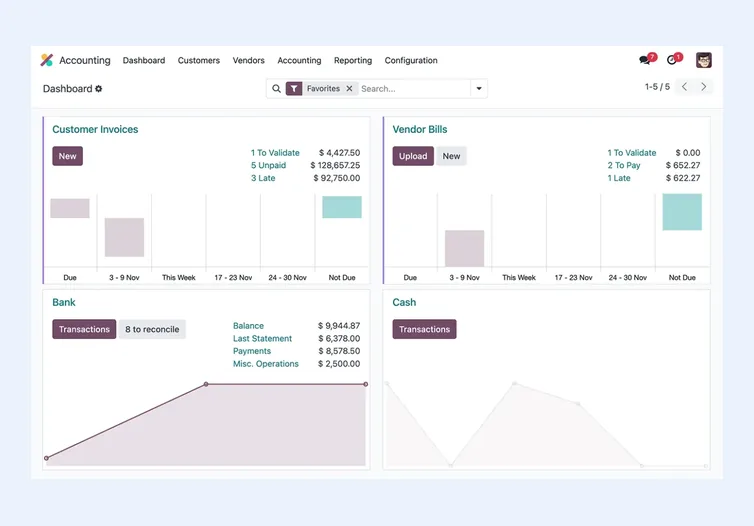
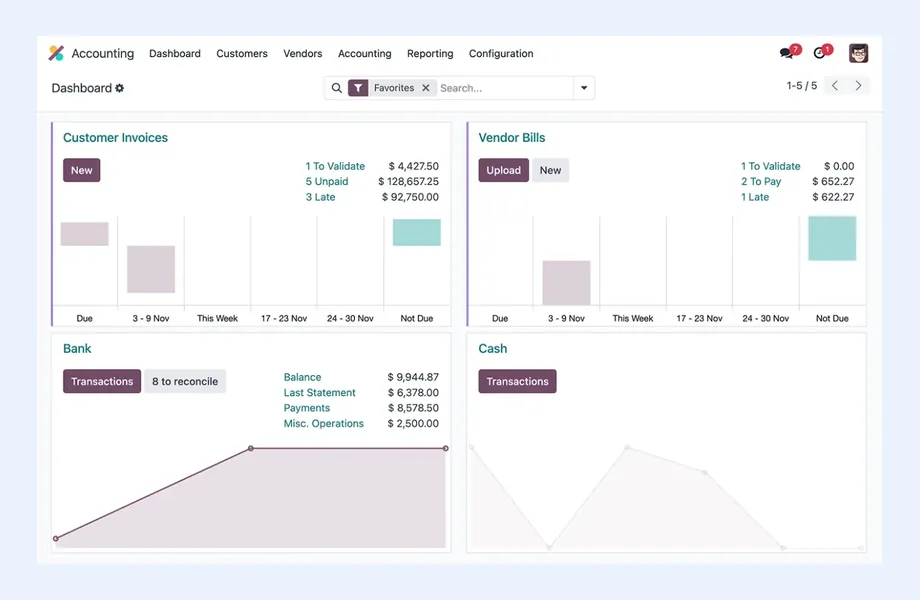
Odoo's Spanish localization installs charts based on the national accounting plan, a large set of taxes and the report definitions used to prepare Spanish VAT and summary returns. The breadth is real, and it is also where errors hide: a company that sells only domestically does not need half the taxes, and a company with intra-EU purchases, island customers and professional suppliers needs several that are easy to configure incorrectly.
My first task is a tax inventory with your gestoría or accountant:
Unused taxes are archived so users cannot pick them. Each used tax is checked for the grids it feeds. A test period of real-looking transactions is then run through the Odoo reports and through the advisor's own process, and every difference is explained before go-live. The Odoo Accounting page describes the general features this sits on.
Spanish electronic reporting comes in layers, and Odoo has modules for several of them. Which apply depends on your entity, territory and customers, and your asesor fiscal confirms each one:
For each layer I record the module providing it, the edition required, the certificates needed and who maintains it. Version matters: a feature described for one Odoo release may work differently in the one your partner installs. I verify on the actual database, not on documentation.
For Navarre, island taxes and other territorial cases, I add specific tests. Platform-level questions belong on Odoo in Spain.
Spanish modules maintained by the open source community cover areas such as tax returns, SII and payment files. That makes Community a credible option for some finance teams. It also moves responsibility: someone must choose compatible modules, test them together and maintain them as Odoo publishes new versions and as the tax agency revises its technical specifications.
Enterprise brings the vendor-maintained localization, vendor support and managed hosting options, at a license cost per user. The finance question is not which is better in general, but which risk you prefer to carry.
I compare the two for your case list on:
The result goes into a short written recommendation with cost drivers, not prices, so management can sign off knowingly. My ERP evaluation service uses the same method for wider platform decisions.
Spanish receivables and payables run on remittances. Customers who pay by SEPA direct debit are grouped into debit remittances sent to the bank, returned debits come back with fees, and supplier payments go out as SEPA transfer files. Some companies also handle promissory notes or confirming lines with their banks.
In Odoo Accounting I design:
Which features come from Enterprise and which from community modules depends on your edition, so I test them on the database you will run. Each bank is tried separately before go-live, because small differences in file content cause rejections.
I plan migration with the gestoría. The cutover lands on the first day of a period, preferably a new fiscal year, so each return is prepared from one system. Customers and suppliers move with validated NIF data, open items keep their original numbers and due dates, and balances are loaded on the new chart and agreed with the advisor. Closed years remain readable in the previous program, which also handles corrections to documents it originally issued if your advisor agrees.
Odoo Accounting is a weaker choice when:
Engagements are remote, with sessions placed in the Spanish morning. Background is on the ERP consultant in Spain page, and my migration checklist sits under data migration.

Tell me about your business and current systems. I’ll suggest the most sensible first step.
Book a Consultation
Not sure which ERP you need?
Share your business requirements with me and I will help you understand the right process, architecture and platform before implementation.
FAQ
The Spanish localization includes report definitions intended for the periodic VAT return and related summaries, fed by tax grids. Whether the figures are right depends on every tax being configured and tagged correctly. I reconcile a test period with your gestoría before the report is used for a real filing.
Odoo has offered an SII module in its Spanish localization, and community modules also exist. Behavior differs by edition and version, so I test submissions, corrections and rejections on the database you will run, using your own certificate, and your asesor fiscal confirms the setup before the first live submission.
The localization includes withholding taxes that can be applied to supplier invoices from professionals and to your own invoices where relevant. I configure them with your advisor, check that they reach the right return lines, and test payments so the net amount and the withheld amount post correctly.
For some companies, yes, because community Spanish modules are extensive. The trade-off is maintenance: your partner or team must keep modules compatible and current. I compare that with Enterprise against your specific obligations, including any regional systems, and record the reasoning for management.
Every business is different. Share where you are today and what you want to fix, and I’ll tell you honestly whether and how I can help.
Book a Consultation
Insights
 Book a Consultation
Book a consultation to talk through your processes, systems and goals. I’ll reply with practical next steps - no obligation.