Contact Info

 Odoo CRM in Spain
Is Odoo CRM a good choice for a Spanish company?
Odoo CRM is a sound choice for a Spanish company whose orders, stock and invoices already live in Odoo, because the pipeline then hands accepted quotes straight to sales orders and to invoices produced under the Spanish localization. I design pipelines for retail buyers, distributors and project sales, set up consent records with your privacy advisor, and confirm edition coverage, working remotely as an independent consultant.
Last reviewed by Vikas Saroj
A fruit and vegetable exporter negotiating a season with European supermarket buyers, a tile manufacturer working through distributors on several continents and an industrial supplier quoting projects at home sell in very different ways. Each still needs to know which conversations will become orders, and each ends with an invoice that Spanish rules govern.
When those invoices come from Odoo, keeping the pipeline in the same database removes a layer of re-keying. I design that pipeline with your commercial director, remotely, and the engagement runs in English. Spanish and Catalan customer documents come from, or are checked by, people for whom those languages are native, whether on your payroll or at a firm you trust.
 What I Do
The work below concerns the commercial side of Odoo and the data it passes to orders and invoicing.

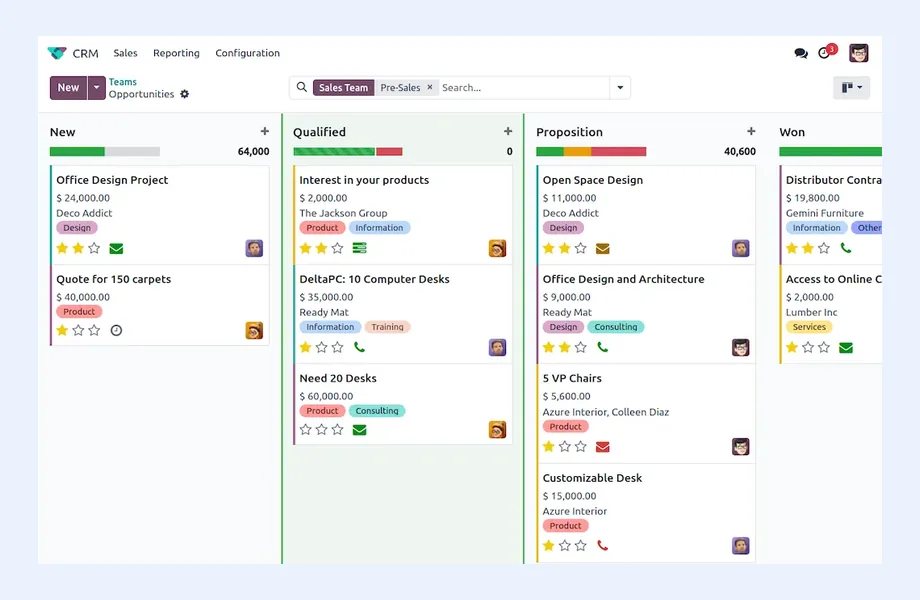
I separate the ways you sell, such as retail chains, importers, distributors, agents and direct projects, and decide which deserve their own pipeline, team and reporting in Odoo.

For agri-food exporters, opportunities that represent a season or program with a buyer, carrying expected volumes per product so planning can see what sales is negotiating.

Quotation templates in Spanish, Catalan or English, with Incoterms, payment method and validity, where the local-language wording is checked by native speakers on the client side.

Required fields for tax identifiers, tax territory and customer type at the point an opportunity is won, so invoicing under the Spanish localization does not stall on missing data.

Contact source, consent scope and opt-out handling configured to the approach your data protection advisor sets under Spanish law, before any campaign leaves Odoo's email marketing tools.

Features such as telephony, signatures and enrichment listed against Community, Enterprise and hosting options, with Odoo or the partner answering in writing before you decide.
How I Work
Channels, buyers and current tools
 Commercial director workshop
Channel list agreed
Existing quotes collected
Privacy advisor contacted
Commercial director workshop
Channel list agreed
Existing quotes collected
Privacy advisor contacted
Teams, stages and templates
Pipelines per channel
Required fiscal fields
Templates sent for review
Consent fields configured
Won deals through to invoices
Test deals converted
Invoice data checked
Forecast report reviewed
Training with sales leads
Spanish fruit, vegetable, olive oil and wine exporters sell much of their output to retail groups and importers elsewhere in Europe. The commercial conversation is often about a season rather than a single order: volumes per week, packaging formats, price ranges and quality specifications agreed before harvest. A standard pipeline built around one-off deals does not show that well.
In Odoo CRM I would model it this way:
Once a program is confirmed, orders arrive through the season, often electronically from the buyer's own systems. That order flow is mostly an integration question rather than a CRM one, and I record it as a separate requirement. My global Odoo CRM page explains the standard features, while Odoo in Spain covers localization and edition choices at platform level.
Spanish ceramic tile and building product manufacturers sell through distributors and importers in many countries, while architects and project specifiers influence which product ends up on a large project. Two kinds of relationship therefore need tracking: the account that buys and the specifier who recommends. Odoo CRM can hold both, provided the data model is clear from the start.
The structure I would propose:
Distributors who want portal access to their own orders and invoices can use Odoo's customer portal; whether they can also register opportunities depends on the edition and modules your partner proposes, which I confirm before promising it to the sales team. For a wider look at how the CRM decision fits Spanish commercial practice, see CRM consultant in Spain.
A quotation in Odoo becomes a sales order and then an invoice, and in Spain that invoice is where regulation applies. Depending on the company and its location, invoices may need to be reported through SII, issued under the Basque or Navarre systems, sent as Facturae to public bodies, or produced by software meeting the newer invoicing software requirements. Those obligations sit with Odoo Accounting and its Spanish localization, not with CRM, but CRM can create problems for them.
The most common problem is incomplete customer data. If a salesperson creates a customer without a valid tax identifier, the right tax territory or the correct customer type, the invoice is delayed or wrong. I prevent that by:
Your asesor fiscal confirms the obligations that apply to you; the partner confirms how your edition meets them. The ledger side is covered on Odoo Accounting in Spain.
Marketing from a Spanish CRM involves the GDPR, the Spanish data protection law that complements it, and separate rules on commercial electronic communications. Together they shape when you may email a contact, what you must tell them and how they opt out. How those rules apply to business contacts, existing customers and trade fair leads is for your data protection advisor to decide, not for the CRM consultant.
What I make sure Odoo can do is follow their decision reliably:
I also check who can export contact lists, and whether access rights should stop area managers seeing other regions' data. If your marketing relies on heavy automation and scoring, a dedicated marketing tool connected to Odoo may suit better than Odoo's own email marketing; I compare both on your requirements through CRM consulting.
Pipelines, activities, quotations and basic reporting come with Odoo Community. Features that Spanish sales teams ask about, such as integrated telephony, lead enrichment, electronic signature of quotes and some advanced reports, may need Enterprise or Odoo's online services. Odoo Online also restricts additional modules, which matters if your Spanish invoicing relies on community modules. Odoo.sh and self-hosting allow more freedom but leave upgrades with you and your partner. I list each feature against these options and get the answer from Odoo or the partner in writing.
I would advise a separate CRM, connected to Odoo, in situations like these:
In those cases the work becomes an integration design, covered on system integration. Nothing in my income depends on which CRM you pick, since I neither resell Odoo nor take partner fees. All work is delivered remotely, during hours that overlap with the Spanish working day, with visits only by arrangement.

Tell me about your business and current systems. I’ll suggest the most sensible first step.
Book a Consultation
Not sure which ERP you need?
Share your business requirements with me and I will help you understand the right process, architecture and platform before implementation.
FAQ
Odoo supports multiple languages for documents and users, so a quotation can print in the customer's language. While the engagement runs in English, the Spanish and Catalan wording is proofread by Spanish and Catalan speakers among your staff, or by a local agency, before customers receive it.
No, those obligations sit with invoicing in Odoo Accounting and its Spanish localization. CRM's role is to capture complete customer fiscal data so invoices are correct. Your asesor fiscal confirms what applies to you, and the partner shows how your edition and version handle it.
The customer portal lets distributors view their quotations, orders and invoices. Letting them register opportunities or leads depends on the edition and modules your partner proposes. I confirm what is possible for your version before the sales team promises it to distributors.
Your data protection advisor decides what consent you need under GDPR and Spanish law. I configure source and consent fields, mailing lists and blacklist handling so Odoo follows that decision, and test that opted-out contacts cannot be reached by any campaign.
My role is design, requirements, testing and oversight. Configuration in the live system is done by your team or your chosen implementation partner, following the design we agree. I am independent of Odoo and of partners, so I can review their work without a conflict.
Every business is different. Share where you are today and what you want to fix, and I’ll tell you honestly whether and how I can help.
Book a Consultation
Insights
 Book a Consultation
Book a consultation to talk through your processes, systems and goals. I’ll reply with practical next steps - no obligation.