Contact Info
 Odoo CRM in India
What does an Odoo CRM consultant do for an Indian business?
For an Indian company running Odoo, a CRM consultant makes the pipeline produce quotations that already carry the right GST split, HSN codes and selling GSTIN, so confirmed orders flow into dispatch, e-way bills and invoices without correction. The work also covers customers keyed on GSTIN, dealer and distributor price lists, rupee and foreign currency export deals, marketplace and ad leads, regional language documents and coexistence with Zoho CRM or Salesforce.
Last reviewed by Vikas Saroj
Indian buyers read a quotation closely. They check HSN codes, whether the tax is CGST plus SGST or IGST, freight and packing terms, and which of your GSTINs will bill them. If any of that is wrong, the purchase order copies the mistake and your accounts team has to unwind it after dispatch.
I work remotely with Indian manufacturers, distributors, exporters and service companies that run Odoo or are moving to it, often from Tally plus spreadsheets. I set up Odoo CRM so the opportunity collects the customer's GSTIN, state and terms early, and the quotation, sales order, delivery and invoice follow from the same data.
I am an independent consultant. I do not sell Odoo licenses or development, and I take no commission from implementers, so my advice covers whether Odoo CRM fits your business at all, not only how to configure it once the decision is made.
 What I Do
These services address the points where Indian Odoo CRM setups usually create work for accounts and dispatch.

Products with HSN or SAC codes and tax rates agreed with your chartered accountant, customers with GSTIN and state, and quotation layouts that show the tax split buyers expect.

Sales teams linked to the company or branch that holds the relevant GSTIN and warehouse, so a quotation is issued from the location that will dispatch and invoice.

Price lists by dealer category, region or volume slab, with scheme discounts approved by managers and visible on the order rather than negotiated in side conversations.

Quotations in dollars or euros with Incoterms, export tax treatment flagged for your accountant to confirm, and advance or letter of credit terms carried into the sales order.

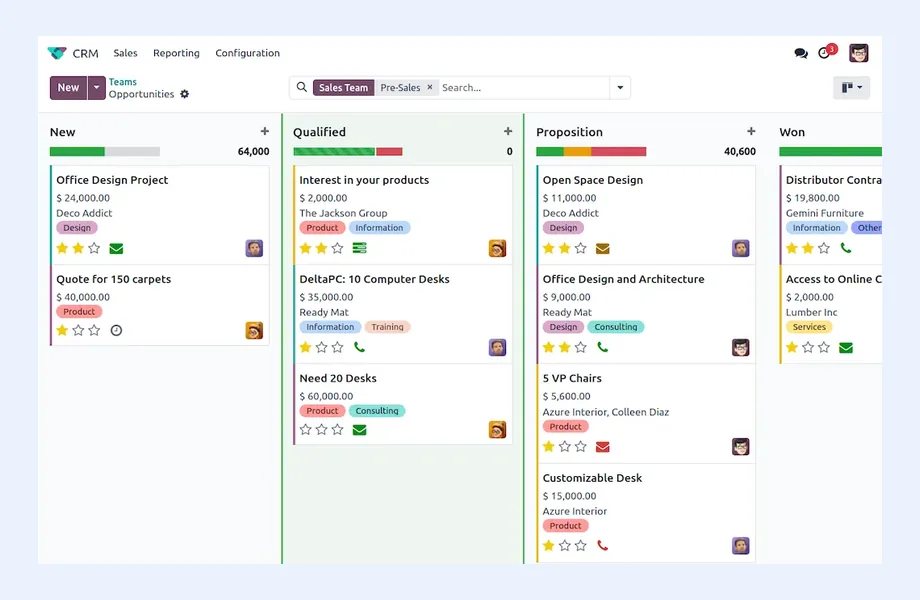
Marketplace inquiries, website and ad forms, trade fair lists and email captured into Odoo with source and campaign, through connectors or the API where they exist for your setup.

When Zoho CRM or Salesforce stays, a clear split of ownership and a tested sync, so reps see order, dispatch and outstanding status without logging into Odoo.
How I Work
Sales as it runs today
 Inquiry sources and volumes
Quotation formats in use
GSTINs, branches and warehouses
Dealer schemes and terms
Inquiry sources and volumes
Quotation formats in use
GSTINs, branches and warehouses
Dealer schemes and terms
CRM built on clean masters
GSTIN checks on customers
HSN codes on products
Price lists and approvals
Stages and lost reasons
Prove it with real orders
Intra and inter-state tests
Export quote walkthrough
Executive mobile training
Weekly pipeline review
Indian GST makes the quotation a tax document in all but name. Whether a line carries CGST and SGST or IGST depends on the place of supply, which for most goods follows where they are delivered. The rate depends on the HSN or SAC code. Get either wrong on the quotation and the error travels into the purchase order and the invoice.
In Odoo, much of this is automatic once the data exists. The Indian localization can choose intra-state or inter-state tax through fiscal positions based on the customer's state, and products carry HSN codes and tax rates. The CRM has to supply the missing pieces:
Tax decisions are your accountant's. My part is ensuring the quote a sales executive sends matches the invoice accounts will raise. E-invoice and e-way bill handling on the accounting side is covered on my Odoo Accounting India page.
Duplicate customers are common in Indian CRMs: one executive enters the company name, another the proprietor's name, a third creates a fresh record for a branch in another state. A GSTIN solves most of this, because it identifies a registration precisely and contains the PAN of the legal entity. Two GSTINs that share a PAN belong to the same business registered in different states.
How I use that in Odoo CRM:
Your own GSTINs matter too. A manufacturer with plants or depots in several states needs each quotation issued by the company or branch that will dispatch and bill. In Odoo I link each sales team to that entity and its warehouse, so the quotation, delivery challan or tax invoice and e-way bill all come from the right registration. The structure is designed with the accounting setup, described on my Odoo consultant India page.
Indian B2B pipelines draw on a mix that few other markets share. B2B marketplaces send a steady stream of inquiries, many of them also sent to competitors. Trade fairs produce batches of visiting cards. Google Ads and the website bring direct inquiries, and existing dealers reorder by phone or WhatsApp.
What I set up for each:
Executives in the field can use Odoo on mobile to log visits and send quotations. WhatsApp and calling integrations exist in various forms; whether they are native, Enterprise-only or third-party depends on your version, so I check before promising them. For paid acquisition, see Google Ads management.
Manufacturers and brands selling through distributors need pricing that reflects dealer category, region and volume. Odoo price lists can handle tiered and category-based pricing, and discounts beyond an agreed level can be routed for approval. I keep schemes visible on the sales order, so accounts can see why a price was given and the scheme cost can be reported later.
Exporters need a different flow. Quotations go out in dollars or euros with Incoterms, payment by advance or letter of credit, and an export tax treatment that your accountant confirms, for example supplies under a letter of undertaking. In Odoo these customers get their own fiscal position and price list, and the sales order carries the currency through to the invoice while the books stay in rupees.
Language is the third element. Many customers and dealers prefer Hindi or a regional language for communication. Odoo prints documents in the language set on each customer where translations exist. In practice I usually keep tax documents in English, which buyers and auditors expect, and prepare email and message templates in the languages your executives use daily. Test any non-Latin script on real printouts before rollout.
For the wider order-to-cash view, see manufacturing ERP.
Many Indian companies run Odoo Community with third-party modules for GST, marketplace connectors and reports. That can work, but it makes you dependent on each module's author for updates. The core CRM app is in Community; VoIP, Studio, some messaging features and parts of the Indian e-invoicing integration may be tied to Enterprise. I check your edition and modules against requirements before design is signed.
Some Indian companies already use Zoho CRM, and subsidiaries of global groups often use Salesforce. Keeping them can make sense when marketing workflows or group reporting depend on them. Then Odoo owns customers, quotations, orders, dispatch and invoices from an agreed stage, and status flows back.
Odoo CRM is a weak fit when:
See the global Odoo CRM page, CRM consulting, the ERP consultant India page and the India hub.

Tell me about your business and current systems. I’ll suggest the most sensible first step.
Book a Consultation
Not sure which ERP you need?
Share your business requirements with me and I will help you understand the right process, architecture and platform before implementation.
FAQ
Yes, when the data is in place. The Indian localization uses fiscal positions based on the customer's state to choose intra-state or inter-state tax, and products carry HSN codes and rates. The CRM must capture GSTIN and state at conversion, and your chartered accountant should confirm the tax setup.
Usually, through third-party connectors or the marketplace's API where available. These are not standard Odoo features, so I check who maintains the connector, whether it suits your Odoo version, and how duplicates are handled before recommending it. Response-time reporting matters as much as the connector itself.
The CRM app in Community covers pipelines, activities and lead management well. Gaps tend to appear around VoIP, messaging, Studio changes and some compliance integrations, which may need Enterprise or third-party modules. I list your requirements first and check them against your edition before you decide.
Yes. I work remotely with businesses across India, holding workshops in IST working hours and recording training for field executives and branch staff who cannot attend live. Where an in-person session genuinely helps, for example a process workshop with several departments, it can be discussed by arrangement.
Every business is different. Share where you are today and what you want to fix, and I’ll tell you honestly whether and how I can help.
Book a Consultation
Insights
 Book a Consultation
Book a consultation to talk through your processes, systems and goals. I’ll reply with practical next steps - no obligation.