Contact Info
 Odoo Manufacturing in Nigeria
How does an Odoo Manufacturing consultant help a Nigerian plant?
For a Nigerian food, beverage or household goods plant, an Odoo Manufacturing consultant structures bills of materials from bulk product to packed cartons, builds diesel and power costs into work center rates, sets lot tracing from raw material to distributor, and confirms which quality and shop floor features need Enterprise. I also say plainly when a process ERP or MES suits the plant better. The work is remote and independent.
Last reviewed by Vikas Saroj
Nigerian food and consumer goods manufacturers carry costs that a standard costing template ignores. Self-generated power, imported inputs priced in dollars, yield losses on bulk mixing and packaging that changes with each promotion all shape the real cost of a carton. If Odoo is set up without them, the system reports margins that finance does not believe.
My role on the production side is remote and freelance. I map how your lines run, decide with operations and finance how much of Odoo Manufacturing you need, write the specification for your implementer, and run pilot orders with your own recipes before the plant depends on the system.
 What I Do
These services focus on the manufacturing decisions that matter in Nigerian food, beverage and household goods production.

Bills of materials split into bulk product, packed unit and shipper carton levels, with units of measure converting kilograms and liters into packs and cartons without manual arithmetic.

Expected yield, scrap and by-products recorded on manufacturing orders, so losses on mixing, filling and packing are visible by line and by shift rather than buried in stock adjustments.

Work center cost rates that include labor, machine time and an agreed share of diesel and power, so production cost reflects what running the line really costs the business.

Lots on raw materials, packaging and finished goods, linked through manufacturing orders, so any batch can be traced back to its suppliers and forward to every distributor that received it.

Quality control points, shop floor screens, PLM and the master production schedule reviewed against the edition you plan, with each dependency confirmed with Odoo or your partner.

An honest assessment of whether your recipes, lines and controls call for a formula-based ERP or a dedicated execution system, used instead of Odoo Manufacturing or connected alongside it.
How I Work
How each line actually produces
 Recipes and pack formats listed
Yields and losses measured
Energy and labor costs gathered
Quality checks documented
Recipes and pack formats listed
Yields and losses measured
Energy and labor costs gathered
Quality checks documented
BoMs, routings and costing agreed
BoM levels decided
Work centers and rates set
Lot policy written
Edition dependencies confirmed
Real orders before go-live
Pilot orders per product family
Cost compared with finance
Trace exercise in both directions
Line supervisors sign off
A Nigerian food or beverage plant rarely makes one product in one step. A flour blend, a juice concentrate or a detergent base is mixed in bulk, then filled into sachets, bottles or packs, then grouped into cartons or shrink-wrapped shippers for distributors. Each level has its own components: raw materials for the bulk, film and bottles for the pack, cartons and labels for the shipper.
In Odoo Manufacturing, I usually decide between two structures with your production team:
Units of measure need care. Bulk is measured in kilograms or liters, packs in units, shippers in cartons. Odoo converts between units within a category, so the BoM can say a carton contains a set number of packs and each pack a set weight. Promotional packs, such as a bonus sachet bundled with a carton, are modeled as separate products or BoM variants so their cost and stock stay distinct. The global Odoo Manufacturing page covers BoM types in general.
Odoo builds a manufactured item's cost from two sources: what its BoM components cost and what its operations cost at each work center. A work center carries an hourly cost rate, and the time each operation takes is recorded or estimated on the manufacturing order. For Nigerian plants, the interesting question is what goes into that rate.
Where a plant runs on generators for long periods, energy is not a minor overhead. I work with your finance lead to decide how it enters the cost:
The choice is an accounting policy for your accountant to approve. What matters in Odoo is that it is applied consistently and reviewed, because diesel prices can move quickly and a rate set once and forgotten will misstate cost.
Costing method also interacts with currency. Standard cost suits plants that want stable product costs and variance reporting; average cost reflects changing dollar input prices directly. I test both against recent production with your finance team. My Odoo Accounting in Nigeria page covers the ledger side.
Nigerian food and drink manufacturers answer to the national food and drug regulator and to their own key-account customers, and both may ask where a batch came from and where it went. A trace that relies on paper production sheets can take days. In Odoo, it can be a report, provided lots are captured at every step.
The traceability chain I design with your quality team:
Odoo's Quality app, an Enterprise feature, adds control points at receipt, during operations and before release, with pass or fail checks and measurements. In Community, quality steps are usually handled with multi-step receipts and documented procedures. Which records your regulator expects is for your regulatory affairs staff to confirm. Before go-live, we run a mock recall on a real batch in both directions. The Odoo Inventory in Nigeria page covers lots through the depot network.
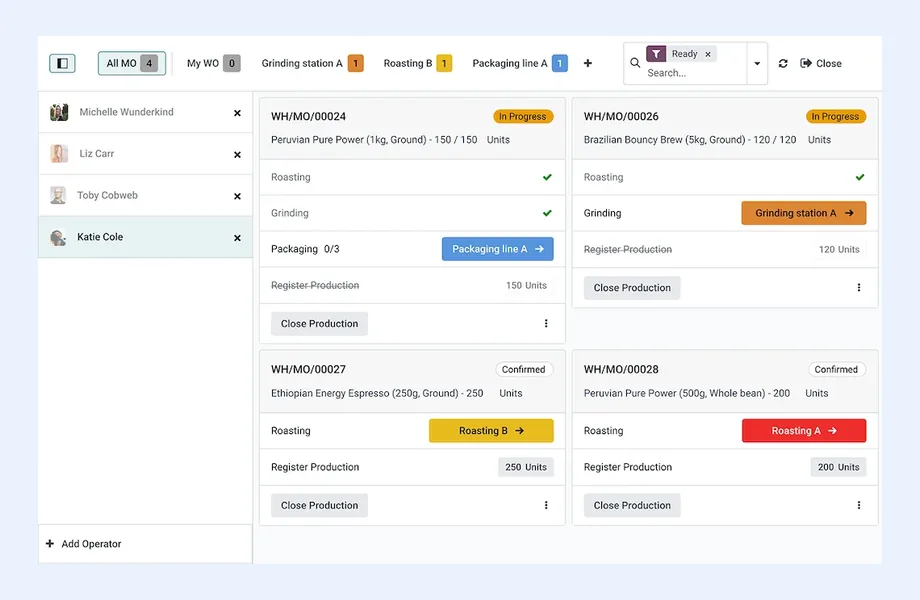
Odoo's shop floor interface lets operators start and finish work orders, record quantities and log scrap on tablets at the line. It is part of the Enterprise experience and, like the rest of Odoo, runs in a browser that needs the database. For Nigerian plants, two practical questions follow.
First, what happens when the line keeps running but the tablet loses its connection? Production does not stop for an outage, so operators need a paper production sheet for each order and a named person who enters the data once Odoo is back. I design that fallback and include it in training. A server on the plant network reduces exposure to internet cuts but depends on stable power for the server room.
Second, which features depend on edition? Each of the following should be checked against your edition and release, in writing, by Odoo or the implementer:
If several of these are critical and the plan is Community, the gap is filled by third-party modules or procedure, each with an owner. The Odoo consultant Nigeria page discusses the edition decision more widely.
Odoo Manufacturing handles discrete and light process production well: defined recipes, packing lines, assembly and make-to-order work. Some Nigerian plants need more than that, and saying so early is cheaper than discovering it in testing.
I recommend looking at alternatives, or adding a specialist system, when:
In those cases, Odoo may still run purchasing, stock, sales and finance with production summarized from the specialist system, or a different ERP may fit better. The ERPNext vs Odoo manufacturing comparison and my ERP consultant Nigeria page cover the wider choice.

Tell me about your business and current systems. I’ll suggest the most sensible first step.
Book a Consultation
Not sure which ERP you need?
Share your business requirements with me and I will help you understand the right process, architecture and platform before implementation.
FAQ
Yes. Bulk can be a semi-finished product with its own BoM and stock, consumed later by packing orders, or a phantom level inside one continuous order. The right choice depends on whether you hold bulk in tanks or silos. I decide it with your production team using real runs.
Energy can sit in work center cost rates for heavy-consuming lines, be absorbed as a period overhead through accounting, or a mix of both. The policy is for your accountant to approve. Rates must be reviewed regularly because diesel costs can move quickly.
It can when lots are recorded on receipts, consumption, output and every delivery. The traceability report then shows suppliers and customers for any lot. Before go-live, I run a mock recall in both directions with your quality team to prove the chain works.
Possibly not on its own. Formula adjustments by input grade, catch weight and continuous process control need a process ERP or execution system. Odoo can still run stock, sales and finance around it. I assess your process before recommending either route.
Every business is different. Share where you are today and what you want to fix, and I’ll tell you honestly whether and how I can help.
Book a Consultation
Insights
 Book a Consultation
Book a consultation to talk through your processes, systems and goals. I’ll reply with practical next steps - no obligation.