Contact Info
 Odoo MRP in the USA
What does an Odoo Manufacturing consultant do for a US manufacturer?
For a US plant, an Odoo Manufacturing consultant turns travelers, job folders and spreadsheet schedules into BoMs, operations and work centers, decides how outside processing and imported parts are planned, sets up the lot and serial controls your customers audit, and agrees a valuation method with your controller. I do this as an independent consultant, remotely across US time zones, and flag early where Odoo MRP will need an add-on.
Last reviewed by Vikas Saroj
A fabricator in Ohio and a co-packer in California can both run Odoo Manufacturing, but they should not end up with the same configuration. One needs operations, labor time and outside processing per job; the other needs recipes, lots and expiry dates. Most of the troubled Odoo setups I review in US plants started from a generic template that fit neither.
My work sits at the configuration level: how deep the bills of materials go, which work centers carry cost rates, how a part sent out for plating or heat treat comes back into stock, how purchased parts from overseas suppliers are planned, and which valuation method your controller signs off before the first manufacturing order is posted.
I work remotely with US manufacturers as an independent consultant, placing live sessions in the overlap with Eastern, Central or Pacific time and recording walkthroughs for second-shift leads. I can also review a configuration that an implementer has already built for you.
 What I Do
These are the Odoo Manufacturing decisions US plants most often get wrong the first time, and the ones I spend the most time on.

For quote-driven work I decide whether each job needs its own BoM and operations or a family BoM adjusted per order, so travelers print correctly and actual hours land against the right job.

Plating, anodizing, heat treat and grinding at vendors modeled as subcontracting BoMs on intermediate items, so material at each vendor stays visible and the service cost reaches the part.

Lot, serial or heat tracking switched on per product, supplier certs attached to receipts, and forward and backward trace proven on test lots before your customers ever ask for it.

Vendor lead times, purchase security days and reordering rules set for parts that cross an ocean, with planners confirming suggestions in the replenishment view instead of trusting blind automation.

Standard, average or FIFO chosen per product category with your controller and CPA, work center rates documented, and stock valuation reconciled in a trial month before go-live.

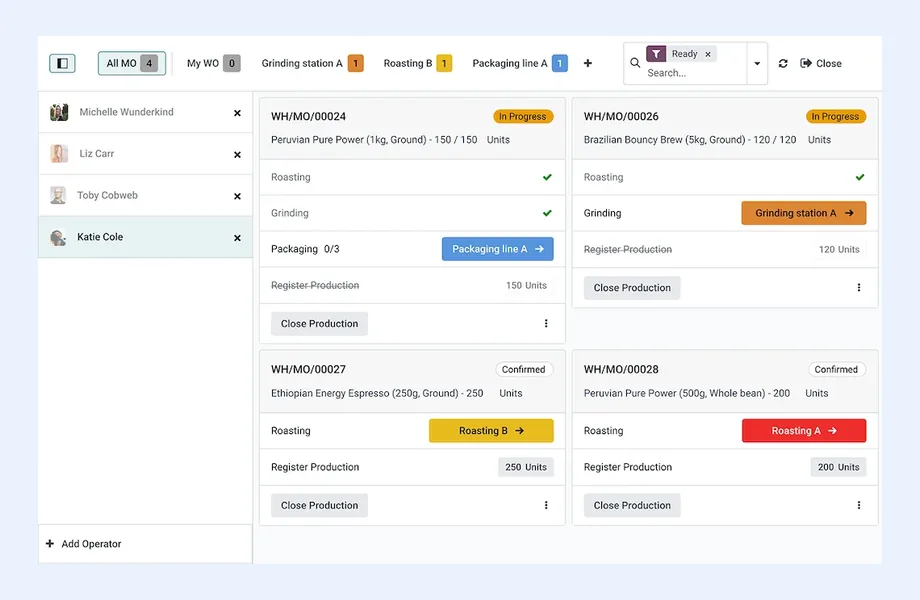
Work order start, pause and finish recorded at each work center, with instructions and checks where your edition supports them, kept simple enough for a busy second shift.
How I Work
Video walkthrough of the plant
 Order types and volumes
Travelers and routings today
Outside processing vendors
Traceability demands by customer
Edition and add-on check
Order types and volumes
Travelers and routings today
Outside processing vendors
Traceability demands by customer
Edition and add-on check
Configure and prove on real parts
Pilot BoMs and work centers
Lead times and reorder rules
Trace test on pilot lots
Trial month costing review
Live by product family
First family on Odoo
Planner and supervisor coaching
Daily variance review
Backlog for the next phase
Most smaller US plants are a mix. Some repeat parts run from stock, while a share of revenue comes from quoted jobs built to customer drawings. Odoo handles both, but the configuration differs, so I decide it per product family rather than once for the whole plant.
Odoo does not estimate jobs from drawings, so quoting usually stays in a spreadsheet or a quoting tool that feeds the sales order. I document that handoff in the process map so estimated and actual hours can later be compared on the same job. The product-level overview is on my Odoo Manufacturing page.
Sending parts out for plating, anodizing, heat treat or grinding is routine for American fabricators and machine shops, and it is one of the places Odoo needs careful design. Standard Odoo subcontracting is built around a vendor producing a whole item from components you supply. That suits contract manufacturers and co-packers well: you create a subcontracting BoM, ship components to the vendor or have your supplier drop them there, and the receipt of the finished item records consumption and the vendor's charge.
Outside processing in the middle of a routing is different. A part machined in-house, sent out for plating and returned for assembly does not map neatly onto one manufacturing order. The options I compare with you:
The first option usually gives the clearest stock picture and cost trail. It does add items, so I agree naming and planning rules with your planners before anything is built, and I test the flow with one real vendor before rolling it out. How this fits the wider build is part of ERP solution design.
American customers push quality requirements down the supply chain. Automotive buyers expect part approval and lot control, aerospace primes want material certifications and revision control, and food customers expect recall-ready lot records under FDA rules. Odoo can carry much of this when it is set up deliberately.
Medical device and other heavily regulated plants should be careful. Odoo is not a validated system out of the box, and device history records or electronic signatures under FDA rules usually need specialist software or validation work well beyond configuration. I say that before scoping, not after. The acceptance scripts I write include a recall exercise on test lots, so traceability is proven rather than assumed; see ERP testing and UAT.
Many US plants buy castings, electronics, fasteners or resin from overseas suppliers, with transit far longer than a domestic order and tariff charges that land after the purchase order is placed. Two areas of Odoo carry most of that risk.
Lead times and reordering rules. The vendor lead time on the supplier line, purchase security days in the settings and the manufacturing lead time on the product together decide when Odoo suggests an order. For imported parts I set them from actual receipt history rather than supplier promises, use minimum quantities that reflect carton or container multiples, and have planners review the replenishment view instead of letting every rule fire automatically.
Valuation. Product categories in Odoo carry the costing method: standard price, average cost or first in, first out, with automated valuation posting stock moves to the ledger. Your controller and CPA should choose, because the choice affects margins, the inventory figures your lender sees and where tariff and freight charges show up. Odoo's landed cost feature applies to average and FIFO products; for items on standard cost, freight and tariffs must be built into the standard and reviewed when they change. I run one trial month with real receipts and orders and reconcile the stock valuation report to the general ledger before go-live. The finance side is covered on Odoo Accounting USA.
The edition question affects manufacturing more than most apps. Bills of materials, manufacturing orders, work orders and basic subcontracting are available in Community. Quality, the Master Production Schedule, PLM, the barcode app and the full tablet shop floor experience are generally Enterprise. Check the current edition list on odoo.com against your requirements, because filling those gaps with third-party modules creates upgrade work your team will own.
Odoo MRP is also not the right tool for every US plant. I tell you so when:
In those cases I compare alternatives, starting with ERPNext vs Odoo for manufacturing. The country-level Odoo view is on Odoo consultant USA, plant-wide requirements on manufacturing ERP USA, and my wider advisory work on ERP consultant USA and the USA hub.

Tell me about your business and current systems. I’ll suggest the most sensible first step.
Book a Consultation
Not sure which ERP you need?
Share your business requirements with me and I will help you understand the right process, architecture and platform before implementation.
FAQ
Yes, with design. Odoo subcontracting fits when a vendor produces a whole item from parts you supply. For a single outside operation in the middle of a routing, I usually make the processed part its own item with a subcontracting BoM, so stock at the vendor and the vendor's charge are both visible. I test it with one real vendor first.
Odoo tracks lots and serial numbers from receipt to shipment and shows forward and backward traceability. Quality checks and certificate handling depend on edition and setup. It is not a validated system for regulated medical device records out of the box. I prove traceability with a recall exercise on test lots during acceptance testing.
It depends on how stable your material prices are, how your controller reports and how tariffs and freight should be treated. Standard cost suits repeat production with planned reviews; average or FIFO absorbs landed costs into item cost. I lay out the trade-offs with your own parts, and your controller and CPA decide.
Odoo plans work orders against work center capacity and working hours, and planners can move them around. It does not optimize sequence, changeovers or operator skills the way a dedicated scheduling system does. For a plant where scheduling is the main constraint, I evaluate add-ons or other platforms before you commit.
Yes. I review BoMs, routes, work centers, valuation settings and custom modules, run test orders and give you a written list of fixes in priority order. US plants often call me when planners have stopped trusting replenishment suggestions or inventory value no longer agrees with the ledger.
Every business is different. Share where you are today and what you want to fix, and I’ll tell you honestly whether and how I can help.
Book a Consultation
Insights
 Book a Consultation
Book a consultation to talk through your processes, systems and goals. I’ll reply with practical next steps - no obligation.