Contact Info
 Odoo MRP Bahrain
Where does Odoo Manufacturing fit in Bahraini industry?
Odoo Manufacturing fits Bahraini aluminum downstream processors, packaging and print converters, food producers and smaller fabricators, provided metal yields, customer-owned material, job-specific print runs and lot traceability for Saudi and other GCC buyers are modeled properly. I advise remotely and independently, from mapping production and agreeing costing with finance to testing the implementer's setup before go-live.
Last reviewed by Vikas Saroj
Bahraini manufacturing is small in plant count but varied in style. Downstream aluminum businesses extrude, roll, cast or draw metal into profiles, sheet, wheels or conductors. Packaging and print converters run short jobs to customer artwork. Food producers and building product makers supply the island and customers across the Causeway.
Each of these needs Odoo Manufacturing set up differently. Metal work is about yield, scrap and sometimes material that belongs to the customer. Print work is about one-off jobs and plates. Food is about lots and expiry. A generic template serves none of them well.
I work remotely and independently with Bahraini plant managers, planners and finance leads. I map production with them, write requirements an implementer can quote against, review the design and lead acceptance testing on your own orders.
 What I Do
These are the manufacturing questions Bahraini producers most often want answered when Odoo is on the table.

Billet, coil or rod consumption recorded against actual output, with process scrap returned to stock as a valued by-product rather than disappearing from the books.

Material supplied by customers held as their property, converted on your lines and returned with a processing charge, without inflating your own stock value or your margins.

Packaging and print runs created per customer job, with artwork version, plates or cylinders and substrate recorded so repeat orders reproduce the same result every time.

Lots linked from raw material to finished goods, with test results and certificates attached, so Saudi and other GCC buyers receive the documents they ask for.

Costing that separates metal value from conversion cost, so quotes and margins can follow metal market movements while processing cost stays stable and visible for management.

A check of which manufacturing features you need against Community and Enterprise, confirmed with Odoo's current edition list before licenses are bought, so nothing essential is missing.
How I Work
Understand how each line runs
 Metal flows and scrap
Toll customer contracts
Print job lifecycle
Buyer document demands
Finance costing logic
Metal flows and scrap
Toll customer contracts
Print job lifecycle
Buyer document demands
Finance costing logic
Configure against real jobs
Yield on a past run
Toll order end to end
Repeat print job test
Lot trace to dispatch
Costing split reviewed
Bring lines live carefully
Approved routings loaded
Opening metal and lots counted
Planner and supervisor coaching
Yield and margin reviews
Aluminum has a long history in Bahrain's industry, and downstream businesses there convert metal into extrusions, rolled products, wheels, conductors and other goods. Their production problems are not those of an assembly plant. Input is bought by weight, output may be counted in pieces, lengths or weight again, and the gap between the two is scrap that often has real value.
In Odoo I model this with care on a few points:
Costing then benefits from separating metal value from conversion cost. Metal prices move with the market while your processing cost does not, and mixing the two hides whether a line is efficient. I agree that structure with finance before standard costs are set. The global Odoo Manufacturing page covers by-products and units of measure in general.
Some Bahraini processors convert metal or other materials that their customer owns. The customer delivers billet, coil or another input, the plant processes it, and the finished goods go back with an invoice for the conversion only. If the system treats that input as the plant's own stock, inventory value is overstated and margins look far better than they are.
Odoo can record stock that belongs to a third party, so customer material sits in your warehouse with an owner attached and outside your valuation. The manufacturing order consumes it and produces goods that remain the customer's property, and a service product carries the processing charge on the invoice. I test this flow with finance on a real past toll order, including the scrap and yield allowance agreed in the contract, because that is usually where disputes start.
The reverse case also appears: Bahraini plants sometimes send their own material to a specialist for a step they cannot do in-house, such as surface finishing, machining or testing. Odoo's subcontracting feature fits that pattern, keeping the material visible at the vendor and adding the vendor's charge to the finished item.
Both arrangements need clear contracts behind them. My ERP solution design service is where these flows are agreed and documented before configuration.
Packaging and print converters in Bahrain often produce to order for food, consumer goods and industrial customers in the Gulf. Every job has its own artwork, colors, substrate and quantity, and repeat orders must match the last run exactly. Food producers, by contrast, make repeat products in batches and live by lot and expiry.
For print and packaging, I usually set up a product per customer item, with a bill of materials naming the substrate, inks and other materials, and the artwork version recorded on the product or the order. Plates and cylinders can be tracked as tooling. A make-to-order route turns each confirmed sales order into its own manufacturing order, so the job carries the customer's reference from quote to delivery. Waste during make-ready and the run is recorded against the job, which is the only way to see whether short runs are profitable.
For food lines, lots and expiry dates run from ingredient receipt to finished pack, quality checks sit at receipt and before release, and the earliest suitable lot is proposed for each order. Arabic and English labels are tested against real product names before printing at volume.
Odoo Inventory settings that sit underneath these flows are discussed on the Odoo Inventory in Bahrain page.
Bahraini manufacturers that sell into Saudi Arabia and other GCC states face buyers who may ask for certificates of origin, product conformity documents, test reports and batch details with each shipment, and requirements differ by product and buyer. I list them early and make sure the lots, quality results and attachments needed for each dossier are captured during production, not hunted down at dispatch. The specific conformity rules are for you and your buyer to confirm.
Bahrain's VAT touches production cost too. Reclaimable VAT on billet, inks or machinery is a tax balance, whereas customs duty and shipping are part of what a finished unit costs to make, and sales to Saudi or other Gulf buyers follow their own rules. Those calls belong to your tax advisor, and the Odoo setup mirrors whatever they decide. The dinar's fils also call for enough precision in cost rollups for low-value components.
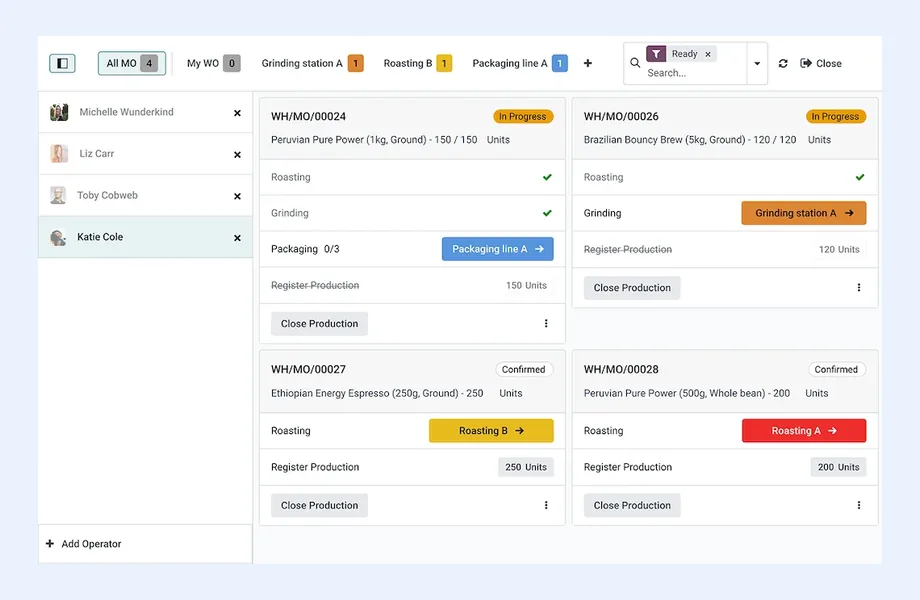
Edition choice shapes what the plant gets. Community gives you the production engine itself. Inspection points, long-range demand planning, controlled BoM revisions and the operator touchscreen view are, to my knowledge, reserved for Enterprise. For a plant with buyer audits and frequent spec changes, Enterprise is usually the practical route. Check the current list for your version, and see the Odoo in Bahrain overview for hosting and localization.
Odoo Manufacturing fits many Bahraini downstream, packaging, food and fabrication businesses, but I recommend alternatives when:
When Odoo is the right answer, I stay on your side through selection and delivery. That means a production requirements document in plain business terms, proposals from Bahraini and regional implementers compared fairly, a configuration review with your planners, and acceptance tests your supervisors run themselves. I do not resell or take commission. Acceptance testing is described under ERP testing and UAT, and the Bahrain ERP consulting page and Bahrain hub for my wider advisory work.

Tell me about your business and current systems. I’ll suggest the most sensible first step.
Book a Consultation
Not sure which ERP you need?
Share your business requirements with me and I will help you understand the right process, architecture and platform before implementation.
FAQ
Yes. Process scrap can be recorded as a by-product of each manufacturing order and returned to stock with a value, so it is not lost from the books. Expected yield on the bill of materials then shows where actual consumption differs from plan, by run, die or product family.
Odoo can hold stock owned by a third party, keeping it outside your valuation. Production consumes the customer's material and returns finished goods that remain theirs, and a service product invoices the conversion. I test the flow on a real past toll order, including agreed scrap allowances.
Odoo can link lots, quality results and attached certificates from raw material to dispatch, which supports most buyer dossiers. The exact documents depend on the product and buyer, so I list each requirement early and confirm with you which ones Odoo should generate and which come from outside.
For job-based production with repeat items, yes: make-to-order jobs, bills of materials per customer item and waste recorded per run work well. Complex estimating for sheet layout and press time may need a specialist print system integrated with Odoo, which I assess during requirements.
Every business is different. Share where you are today and what you want to fix, and I’ll tell you honestly whether and how I can help.
Book a Consultation
Insights
 Book a Consultation
Book a consultation to talk through your processes, systems and goals. I’ll reply with practical next steps - no obligation.