Contact Info

 Zoho in Lebanon
What does hiring a Zoho consultant in Lebanon involve?
A Zoho consultant in Lebanon decides which Zoho apps a company needs, then sets up Zoho Books with the right base currency, a documented approach to any second exchange rate, VAT as tax rates your accountant confirms, and a separate organization for each company abroad. I do this independently and remotely, alongside whoever configures the apps, while your bilingual staff check Arabic and French templates.
Last reviewed by Vikas Saroj
Lebanese services firms, agencies and smaller trading houses often look at Zoho because it is quick to start: sign up, invite users and issue invoices within days. The difficulty shows later, when the accountant asks which rate a dollar invoice was booked at, or when a sister company abroad needs its own books and the owner still wants one group view.
As an independent Zoho consultant I have no commercial link with Zoho itself or with the firms that implement it. My work with Lebanese clients is remote and conducted in English, and it settles the design questions before anyone configures the apps: currency rules, tax rates, organization structure, document languages and who supports the system once it is live.
 What I Do
Most of the risk in a Lebanese Zoho rollout sits in a handful of design choices. These services deal with them before configuration starts.

I work out which Zoho apps your business needs now and which can wait, comparing Zoho One against individual subscriptions for Books, CRM, Inventory and Projects based on how your teams actually work.

Together with your accountant I fix the currency each organization keeps its books in, list the foreign currencies you trade in, and design how any additional rate used for management figures is captured and reported.

Your accountant defines the VAT treatment. I turn it into tax rates, item defaults and invoice fields in Zoho Books, then test each document type with real examples before go-live.

Each company in Lebanon or abroad gets its own Zoho Books organization. I define shared naming, intercompany invoicing rules and a consolidated view built in Zoho Analytics or a controlled reporting workbook.

For services firms and traders I link deals and quotes in Zoho CRM with estimates and invoices in Books, so pipeline, billing and collections tell the same story in each currency you use.

Whether a Lebanese firm, a regional provider or a freelancer configures Zoho, I review their scope, compare what they configure with the agreed design and lead user acceptance testing ahead of launch.
How I Work
Apps, entities and currency rules
 List companies and base currencies
Record rate practice with accountant
Collect invoice and receipt samples
Choose apps and licensing model
List companies and base currencies
Record rate practice with accountant
Collect invoice and receipt samples
Choose apps and licensing model
Configure and test in a trial organization
Tax rates and item defaults
Templates per document language
Deal to invoice flow
Trial imports of open balances
Go live and hand over
Opening balances reconciled
First month-end reviewed
Key users ready to train others
Support contact agreed
Zoho sells Zoho Books in several country versions, and the tax features differ between them. Before subscribing, confirm the version a new Lebanese account lands in and which tax options it actually gives you. Where no edition is specific to Lebanon, companies typically run a general edition and configure VAT themselves as tax rates, with a chart of accounts that the implementer or your accountant adapts from the default list. That is workable, but it means nobody has pre-built a Lebanese VAT return for you.
So I treat the tax layer as a design task. Your accountant confirms how local sales, exports, purchases, imported services and credit notes are treated, and I convert that into tax rates, item defaults and report filters that produce the figures they need. I do not interpret VAT law; the configuration follows their written guidance and is tested before go-live.
The same care applies to where your data sits. Zoho operates data centers in more than one region, and an account generally stays in the region chosen when it was opened. If a client, bank or group policy asks where records are stored, confirm the region before users start entering data, because moving an account later is not a routine change. The Zoho Books page covers the product itself.
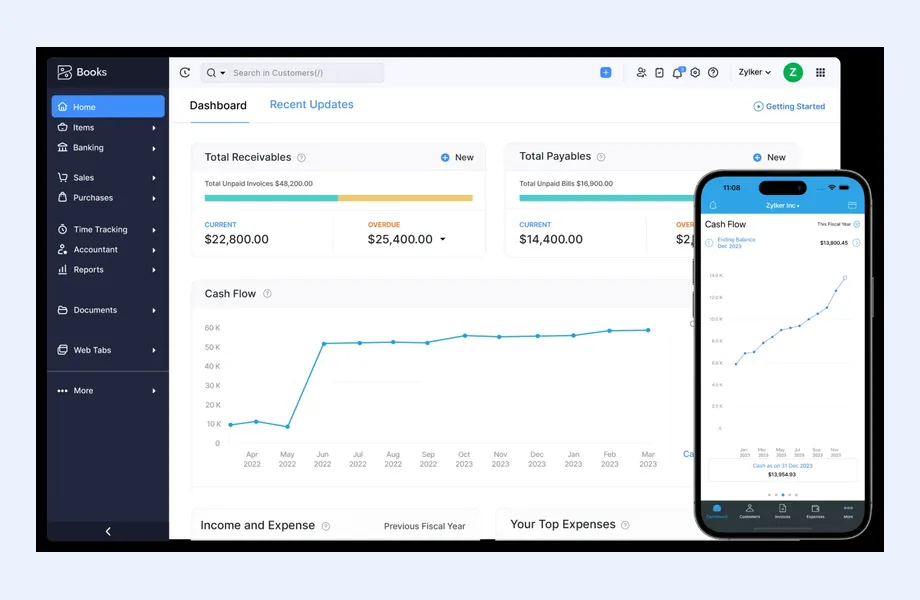
Zoho Books works with one base currency per organization and lets you invoice, bill and hold bank accounts in other currencies, converting each transaction at an exchange rate you enter or accept. For many companies that is enough. For a Lebanese business that also tracks another rate for management or reporting purposes, the standard setup does not hold two rates against one document, and that gap should be faced openly at the start.
I work through the options with your finance team and accountant:
Each option is tested with real invoices before go-live. If the rate rules are complex enough that none of these feels safe, that is a signal to compare other platforms, which I explain further down. For the wider design issues, read the multi-currency ERP page.
Lebanese trading, hospitality and services groups often own companies in other countries. In Zoho, every legal entity is normally set up as a separate Books organization carrying its own base currency, tax settings and numbering, which keeps local books clean and lets each country's accountant work in familiar terms. Zoho Books does not produce a consolidated group report with eliminations on its own, so the group picture is built as its own layer, typically an Analytics workspace reading from every organization, or a controlled workbook if the group is small.
Intercompany activity needs agreed rules: who invoices whom for management fees, shared staff or goods, the currency used, and the way each company books its side so the balances tie out. I write those rules down and test them before go-live.
For services firms and agencies, Zoho CRM often matters as much as accounting. I map how leads, proposals and signed engagements flow into estimates and invoices, so an account manager in Lebanon and a colleague in a sister company abroad see the same client record. For traders, Zoho Inventory may cover purchase orders, warehouses and basic landed cost handling depending on edition; I check its limits against your import volumes before you commit. The Lebanon ERP consultant page explains how I approach group design across platforms.
Customers, suppliers and authorities may expect a quotation, invoice or statement in Arabic, French or English. Zoho templates can be customized and the apps offer several interface languages, but right-to-left layouts, mixed-language lines and fonts need testing on real documents for each app you plan to use. I specify which document goes to which audience in which language; the implementer builds the templates; a bilingual person on your staff checks the wording and signs off. My own working language is English, so translation quality is judged by your team.
Migration is usually from spreadsheets or a local desktop accounting package. I decide with finance which customer, supplier and item lists move, which open invoices and bills are loaded, and how opening balances in each currency are reconciled against the old system before sign-off.
Support after go-live is the last practical question. Ask any implementer you consider how many Zoho projects they have delivered recently for companies like yours, who will handle changes once the project closes, and whether they work from Lebanon, elsewhere in the region or fully remotely. A short reference call with an existing client tells you more than a polished proposal. My ERP implementation page describes how I oversee that delivery for you.
Zoho is a sensible choice for many Lebanese clients, and I am direct about the cases where it falls short. Situations where I would look elsewhere:
Through an ERP evaluation I put your own transactions through every shortlisted platform and score what happens, which beats judging a vendor demo. The Lebanon hub and the global Zoho consulting page give more background.

Tell me about your business and current systems. I’ll suggest the most sensible first step.
Book a Consultation
Not sure which ERP you need?
Share your business requirements with me and I will help you understand the right process, architecture and platform before implementation.
FAQ
Check at signup, because Zoho's list of country editions can change. Where no edition is specific to Lebanon, businesses usually run a general edition with VAT configured as tax rates and a chart of accounts adapted by the implementer or accountant. That works, but return figures come from reports you design, so test them with your accountant first.
Each transaction in Zoho Books is converted at one rate into the base currency. If you also need an alternative rate for management purposes, it is usually stored in a custom field and reported through Zoho Analytics or a workbook. I test that approach with your accountant, and if it is not robust enough, we compare other platforms.
It depends on how many apps each person really uses. A services firm working across CRM, Books, Projects and a few other apps may find the bundle simpler to manage, while a small trader that only needs Books and Inventory may not. I map users to apps and compare the licensing models, without selling any subscription.
My role is advisory and oversight: requirements, design, implementer review, testing and handover. On smaller setups I can guide your internal administrator through the configuration step by step. Bigger rollouts are normally configured by an implementer, and my job is to confirm their work follows the signed-off design and your accountant's guidance.
Every business is different. Share where you are today and what you want to fix, and I’ll tell you honestly whether and how I can help.
Book a Consultation
Insights
 Book a Consultation
Book a consultation to talk through your processes, systems and goals. I’ll reply with practical next steps - no obligation.