Contact Info

 ERPNext in Lebanon
Which Lebanese companies are a good match for ERPNext?
ERPNext suits Lebanese companies that want open-source software they can host where they choose, with accounting, stock, buying, selling and projects in one system. An ERPNext consultant confirms how VAT templates, currency exchange records and a multi-company setup will work, decides between Frappe Cloud and self-hosting, and checks who will maintain the system. I provide that guidance independently and remotely, in English.
Last reviewed by Vikas Saroj
Some Lebanese owners reach ERPNext because they want control: no license fee for the software itself, freedom to host it themselves and access to the code if a change is ever needed. Others hear about it from a developer they trust. Both are reasonable starting points, provided the business requirements stay in charge of the final decision.
I am an ERPNext consultant working independently of Frappe and of every implementer. With Lebanese clients I settle the accounting design, hosting model and support arrangements first, then guide the build so the system treats your currencies, VAT and documents the way your accountant expects.
 What I Do
Open source gives Lebanese companies flexibility, and each service below turns that flexibility into a system someone can maintain.

I compare Frappe Cloud with a self-managed server on backups, update routines, monitoring, restore testing and who responds when the system slows down, then write the chosen arrangement into the support agreement.

I review the chart of accounts adapted for your company and the sales and purchase tax templates built from your accountant's VAT guidance, and test that every document type posts as expected.

I define the company currency, the currency exchange records you maintain, whether purchases and sales should use different rates, and how exchange gain or loss is posted and revalued at month-end.

Lebanese and overseas companies set up as separate companies on one ERPNext site, with shared items and parties where sensible, inter-company documents and a consolidated statement reviewed with your finance lead.

I specify invoice, quotation and delivery note formats for each language and audience. The developer builds them, and your bilingual staff confirm the Arabic or French wording before anything reaches a customer.

Before any change is built I ask whether standard ERPNext already does it. Anything approved lives in a custom app, never in core code, so upgrades stay manageable and another developer can take over later.
How I Work
Requirements, hosting and support model
 Requirements written with each team
Hosting options compared
Support provider identified
Currency rules agreed
Requirements written with each team
Hosting options compared
Support provider identified
Currency rules agreed
Build on a test site
Companies and adapted accounts
Tax templates per scenario
Print formats per language
Trial data imports
Go live with clear ownership
Balances reconciled at cutover
Backup restore tested
Internal administrator trained
Upgrade routine documented
ERPNext is open-source software built on the Frappe framework, and it can run in more than one way. Frappe Cloud, run by the company that builds ERPNext, is the managed option: it looks after servers, updates and backups, and you pick a plan and a hosting region. Self-hosting means your company or a provider installs ERPNext on a server you control, in a data center or on your own premises.
For a Lebanese business the decision usually turns on a few practical points:
I set out the options in writing and make sure the support agreement names who restores service and within what response window. For the platform as a whole, see ERPNext consulting.
ERPNext includes country-specific setups for a number of markets, sometimes as regional apps maintained by the community. Whether anything specific to Lebanon is available for your version should be checked directly; I would expect most Lebanese projects to begin from a standard chart of accounts that the implementer adapts with your accountant's input. VAT is configured through tax templates on the sales side, the purchase side and individual items, flexible enough to reflect the VAT treatment your accountant confirms.
Currency needs particular care. ERPNext keeps a company currency and lets you transact in others, using currency exchange records that can be flagged for buying, selling or both. That makes it possible to apply different rates to purchases and sales where your accountant's rules call for it, but the behavior should be tested in your version rather than assumed. My test cases include:
Tax law is outside my scope; I turn your accountant's guidance into templates and prove they work. See ERPNext Accounting for the finance features in more depth.
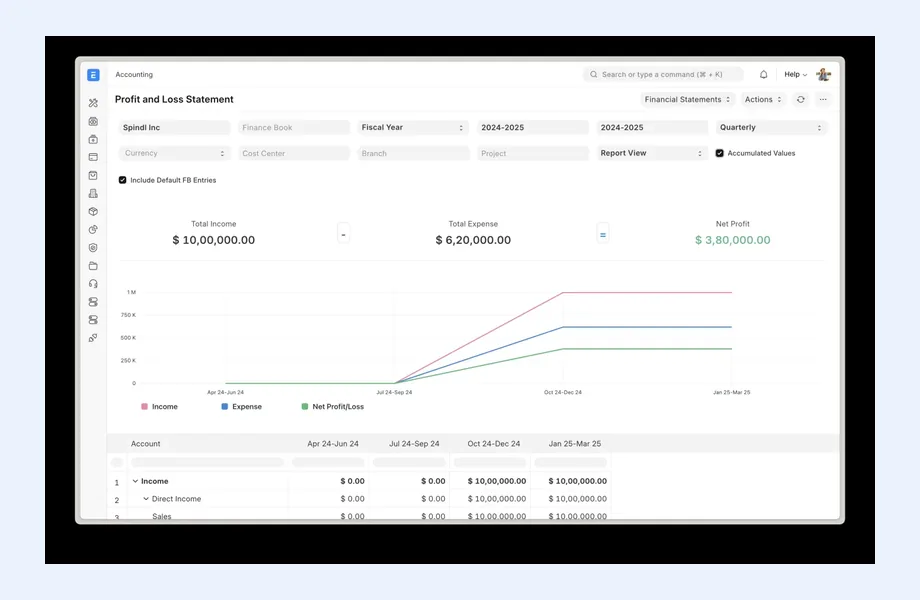
Several companies can share one ERPNext site while keeping separate charts of accounts, currencies, tax templates and naming series. For a Lebanese trading or services group with a company abroad, that means one login and one set of item and party records, while each entity keeps books its own accountant recognizes. ERPNext also offers a consolidated financial statement report across companies, which I review with your finance lead to see whether it meets management needs or whether eliminations call for an extra reporting step.
Intercompany activity runs through linked documents: a sales invoice in one company can create the matching purchase invoice in another. I define which transactions take this route, which currency each side records and how mismatches are investigated.
Permissions deserve the same attention. Staff in the overseas company should see only their own company, while group finance sees everything. I agree those rules with management and check them during acceptance testing, because a permission mistake discovered after go-live is harder to unwind. The multi-company ERP page explains the design questions in general terms, and the ERP consultant for Lebanon page covers group structures across platforms.
Lebanese ERPNext projects are carried out by specialist firms, independent developers or in-house IT staff who picked up the framework. Depth of ERPNext experience differs a lot between providers, so I ask each candidate for evidence of recent projects, how they handle upgrades and whether another developer could pick up their work.
Customization is the main long-term risk. Frappe makes it easy to bolt on fields, scripts and whole new doctypes, and that ease tempts teams to change too much. My rule is simple: standard features first, then configuration, then a custom app, and never edits to core code. Every approved change is logged with its reason.
Print formats are a common area of custom work. Lebanese companies may send invoices and statements in Arabic, French or English, and a separate print format can be prepared for each language, including right-to-left text. I list which document needs which version; the developer builds it; a bilingual colleague on your side reviews the wording.
Data usually arrives from spreadsheets or an older local accounting package, and ERPNext's data import tool handles masters and opening entries once the files are cleaned. Finally, an internal administrator is trained to manage users and routine settings. My implementation oversight covers all of this.
ERPNext rewards companies that are ready to own their system and frustrates those that are not. I would steer a Lebanese client elsewhere when:
I score each option on your scenarios through ERP gap analysis, and the Odoo vs ERPNext comparison shows the dimensions I use. For more on the market, see the Lebanon overview.

Tell me about your business and current systems. I’ll suggest the most sensible first step.
Book a Consultation
Not sure which ERP you need?
Share your business requirements with me and I will help you understand the right process, architecture and platform before implementation.
FAQ
The software is open source, so there is no license fee for ERPNext itself. Costs come from hosting, implementation, any custom apps, training and ongoing support. Those drivers can be significant, so I list them for each option instead of comparing a free download with a commercial subscription.
ERPNext offers interface translations, including Arabic with right-to-left layouts, but quality varies by screen and print format, so test the documents your customers will see. Your bilingual staff check the wording; I specify which documents need Arabic, French or English and confirm the formats exist before go-live.
Choose managed hosting unless someone in your company or a contracted provider will reliably handle updates, monitoring and tested backups. Self-hosting gives control over location and custom apps but moves all of that responsibility to you. I compare both options and write the outcome into the support agreement.
Currency exchange records in ERPNext can be marked for buying, selling or both, which helps where your accountant's rules separate them. Behavior can vary between versions, so I test invoices, payments and revaluation with real figures before anyone relies on it for live transactions.
Every business is different. Share where you are today and what you want to fix, and I’ll tell you honestly whether and how I can help.
Book a Consultation
Insights
 Book a Consultation
Book a consultation to talk through your processes, systems and goals. I’ll reply with practical next steps - no obligation.