Contact Info

 Australia
How does an independent CRM consultant help an Australian business?
An independent CRM consultant helps an Australian business design its CRM around the way it really wins work: state-based sales teams, distributors and buying groups, government tenders and supplier panels, and inbound phone and web inquiries. I define pipelines, routing and the handoff to Xero, MYOB or the ERP, check Spam Act and Privacy Act points with your advisor and compare platforms neutrally, all delivered remotely.
Last reviewed by Vikas Saroj
Australian companies often run separate sales teams in each state, sell through distributors and buying groups as well as direct, chase government and corporate work through tenders and supplier panels, and still take a large share of inquiries by phone. Put all of that into a CRM designed for one inbound funnel and the pipeline stops telling the truth.
My CRM consulting for Australian businesses is remote and tied to no platform. I begin with how revenue reaches you, write down who owns each kind of opportunity and how it moves, and only then compare products. No vendor or partner pays me, so the choice follows your sales model, your finance system and the people who will maintain the CRM.
The design also covers what happens after a deal is won: the customer details finance needs, the job or order created downstream, and the status information that should return to the salesperson.
 What I Do
Each piece of work leaves a document your team can use whichever CRM is chosen.

A written picture of direct sales by state, distributors, buying groups, tenders and inbound inquiries, with who finds, qualifies, wins and services the customer on each path.

A separate pipeline for tenders, expressions of interest and supplier panel applications, with submission dates, compliance documents, outcomes and the work actually awarded under each panel.

Rules for phone calls, web forms, quote requests, trade show leads and referrals: capture, deduplication, routing by state or postcode, and a response target agreed for each source.

A specification for how a won opportunity creates a customer, order or job in Xero, MYOB, the ERP or a job management app, and which statuses come back to sales.

Selection tests based on your advisor's position on the Spam Act, Do Not Call rules and the Privacy Act, covering consent records, unsubscribes, access controls and retention.

Vendors such as Salesforce, Zoho CRM, Odoo CRM and HubSpot asked to run your real scenarios, with scoring done by the sales and finance staff who will live with the result.
How I Work
See how each team sells
 Workshops with each state team
Map channels and lead sources
Review current CRM or spreadsheets
Agree leadership reports
Workshops with each state team
Map channels and lead sources
Review current CRM or spreadsheets
Agree leadership reports
Write the CRM blueprint
Pipelines, stages and territories
Routing and consent rules
Finance and job handoff
Shortlist and demo scripts
Oversee build and adoption
Check configuration against design
Clean and import records
Train teams state by state
Review usage and refine
Australian sales organizations are frequently shaped by geography. A business headquartered in Sydney or Melbourne may run its own team in Queensland, rely on a distributor in Western Australia and serve Tasmania and the Northern Territory by phone. Each arrangement needs different CRM rules:
I write a short process for each path, covering where records originate, what qualifies them, which stages apply and who owns the customer once won. Leadership signs off the ownership rules before configuration starts. This is the step most often skipped, and it is the reason many Australian CRMs end up with a different stage meaning in every state.
Plenty of Australian buyers still pick up the phone, especially in trades, building supplies, equipment and services. A CRM design that only captures web forms misses a large part of the funnel, and managers end up judging marketing on incomplete data.
I design lead intake across every door the business has:
Routing then follows written rules: by state or postcode, by product line, by customer size or round-robin within a team, with a response target for each source and a report showing how quickly leads are actually contacted. Because paid acquisition is my second specialty, I can also connect campaign data to closed deals, as described under B2B lead generation and Google Ads management, so spend decisions rest on revenue rather than lead counts.
In many Australian businesses the CRM does not hand over to one system but to two: the accounting package or ERP for billing, and a job management or field service app for the work itself. If that handoff is manual, details are retyped, jobs start without the agreed scope and invoices go out with the wrong customer entity.
The handoff specification I write covers:
The links are built by developers or an implementation partner; I provide the mapping and acceptance tests, then check results with real deals. Bank, payroll and channel links around the ledger are the subject of my system integration consultant Australia page, and the CRM and ERP integration solution page explains the pattern.
Commercial emails and texts in Australia fall under the Spam Act, telemarketing to numbers on the Do Not Call Register has its own rules, and the Privacy Act and its principles apply to many organizations, with notification duties when certain data breaches occur. Whether and how each applies to your business is for your advisor to decide. I turn their position into capabilities that every shortlisted CRM must demonstrate, rather than leaving compliance to staff memory.
The tests typically include:
Data location is the other selection question. Some buyers prefer Australian hosting, and government suppliers may be asked about it directly. Each vendor provides written answers on hosting regions, subcontractors and security assurance, which go to your advisor. Product-specific setup is covered on my Zoho CRM Australia and Odoo CRM Australia pages.
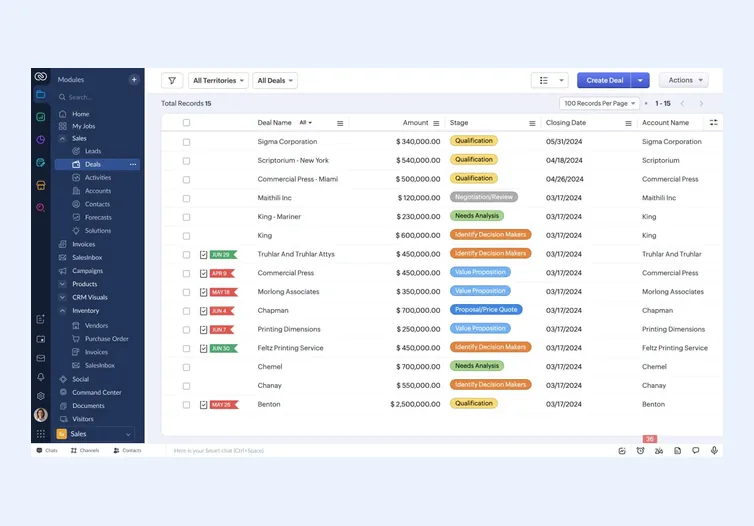
With sales paths, intake, handoff and privacy rules written down, the platform comparison becomes a test on your own ground. Your accounting system shapes it heavily: a business staying on Xero or MYOB needs a CRM with a reliable connection to it, while one moving to Odoo, Zoho or Dynamics 365 may prefer a CRM inside the same suite. Each vendor or partner demonstrates your scenarios: a tender won and converted, a buying group member ordering, a phone lead routed by postcode.
Reporting is defined during design. A national sales manager usually needs pipeline by state and channel, tender win rates, lead response times, quote conversion and forecast against target. Each measure is written down with its exact rules, so state managers compare like with like.
Adoption gets planned too. State teams are trained separately, with examples from their own pipeline, and usage is reviewed after launch so problems are fixed while habits are still forming.
The engagement is remote, with sessions scheduled inside Australian business hours across the eastern and western time zones; in-person visits can be arranged if needed. My fee is the only income from the work; vendors pay nothing. The underlying method is on CRM consulting; for ERP advice see my Australia ERP consultant page and the Australia hub.

Tell me about your business and current systems. I’ll suggest the most sensible first step.
Book a Consultation
Not sure which ERP you need?
Share your business requirements with me and I will help you understand the right process, architecture and platform before implementation.
FAQ
Usually yes. Tenders follow fixed dates, compliance steps and evaluation periods that do not match normal sales stages, and a panel appointment is not revenue until work is awarded under it. A separate pipeline keeps the main forecast honest and lets you measure tender win rates and the value actually drawn from each panel.
Keeping Xero and connecting a CRM is often sensible, as long as the connection handles customers, quotes and invoice status reliably. I check how each shortlisted CRM links to Xero, what needs middleware and what stays manual, and compare that with moving to a suite where CRM and accounting share one database.
No. That judgment sits with your legal advisor. My job is to give them evidence they can rely on: where each contact came from, what was agreed and when, and that unsubscribes and Do Not Call status are applied across every tool you use to contact people.
Remotely, team by team, using records from their own pipeline rather than demo data. Short sessions focused on daily tasks work better than one long overview. After launch I review usage reports by state, follow up with teams that are struggling and adjust the design where it creates unnecessary admin.
Every business is different. Share where you are today and what you want to fix, and I’ll tell you honestly whether and how I can help.
Book a Consultation
Insights
 Book a Consultation
Book a consultation to talk through your processes, systems and goals. I’ll reply with practical next steps - no obligation.