Contact Info

 Adelaide
Where does Zoho fit for an Adelaide business?
Zoho fits Adelaide businesses whose work is mostly relationships, records and follow-up rather than complex production: engineering firms pursuing work in the defense supply chain, small food and drink makers selling to independent grocers and markets, wind and solar developers managing landholders, and consultancies working under government panels. I advise remotely and independently: I select the apps, brief whoever configures them, test what gets built and say when a different product would serve better.
Last reviewed by Vikas Saroj
Zoho tends to suit the Adelaide businesses that win and keep work through relationships: engineering firms courting defense primes, small producers in the Adelaide Hills, the Barossa and the Fleurieu selling to independent supermarkets, energy developers working with landholders, and consultancies delivering government work under panel arrangements. Their main need is records people trust and follow-ups that do not slip.
I am an independent Zoho consultant with no partnership and no license commission. Working remotely, I map how each important record moves through the business, choose the Zoho apps that carry it and write a build brief for your administrator or implementer, then review what they build. Visits can be arranged when a session in person would help.
 What I Do
Each design starts from one record that matters to you, a pursuit, a store order, a landholder or a work order, and follows it to the invoice or decision.

Opportunities with primes and their suppliers held in Zoho CRM with each contact's role, every expression of interest and deadline, capability statement versions and signed agreements, while controlled information stays outside the CRM.

For small food and drink makers, Zoho Inventory and Zoho Books set up with store price lists, batch and best-before records, market day stock and invoices that match what each grocer expects to see.

For wind, solar and storage developers, a register of landholders, neighbors and community contacts with agreements, commitments and every conversation logged, so nothing promised at a kitchen table is forgotten later.

For consultancies, each government panel recorded with its rates and expiry, each request for quote tracked to a decision, and won work delivered in Zoho Projects against its budget and milestones.

Links to accounting, mapping, document storage or e-commerce tools designed with one owner for each record, so staff never have to wonder which system holds the true figure or the latest contact detail.

A written brief for whoever configures Zoho, followed by tests using your own records and plain notes on every field, rule and automation so that later changes can be made safely.
How I Work
List every tool and record today
 Spreadsheets, inboxes and apps
Who updates what, and when
Data worth bringing across
Records that must stay out
Spreadsheets, inboxes and apps
Who updates what, and when
Data worth bringing across
Records that must stay out
Decide apps, fields and automations
App choice per process
Fields, stages and permissions
Reminders and approvals
Build brief in writing
Test the build with your cases
Scripted tests with real records
Import checks and fixes
Short role-based training
Notes for future changes
Engineering, electronics and services firms around Edinburgh, Mawson Lakes and the Lefevre Peninsula put a great deal of effort into getting onto defense programs. The selling is unlike a normal pipeline. A pursuit may involve a prime contractor, several of its major subcontractors and a government program office, each with their own contacts, portals and timetables. Industry briefings lead to expressions of interest, supplier registrations, capability statements, non-disclosure agreements and sometimes teaming arrangements, often long before any purchase order appears.
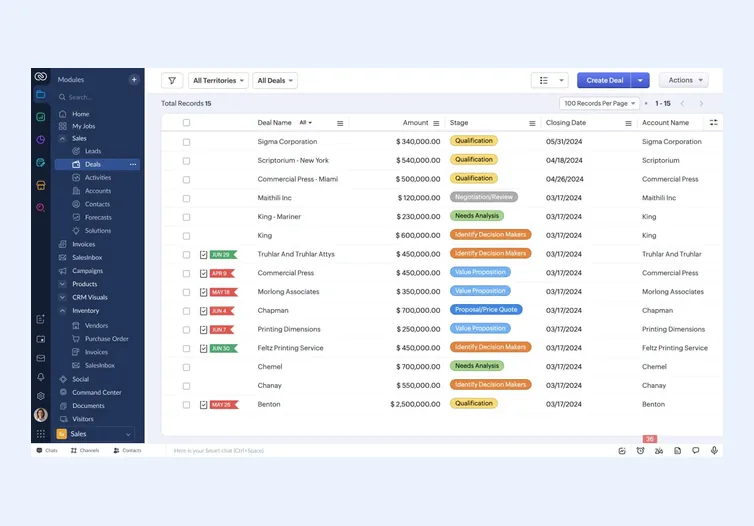
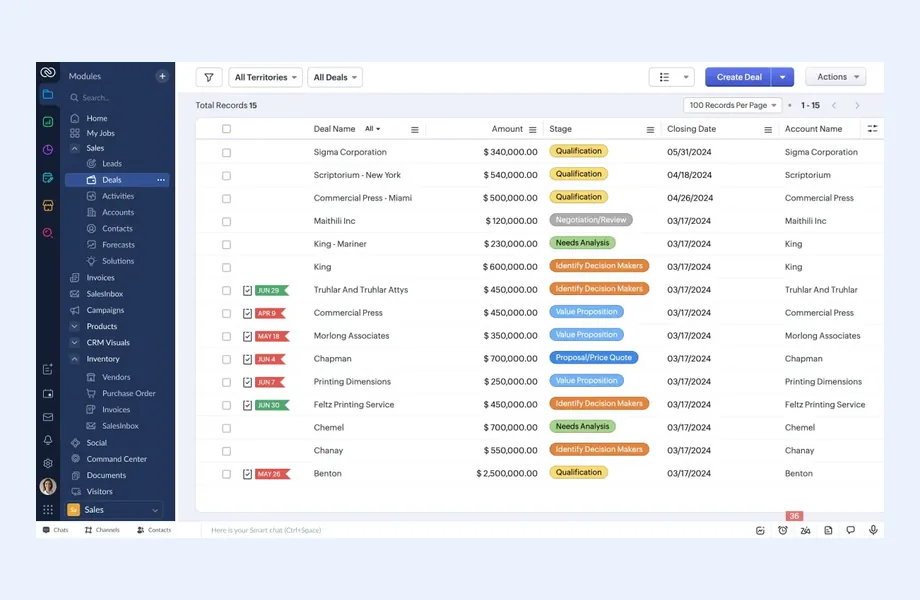
In Zoho CRM I design accounts that reflect those layers, with each contact's role and influence recorded and every pursuit linked to the program it concerns. Expressions of interest and tender submissions become dated records with owners and approval steps, capability statements are versioned so the team knows which one each prime received, and signed agreements are stored or linked against the right account. Reports show which pursuits are active, what is due next and where business development effort is going.
One boundary matters more than the rest. A cloud CRM should hold commercial relationship information only, and anything controlled, classified or export-sensitive stays out of it, as your security officer directs. The Zoho CRM page describes the product, and CRM consulting explains how a sales process is designed before anything is configured.
The Adelaide Hills, the Barossa and the Fleurieu are home to small makers of cheese, smallgoods, sauces, baked goods, chocolate, gin and much more. Many sell through a mix that suits South Australia: weekend farmers markets, shopfronts and tasting rooms of their own, online orders, and independent supermarkets, which can be more willing to stock local lines than national chains. Each channel brings different prices, paperwork and timing.
Zoho Inventory and Zoho Books can carry much of this for a small team. I set up price lists per store or buying group, batch and best-before records for products that need them, stock that leaves for a market day and comes back with whatever did not sell, and invoices that carry the order numbers and product codes each grocer asks for. Online orders can flow in from an e-commerce platform so stock is counted in one place.
A few points need care. Larger grocery customers may ask for barcodes, set invoice formats or electronic ordering, and those needs should be confirmed before the design is settled. Food safety records and labeling rules sit with your food safety advisor. If production itself becomes complex, with recipes, yields and multi-stage batches, a manufacturing ERP may serve better, as the Odoo consultant page for Adelaide discusses. Stock features are described on the Zoho Inventory page.
South Australia has built a reputation for wind, solar and battery projects, and developers working from Adelaide deal with far more than engineering. Before a project is built, they negotiate with landholders over options and leases, agree terms with neighbors, consult communities and councils, and make commitments about access, roads, fences and local benefits. Those relationships can run for years, through changes in project staff and even in ownership.
Zoho CRM can act as the stakeholder register at the center of that work. I design records for landholders, neighbors, community groups and agencies, linked to the parcels or project areas they relate to, with agreements, key dates and every interaction logged. A separate commitments register, often a small Zoho Creator app, tracks each promise made, who owns it and when it was met. Complaints and inquiries can follow a defined path with response dates so none sits unanswered.
Two limits apply. Mapping and land data belong in your GIS tools, with the CRM holding a reference to each parcel rather than trying to replace them. Landholder information is personal and sensitive, so access rules and retention follow your privacy advisor's guidance. The Zoho Creator page explains custom apps, and system integration covers linking the register to GIS and document tools.
State agencies, metropolitan councils and federal programs based in Adelaide buy a great deal of professional work through panel arrangements. Engineering, environmental, heritage, planning and technical consultancies in the city and its inner suburbs may sit on several panels at once, each with its own rate schedule, insurance conditions and expiry date. A place on a panel promises no work. Each request for quote still has to be won, and each engagement has to be delivered within the agreed rates and budget.
I design Zoho CRM so every panel is a record with its rates, conditions and renewal date, and every request for quote is tracked to a submission and a decision. Won work moves into Zoho Projects with its budget, milestones and assigned people, and timesheets show how effort compares with the fee. Zoho Books then invoices against the client's purchase order number, which public sector buyers commonly require before they will pay.
The value shows up in the reporting. Principals can see which panels actually produce work, how often quotes under each one succeed, and which engagements are overrunning before they turn into write-offs. The Zoho Projects page covers delivery tracking in more detail, and project costing explains how budgets and actuals are compared.
Some South Australian businesses outgrow what Zoho does well, or never fit it. Wineries managing vessels, blends and additions need dedicated winery production software or a manufacturing ERP alongside their sales tools. Manufacturers with routings, work centers and multi-level bills of materials are better served by a platform built for production, such as the one covered on the ERPNext page for Adelaide. Suppliers whose defense contracts call for formal configuration control and detailed contract costing should test heavier ERP options first.
Grain traders and marketers that manage positions, pools and grower payments generally rely on specialist commodity software, with Zoho at most handling customer relationships. Payroll for award-based workforces belongs in a dedicated payroll product, while payroll, tax and hosting questions that apply nationwide are covered by the Zoho in Australia page.
Running Zoho next to any of these systems for sales, service or stakeholder records can work well, provided each system owns its own data and the connection between them is designed rather than improvised. Zoho Creator makes custom apps quick to build, which is both its strength and its risk: an app nobody on staff understands becomes a liability when its builder leaves. Before anything custom is built, I weigh it against a standard app or a specialist product and record why the choice was made. The Zoho platform page gives the wider product picture.

Tell me about your business and current systems. I’ll suggest the most sensible first step.
Book a Consultation
Not sure which ERP you need?
Share your business requirements with me and I will help you understand the right process, architecture and platform before implementation.
FAQ
Yes. Each prime, major subcontractor and program office can be its own account, with contacts, roles, expressions of interest, submissions and agreements linked to the right pursuit. Reports then show what is due and where effort is going. Keep anything controlled or classified out of the CRM, as your security officer directs.
For many small producers it will. Store price lists, batch and best-before records, market day stock movements and invoices carrying each grocer's order numbers can all be set up. Confirm early whether any customer needs barcodes or electronic ordering, and consider a manufacturing ERP if recipes and yields become complex.
It can, with careful design. Landholders, neighbors and community contacts can be linked to parcels or project areas, with agreements, interactions and commitments recorded over the life of the project. Mapping stays in your GIS tools, and access to personal information follows your privacy advisor's guidance.
Record each panel with its rates, conditions and renewal date, then track every request for quote against it through to a decision. Won work moves into Zoho Projects with its budget and milestones, and invoices in Zoho Books carry the client's purchase order number. Reporting then shows which panels actually produce work.
Every business is different. Share where you are today and what you want to fix, and I’ll tell you honestly whether and how I can help.
Book a Consultation
Insights
 Book a Consultation
Book a consultation to talk through your processes, systems and goals. I’ll reply with practical next steps - no obligation.