Contact Info
 Odoo in SF
How can an Odoo consultant help a San Francisco hardware company?
An Odoo consultant helps a San Francisco hardware company judge whether Odoo can carry it from prototype builds to steady production, and how to set it up. That covers engineering changes and bill of materials revisions, components sent to contract manufacturers, serial numbers on shipped units and repairs that come back. I work remotely and independently, while your chosen implementation firm or developers do the build.
Last reviewed by Vikas Saroj
The Bay Area is home to many hardware ventures: robotics, consumer devices, lab instruments, energy and climate equipment. Most start with engineering spreadsheets and an accounting app, then need a real system once production orders, supplier lead times and shipped units pile up. Odoo is one of the platforms these teams consider because manufacturing, inventory, purchasing and accounting live in one database.
I help you test that fit against your actual product: how designs change, who builds the units, how you track each one after it ships. As a freelance Odoo consultant with no tie to Odoo or its resellers, I work remotely and write the design your implementer builds from.
 What I Do
Each item below targets a decision that hardware companies tend to get wrong when they configure Odoo in a hurry.

I test whether Odoo handles your build stages, from engineering samples to pilot runs and volume orders, using your own parts lists and supplier data rather than a generic demonstration.

I design how engineering changes are proposed, approved and released in Odoo, so purchasing and production always build from the right revision and old stock is handled deliberately.

When a contract manufacturer builds your product with components you supply, I map the subcontracting flow so inventory at their site stays visible and costs land correctly.

I define how serial numbers are assigned, which component lots are recorded against each unit, and how that history supports warranty decisions and field issues later.

I design the path for units that come back from customers: authorization, inspection, repair or replacement, and how the spare parts used in each repair are costed and reordered.

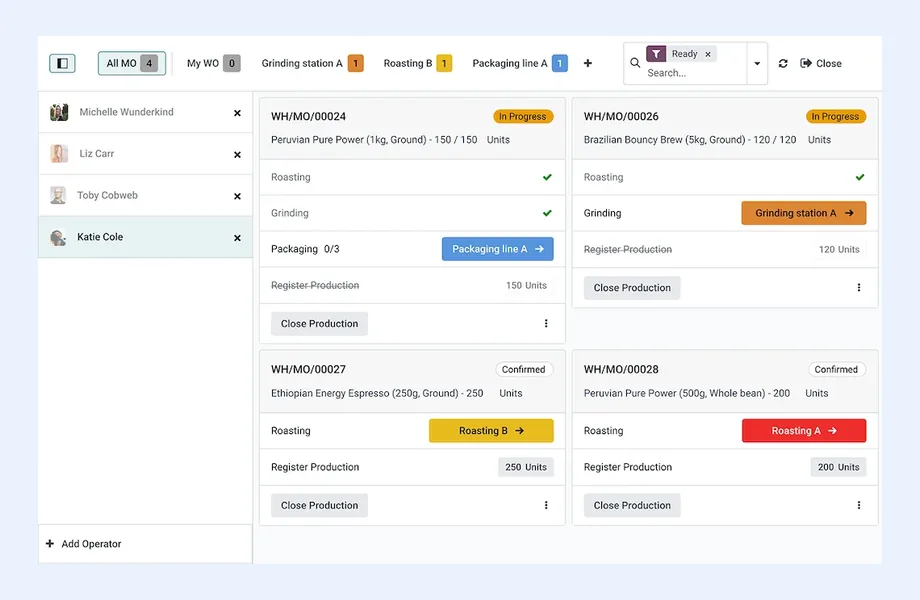
For roasters, bakers and other makers who ship on a recurring schedule, I connect subscription orders to production planning so batches match what subscribers will receive.
How I Work
Prove fit on your product
 Load a real parts list
Walk one change end to end
Run a subcontract order
Note gaps and workarounds
Load a real parts list
Walk one change end to end
Run a subcontract order
Note gaps and workarounds
Write what the partner builds
Revision and approval rules
Warehouse and location model
Serial and lot policy
Integration list and owners
Keep the build on course
Review partner configuration
Script acceptance tests
Check opening stock values
Support the first production run
Hardware startups in the region often grow out of a lab, a garage or a university spinout, and their first operating tools are an engineering spreadsheet for parts, a purchasing inbox and an accounting app. That holds until the company commits to its first serious production run. Then purchasing needs lead times, finance needs inventory values, engineering needs to know which revision is being built and support needs to know what shipped to whom.
Odoo appeals at that point because manufacturing, inventory, purchasing, quality and accounting share one database, and modules can be added as the company grows. It also tends to be quicker to stand up than larger manufacturing suites. The open question is whether its standard flows match your product and supply chain, or whether you will spend the first year building workarounds.
I answer that with a fit test on your real data: a genuine parts list, a recent engineering change, one subcontracted build. US accounting and sales tax considerations for Odoo are covered on the US Odoo page, and the wider manufacturing picture is on the manufacturing ERP page.
Early hardware products change constantly. A connector is swapped for one with better supply, a housing is redesigned after drop testing, firmware moves to a new chip. Each change affects what purchasing should order, what production should build, and what happens to parts already on the shelf or in transit. When those decisions live in email threads, companies build the wrong revision or write off stock they could have used.
Odoo's product lifecycle features let a team propose a change, route it for approval and release a new bill of materials version at a controlled moment. The configuration questions are the important part: who can approve which kinds of change, whether the new revision applies to open orders, how remaining stock of the old part is used up or scrapped, and how the change is linked back to the engineering files your team keeps elsewhere.
I work those rules out with engineering, operations and finance together, because each group feels a change differently. The result is a written change policy that your partner configures and your team can follow without guesswork. Some of these features, including engineering change management, may need Odoo's Enterprise edition, so I confirm which edition and apps your design depends on before you commit. More detail on the module itself is on the Odoo Manufacturing page.
Many Bay Area hardware companies do not run their own factory. They design in the city and rely on contract manufacturers in other states or overseas, often supplying key components themselves: a custom chip, a sensor bought in volume, a part with long lead times the company wants to control. That means valuable stock sits at a partner's site, and the company still needs to know how much is there and what it is worth.
Odoo supports subcontracting, where components are sent to a subcontractor and finished goods come back against a purchase order. I design how this runs for your partners: which components are consigned and which the manufacturer buys, how shipments to the partner are recorded, how yield losses and scrap are reported, and how the finished unit's cost picks up both your components and the build charge.
Where a contract manufacturer sends data electronically, the integration is scoped as its own piece of work. Where they send spreadsheets, the design sets out who checks them and when. Inventory structure across your own and partner locations is covered further on the Odoo Inventory page.
For many hardware products, the relationship with a unit continues long after it leaves the warehouse. A robot or instrument may be installed at a customer site, updated remotely and brought back for repair. A consumer device may be returned under warranty. Support teams need to see what was shipped, which component lots went into it and what has happened to it since.
In Odoo, serial numbers can be assigned at production or receipt and followed through delivery. I define the policy: which products are serialized, which components are tracked by lot within each unit, and how that history is recorded when parts are replaced. Without that policy, traceability exists on paper but answers few practical questions.
Returns and repairs are designed as a flow of their own: authorization, receipt, inspection, a decision to repair, replace or refund, and the accounting that follows. Parts consumed in repairs need costing and replenishment, and a pattern of failures should reach engineering, not just the support queue. Odoo includes repair and help desk features, and I design how they connect with inventory and manufacturing.
Not every San Francisco maker builds electronics. Coffee roasters, bakeries, chocolate makers and similar producers often sell on a recurring schedule to households and offices. For them the challenge is matching production to subscriptions: knowing on roasting or baking day exactly what subscribers will receive, plus wholesale orders for cafes and shops. Odoo's subscription and manufacturing features can be combined for this, and I design how the two meet.
Odoo is not right for every company, though. A hardware business that needs deep regulated quality processes, complex engineering data management or tight links to a dedicated product data platform may find Odoo too light in places. A software company with no physical product rarely needs its manufacturing features at all. In those cases I say so and suggest what to evaluate instead.
I work remotely and do not implement Odoo myself: a partner or your own developers build, and I keep the work tied to your requirements. For a comparison with another open platform, see Odoo vs ERPNext. For core finance questions in the city, the San Francisco ERP consultant page is the place to start.

Tell me about your business and current systems. I’ll suggest the most sensible first step.
Book a Consultation
Not sure which ERP you need?
Share your business requirements with me and I will help you understand the right process, architecture and platform before implementation.
FAQ
Odoo has product lifecycle features for proposing, approving and releasing bill of materials changes. Whether they are enough depends on how often your designs change and how tightly they must link to engineering files. I test that on a real recent change before you commit to the build.
Yes, through subcontracting flows where components are sent to the partner and finished goods return against a purchase order. I design which parts are consigned, how shipments and scrap are recorded and how the finished unit is costed, so stock at the partner's site stays visible.
Yes. Serial numbers can be assigned at production or receipt and followed through delivery, returns and repairs. The value comes from a clear policy on which products and components are tracked, which I define with your operations and support teams before anything is configured.
Not necessarily. If you roast to order, sell wholesale and ship subscriptions, connecting those to production can save real effort. For a very small operation, simpler tools may be enough. I look at your volumes and channels and recommend the lightest setup that works.
Every business is different. Share where you are today and what you want to fix, and I’ll tell you honestly whether and how I can help.
Book a Consultation
Insights
 Book a Consultation
Book a consultation to talk through your processes, systems and goals. I’ll reply with practical next steps - no obligation.