Contact Info

 Odoo in Boston
Is Odoo a good fit for Boston food, beverage and distribution companies?
Odoo can be a good fit for Boston companies that need inventory, production and accounting in one system without enterprise-level cost. Locally that includes seafood processors handling variable weights and short shelf lives, craft breweries tracking batches and returnable kegs, and distributors supplying reagents and consumables to Cambridge labs. I assess fit remotely and independently, and I flag where Odoo needs add-ons or is the wrong choice.
Last reviewed by Vikas Saroj
Not all of Boston's economy runs in labs and lecture halls. On the South Boston waterfront and in fishing ports along the coast, processors cut, pack and ship seafood that must move within days. Taprooms and distilleries across the city and its older mill towns brew in batches and track kegs that come back empty. And a quieter group of distributors keeps Cambridge laboratories supplied with reagents, plastics and consumables, often under tight delivery promises.
These businesses share a need for lot-level inventory, simple production and clean accounting in one place. I help them test whether Odoo meets that need, which edition and hosting option fits, and what an implementer should build. I work remotely as a freelance consultant and do not sell Odoo.
 What I Do
I test Odoo against the awkward parts of each business first, because that is where a system choice succeeds or fails.

I define how fish and shellfish are received by lot, broken down into cuts, packed by actual weight and invoiced, then test how Odoo handles variable weights with configuration, an add-on or custom work.

I map recipes, brew batches, packaging into cans and kegs, and the inventory records excise reporting depends on, then check how Odoo Manufacturing and Inventory carry each step.

I design how kegs, casks and other returnable containers are tracked to customers and back, with deposits on invoices and reports that show which bars still hold your containers.

For distributors serving research labs, I scope lot and expiry tracking, cold storage locations, fast replenishment and stock held on consignment at customer sites, then test them in Odoo Inventory.

I compare Odoo Community, Odoo Enterprise on Odoo Online or Odoo.sh, and self-hosted options against the apps you actually need, so licensing and support follow from requirements.

I write the requirement brief an Odoo implementer quotes against, check their proposal for missing data migration and testing, and review the configured system before you accept it.
How I Work
Find where Odoo might struggle
 List awkward scenarios
Collect sample lots and orders
Note compliance records
Agree what success means
List awkward scenarios
Collect sample lots and orders
Note compliance records
Agree what success means
Run your scenarios in Odoo
Demo with your own products
Test weights, lots and kegs
Check edition differences
Price add-ons and custom work
Decide and brief the build
Recommend go or no-go
Write the implementer brief
Review the proposal
Plan acceptance tests
Seafood businesses around Boston buy whole fish and shellfish, often from boats landing at local ports or from importers, then cut, portion, pack and ship to restaurants, retailers and wholesalers within days. Every case can weigh a different amount, every lot traces back to a landing or a supplier shipment, and every hour of shelf life matters.
Odoo handles lots and serial numbers well, and its inventory can record expiration and use-by dates. Selling by actual weight is harder. Many seafood companies price per pound but count cases, which needs two units of measure working together on one order line. Odoo can approach this with configuration, community add-ons or custom development, and the right answer depends on your volume and how your customers order. I test it with your real price lists and pack sizes before anyone commits.
Traceability matters too. Federal food traceability rules cover many seafood items, and buyers increasingly expect quick answers about where a lot came from and where it went. I design the receiving, processing and shipping records so a lot can be traced both ways. Which rules apply and when is a question for your food safety advisor. The US Odoo consultant page covers sales tax and QuickBooks migration, so I leave those aside here.
Greater Boston has a busy craft beverage scene, with breweries and distilleries in city neighborhoods and in former industrial buildings in nearby towns. They brew or distill in batches, package into cans, bottles and kegs, sell through their own taprooms and through distributors, and must keep records that support federal and state excise reporting.
In Odoo, recipes become bills of materials and each brew becomes a manufacturing order that consumes malt, hops, yeast and packaging. Lot numbers on finished goods let you trace a batch to its ingredients if quality questions arise. The taproom can run on Odoo Point of Sale, though some breweries prefer to keep a hospitality point-of-sale system and send daily sales to Odoo.
Kegs are the awkward part. They leave full, sit at bars for weeks and come back empty, sometimes carrying a deposit. I design how kegs are identified, recorded against customers and returned, and test reports that show which accounts are holding your containers. Excise forms themselves are prepared by your accountant or compliance service. My goal is that Odoo holds the production and removal data they need without a separate spreadsheet.
Research labs around Kendall Square, the Seaport and the suburban science parks consume a steady stream of reagents, plastics, gloves and small equipment. Distributors who supply them compete on speed and reliability: same-day or next-day delivery, correct lots and expiry dates, and cold chain for sensitive items.
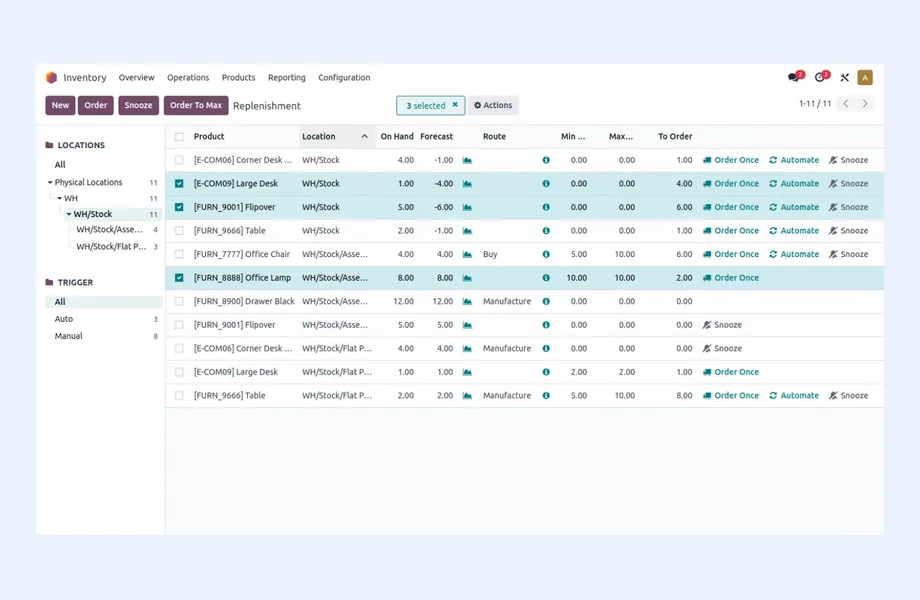
Odoo Inventory can model this with multiple warehouses and locations, including refrigerated and freezer zones, putaway rules that send items to the right storage, and replenishment rules that reorder automatically. Lot and expiry tracking supports first-expiring-first-out picking. Many lab suppliers also keep stock on consignment inside customer buildings, in stockrooms or vending cabinets, and invoice only when items are taken. That can be set up as customer-site locations owned by you, with consumption reported periodically.
Customer contracts often require punch-out catalogs or supplier portals connected to the client's procurement system. Odoo does not provide those out of the box, so I scope the integration work separately and check whether your largest customers use a portal that an implementer has connected before. I also check how product data from your manufacturers will be loaded and kept current, since catalogs in this trade are large.
Odoo comes as a free Community edition and a paid Enterprise edition, and Enterprise can run on Odoo Online, on Odoo.sh or on your own servers. For the businesses on this page, the choice usually turns on a few features. Barcode scanning in the warehouse, the Quality app and some manufacturing features depend on the edition, so I check each requirement against what your chosen edition includes rather than assuming.
Hosting matters for a different reason. Odoo Online is simplest but limits custom code. A seafood processor that needs a custom catch weight module, or a distributor that needs a procurement portal integration, will probably need Odoo.sh or self-hosting. That decision affects cost, upgrade effort and who supports the system.
Most Boston companies will hire an Odoo implementation partner for the build. I write the brief they quote against, review proposals for missing data migration and testing, and test the configured system with your scenarios before acceptance. I am independent of every partner, so I can tell you plainly if a proposal is oversized or skips something that matters. The Odoo platform page gives a broader view of the product.
Odoo covers a lot, but some Boston businesses need something else. A life science company manufacturing regulated products may need a system with established validation documentation and quality processes, along with a vendor and partner used to working under that scrutiny. Odoo can be validated in principle, but the effort and evidence fall largely on you and your implementer.
A large seafood or food company with high volumes, complex pricing contracts with retail chains and electronic data interchange requirements may find a food-specific ERP more comfortable. A distributor whose main differentiator is a sophisticated customer portal with contract pricing and punch-out to many procurement systems may outgrow standard Odoo quickly. And a very small brewery may be better served by brewery-specific software and a simple accounting tool until it adds distribution.
I would rather tell you this early than help you discover it after go-live. When Odoo is not the right fit, I compare alternatives on the same scenarios. For an open-source option with a different design, see ERPNext consulting in Boston, and for the regional picture the Boston ERP consultant page.

Tell me about your business and current systems. I’ll suggest the most sensible first step.
Book a Consultation
Not sure which ERP you need?
Share your business requirements with me and I will help you understand the right process, architecture and platform before implementation.
FAQ
Odoo can approach it, but it is not a native strength. Working with two units on one order line usually needs configuration, a community add-on or custom development. I test the options with your own price lists, pack sizes and customer orders, then recommend the simplest approach that your invoices and stock reports can rely on.
Yes, with some design work. Kegs can be tracked as serialized items or as returnable containers recorded against customers, with deposits on invoices if you charge them. I set up reports showing which accounts hold your kegs and how long they have had them, so collection runs can be planned.
It can model consignment as stock locations at customer sites that you still own. Consumption is then recorded, either from customer reports or periodic counts, and invoiced. I design how counts happen in practice and test the flow, including returns of expired items, before recommending it.
It depends on the features you need. Some warehouse barcode, quality and manufacturing features may depend on the edition, and hosting choices affect custom code. I check each requirement against what each edition includes and give you a clear comparison, so the choice follows from your needs rather than from a sales conversation.
Every business is different. Share where you are today and what you want to fix, and I’ll tell you honestly whether and how I can help.
Book a Consultation
Insights
 Book a Consultation
Book a consultation to talk through your processes, systems and goals. I’ll reply with practical next steps - no obligation.