Contact Info
 Odoo in New York
What does an Odoo consultant do for a New York company?
An Odoo consultant designs how Odoo apps run a New York company's production, stock, stores and books, then guides the rollout. In this city that often means small-batch makers in converted industrial buildings, food producers and distributors supplying restaurants, and retailers with a few neighborhood shops and an online store. I work remotely as a freelance Odoo consultant and keep custom code to a minimum.
Last reviewed by Vikas Saroj
New York still makes things. Furniture, food, cosmetics, printed goods, lighting and fashion accessories come out of workshops in Brooklyn, Queens and the Bronx, often from shared industrial buildings where every square foot is costly. Those businesses, and the shops and distributors around them, need production, stock and sales tied together without a large IT budget.
Odoo can do that because manufacturing, inventory, point of sale, ecommerce and accounting sit in one database. As a freelance Odoo consultant working remotely, I map how your goods are made, stored and sold, then decide which Odoo apps to use, how to configure them and what to leave out.
 What I Do
The work starts from your floor, kitchen or shop, not from a list of Odoo apps.

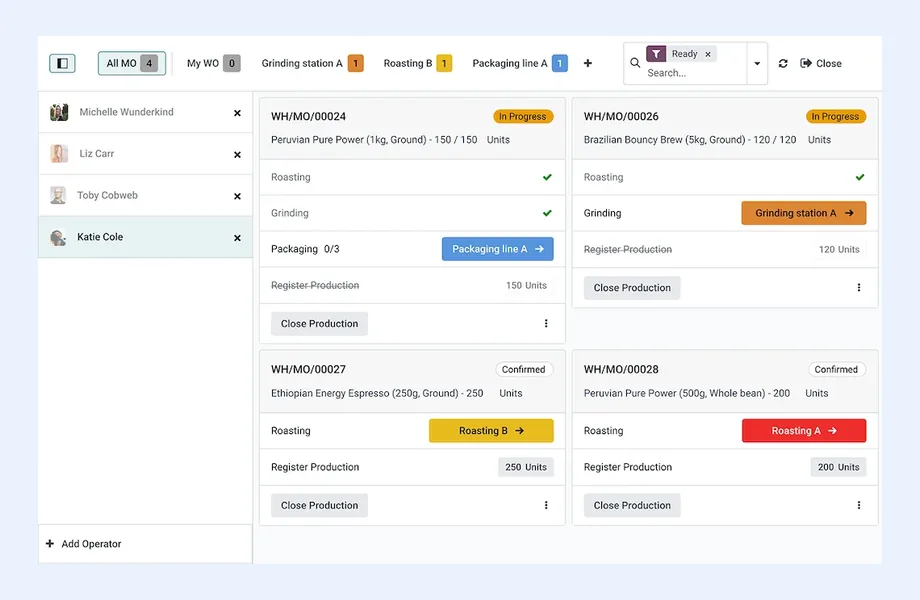
I set up bills of materials, work centers and manufacturing orders that match how a city workshop really runs: short runs, made-to-order pieces and a few skilled people moving between tasks.

For bakeries, sauce makers, roasters and other food producers, I design lot and expiry tracking from ingredient receipt to finished case, so a recall question can be answered from the system.

For distributors serving restaurants and grocers, I configure price lists, standing orders, delivery routes and credit holds so the late-night order rush does not depend on one person's memory.

For retailers with a few shops across different neighborhoods, I plan Odoo Point of Sale with shared stock, transfers between stores, and online orders picked from the nearest location.

Where stock sits in a New Jersey warehouse or a storage unit away from the workshop, I model locations, transfers and third-party logistics connections so on-hand figures stay trustworthy.

For businesses whose Odoo database has grown through quick fixes and modules nobody remembers installing, I review configuration and custom code, then write a plan to simplify it.
How I Work
See how goods really move
 Video walk-through of the floor
Trace an order end to end
List items, recipes and routes
Note space and storage limits
Video walk-through of the floor
Trace an order end to end
List items, recipes and routes
Note space and storage limits
Design and build in Odoo
Choose apps and edition
Set up products and routes
Design POS and online flows
Limit custom modules
Go live and settle in
Count and load opening stock
Test a full production cycle
Train floor and store staff
Review the first month
Manufacturing in New York looks different from manufacturing in an industrial park. Workshops occupy floors in former warehouses and shipyard buildings in places such as the Brooklyn Navy Yard, Sunset Park, Long Island City and the South Bronx. Space is tight, rents are high and production is often short runs, custom orders or small batches sold direct and to stores.
That shapes how Odoo should be configured. Bills of materials need to be accurate but not bureaucratic, because many products are variations on a theme. Work centers may be one bench and one machine rather than a production line. Planning has to handle made-to-order pieces with promised dates alongside stock items that are replenished when they run low. And because raw materials compete with finished goods for the same shelves, it matters that the system knows exactly what is where.
I start by watching a production cycle on video with the person who runs the floor. Then I configure Odoo Manufacturing and Inventory so a manufacturing order reflects the real steps, with components consumed as they are used and finished goods appearing in the right location. Custom code is kept to what the operation genuinely needs. The broader view of Odoo for American companies, including sales tax and hosting choices, is on my Odoo consultant page for the USA.
New York's restaurants, delis, grocers and cafes are supplied by a vast network of producers and distributors, from the large food markets in the Bronx to small bakeries, coffee roasters and specialty importers across the boroughs. Many of these businesses run on paper order books, phone and messaging orders taken late at night, and a driver who knows every customer's quirks.
Odoo can bring order to that world if it is set up with care. For producers, I configure lot and expiry tracking from ingredient receipt to finished product, so you can trace a batch quickly if a customer or inspector asks. For distributors, I design customer-specific price lists, standing orders for regular accounts, delivery routes, minimum order rules and credit holds for accounts that fall behind.
The hardest part is usually the order intake. Restaurants order at odd hours and by whatever channel is convenient. I map how orders arrive today and decide which can move to an online portal, which are best entered by staff, and how cut-off times work for next-day delivery. Food safety rules and their documentation are for your food safety advisor and the relevant inspectors to define; my job is to make sure the system holds the records they ask for. My food and beverage ERP page covers the wider process.
Many New York retailers have grown from one shop to a handful across different neighborhoods, plus an online store, with stock kept partly in the shops and partly in a storage space or third-party warehouse outside the city. Customers expect to see what is in stock, buy online and pick up locally, or return an online purchase in a store.
Odoo Point of Sale, Inventory and eCommerce share one product catalog and one stock picture, which suits this pattern. The design work is in the details. Each shop becomes a location with its own replenishment rules. Transfers between shops are recorded properly instead of carried across town in a tote bag and forgotten. Online orders are assigned to the location that can fulfill them fastest. Gift cards, loyalty and returns work the same way online and in store.
I also plan the practical side of point of sale in a busy city shop: offline behavior when the connection drops, hardware such as receipt printers and scanners, and how cash and card takings are reconciled with the books each day. Payment terminals and processors vary, so I check which ones connect to Odoo in your setup before anything is bought. The wider approach is on my retail ERP page.
New York's workshops, kitchens, warehouses and shops employ people who speak many languages at home, including Spanish, Chinese, Russian, Bengali, Haitian Creole and Korean. An ERP that only works well for people comfortable reading English menus can slow the floor down or push staff back to paper.
Odoo lets each user work in an interface language chosen from those installed in the database, while documents such as invoices and delivery slips can use the customer's language. That flexibility helps, but it needs planning. Some translations in Odoo come from the community and may be incomplete or awkward for your trade's vocabulary, so I suggest that bilingual staff review the screens your team uses most. Product names and instructions for production steps can also be stored in more than one language.
The engagement itself runs in English. Training materials for floor and store staff are written simply, with screenshots, and translated or checked by bilingual members of your team where needed. I keep the screens each role uses to a minimum, because a short, familiar workflow matters more than a full translation. This is one reason I prefer configuring standard Odoo screens over building custom ones, which then need their own translations and upkeep.
Odoo is a strong candidate for city makers, food businesses and multi-store retailers that want production, stock, sales and accounting in one place. It is a weaker fit for some New York companies. Professional firms that bill time and manage matters may find a services-focused platform simpler. Apparel wholesalers with heavy retailer compliance often need specialist tools for that side of the business. Companies with complex finance structures may prefer a platform with deeper consolidation.
I also look at who will support the system after go-live. Odoo has a large community of partners and freelancers, and quality varies. If an implementer is needed, I help you select one, review their proposal and check the build against your requirements. If your team is small, I can guide configuration directly and keep the database close to standard so future upgrades stay manageable.
If you are comparing Odoo with an open-source alternative, my ERPNext consultant page for New York covers the other side, and the Odoo vs ERPNext comparison sets out the trade-offs. For the overall systems picture, see my New York ERP consultant page, or get in touch to talk through your operation.

Tell me about your business and current systems. I’ll suggest the most sensible first step.
Book a Consultation
Not sure which ERP you need?
Share your business requirements with me and I will help you understand the right process, architecture and platform before implementation.
FAQ
Yes, for many small manufacturers. Odoo Manufacturing supports bills of materials, variants, work centers and manufacturing orders that can be triggered by sales orders or reorder rules. The key is keeping the setup as simple as the workshop. I configure it around a real production cycle rather than a generic factory template.
It can, with lot and expiry tracking, customer price lists, routes and credit controls. The success factor is order intake: how late-night phone and message orders get into the system before cut-off. I design that process with your team before configuring anything, and test it during a real order rush.
Odoo lets each user choose an interface language from those installed, and customer documents can be printed in other languages. Some translations need review, so bilingual members of your team should check the screens they use most. The engagement and core documentation run in English.
Yes. Point of Sale, Inventory and eCommerce share products and stock, so each shop and warehouse becomes a location with its own rules. I check payment terminal options, offline behavior and daily cash reconciliation for your setup before you commit to hardware.
The work is remote. I ask for a video walk-through of the floor, storage and shop, which is usually enough to design the system. A visit can be arranged in advance for go-live or a stock count if it would genuinely help.
Every business is different. Share where you are today and what you want to fix, and I’ll tell you honestly whether and how I can help.
Book a Consultation
Insights
 Book a Consultation
Book a consultation to talk through your processes, systems and goals. I’ll reply with practical next steps - no obligation.