Contact Info

 Odoo Inventory UK
How does an Odoo Inventory consultant help a UK business?
An Odoo Inventory consultant helps a UK business set up goods-in checks, courier and pallet dispatch, stock held with fulfillment partners or in the EU, customs duty in item cost, batch and best-before tracking, and a valuation method your accountant approves. I work remotely and independently, mapping how goods physically move in your unit before anything is configured in Odoo.
Last reviewed by Vikas Saroj
Many British wholesalers and online brands run stock from a single industrial unit, with an overflow arrangement at a fulfillment partner and sometimes a small holding of goods on the continent to serve EU customers. Stock usually lives in a Sage or Xero add-on, a courier portal and a few spreadsheets, and the numbers rarely agree at the end of the month.
Odoo Inventory can pull that together, provided the design follows the way your unit really works: how deliveries are checked at goods-in, when the courier collects, which items carry batch numbers or best-before dates, and how EU movements are documented.
I am an independent Odoo consultant and work remotely with UK operations managers and finance directors inside the UK working day. I do not resell licenses, so my recommendations on edition, apps and connectors are not tied to any sale.
 What I Do
The work below reflects the questions UK operations and finance teams bring to an Odoo Inventory project.

Deliveries checked against the purchase order and delivery note, discrepancies and damage moved to a quarantine location, and putaway driven by rules rather than memory.

Pick and pack routines organized around courier and pallet network collection times, so orders taken before the cut-off are ready when the van arrives.

Your own unit, an overflow store and a fulfillment partner set up as warehouses or locations with resupply routes, so buyers see availability across all of them.

Stock sent to an EU warehouse or partner modeled as its own warehouse, with the documents and tax treatment confirmed by your advisor reflected in the process.

Freight, customs duty and agent fees attached to each consignment and spread across the goods, while recoverable import VAT stays out of item cost.

Batch numbers, best-before and use-by dates where your products carry them, with first expired, first out picking and a traceability report you can run on request.
How I Work
Follow goods through your unit
 Goods-in walk-through
Courier and pallet schedule
Sites and partners listed
Batch and date needs
Accountant's valuation view
Goods-in walk-through
Courier and pallet schedule
Sites and partners listed
Batch and date needs
Accountant's valuation view
Build and test with real orders
Warehouses and locations
Receipt and dispatch steps
Landed cost on a consignment
Scanner trial at goods-in
Partner stock file test
Launch from a counted stock
Full count before cutover
Opening value agreed
Picker and buyer training
Cycle counts scheduled
Goods-in is where UK stock records usually start to drift. A supplier delivers short, a pallet arrives damaged, or a substitute product turns up with a different code, and the person receiving it books the full order to clear the screen. Odoo Inventory gives you a way to stop that: an input location where deliveries are counted against the purchase order, a quarantine location for anything that fails a check, and putaway rules that send accepted goods to the right bay.
Whether you need that extra step depends on volume and staffing. A small unit with one experienced storeperson may receive straight into stock. A busier site with temporary staff during peak season usually benefits from separating the count from the putaway, because errors become visible before stock is available to sell.
Dispatch in the UK is often shaped by collection times. Parcel couriers and pallet networks collect at set times, and orders taken before the cut-off are expected to leave that day. I design pick and pack operations so the warehouse sees which orders must go on the next collection, packs them with the right package type and weight, and confirms dispatch in Odoo as the van leaves. Where pallets go to retail distribution centers, I check booking-in requirements and paperwork with your customers as part of requirements, not after go-live.
Moving goods between your own UK sites is an internal transfer in Odoo and, in normal circumstances, not a supply for VAT. I set up each site as a warehouse with resupply routes so the main unit replenishes the overflow store or the fulfillment partner automatically when stock falls below the levels you set.
Stock held in the EU is a different matter. Since the UK left the single market, sending your own goods to a warehouse in an EU country generally means an export from the UK and an import into the EU, with customs formalities on both sides, and holding stock there may require a VAT registration in that country. Goods moving to or from Northern Ireland follow their own arrangements. I do not advise on any of these points. I make sure the Odoo design reflects what your tax advisor and customs agent decide, which usually means:
For UK and EU accounting configuration, my Odoo Accounting page for UK businesses covers the ledger side, and the UK Odoo overview covers editions and hosting.
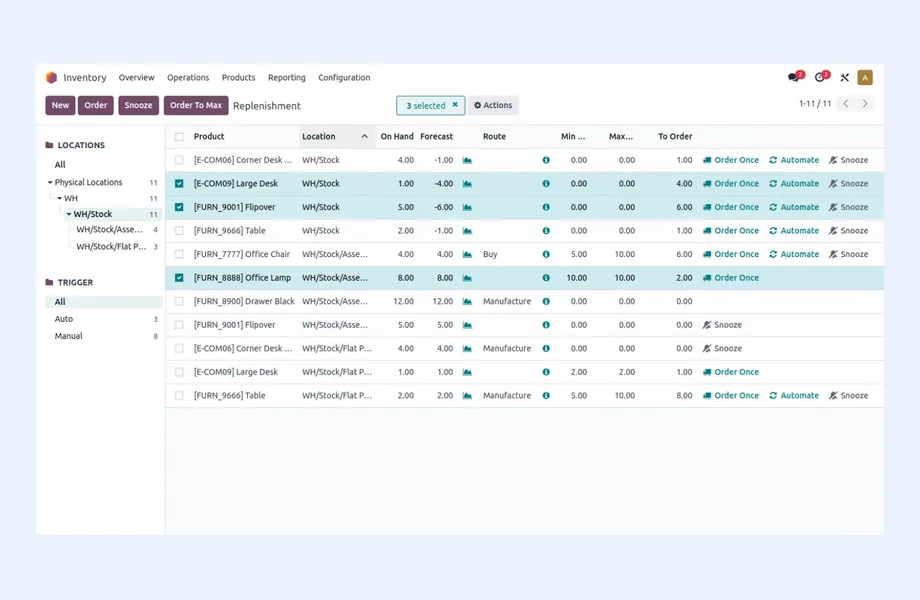
For a British importer, the cost of a consignment arrives in pieces: the supplier invoice, freight from the forwarder, the customs agent's fees, duty, port charges and haulage to your unit. Odoo's landed cost feature lets you attach those extra charges to the receipt and allocate them over the received lines with a split rule such as weight, volume, quantity or line value. I confirm early that your edition and setup include it as expected.
The point that needs most care is import VAT. It is a tax, normally recoverable, and it should not end up inside item cost. Many UK businesses account for it through postponed VAT accounting, others pay it through a deferment account or the customs agent. Whichever route your accountant uses, I keep import VAT on its own line in purchasing and accounting, and limit landed cost to the charges that genuinely belong in the cost of the goods.
Timing matters too. Agent and haulage invoices often arrive after the goods have been received and partly sold. I set up a simple routine for open consignments, so buyers and finance can see which shipments are still waiting for costs, and so duty changes show up in margin before your next price list goes out.
Odoo sets a costing method on each product category, a fixed standard, a running average or first in, first out, and either posts stock value to the ledger as goods move or leaves it for periodic journal entries. For a UK company, the closing stock figure in the statutory accounts comes from this choice, so I treat it as a finance decision that your accountant owns.
I do not offer accounting or tax advice. My part is to make the options concrete. I take a sample of your products, a month of purchases with duty and freight, and a month of sales, then show your accountant how each method values them and what the journal entries look like. Common findings:
I also plan the year-end routine with finance: when the full count happens, how count differences are approved, and how the valuation report is tied to the balance sheet. A year-end that depends on a separate spreadsheet is usually a sign the Odoo setup was never agreed with the accountant in the first place.
Odoo's Barcode app runs on handheld mobile computers and phones, and to my knowledge it is an Enterprise feature, so the edition decision comes before any hardware order. I trial devices at your goods-in and pick faces with your real labels before you commit.
Odoo offers shipping connectors for some large international carriers, mainly within Enterprise. Many UK couriers and pallet networks are reached through a third-party connector, a shipping platform you may already use, or API work. I list each carrier, what it needs from Odoo and how labels will print, and only then decide whether to integrate, replace or keep the existing tool.
Fulfillment partners usually share stock and dispatch confirmations by file or API. I define what is exchanged, how often, and who reconciles their stock report against Odoo when they differ.
For food, drink, cosmetics and supplements, batch numbers and dates matter. UK labeling uses both best-before and use-by dates, and they carry different weight, so I agree with you which date drives first expired, first out picking and when stock is blocked. Serial numbers suit equipment sold with warranties. Tracking is applied only to lines that need it, because every tracked item adds work at goods-in.
Odoo Inventory works well for most UK wholesalers, online brands and light manufacturers. I recommend looking at a specialist warehouse management system, linked to Odoo for orders and accounting, when:
In those cases I help define where Odoo stops and the WMS starts, write the interface specification and review proposals independently. See my pages for UK trading companies, warehousing and the ERP solution design service.

Tell me about your business and current systems. I’ll suggest the most sensible first step.
Book a Consultation
Not sure which ERP you need?
Share your business requirements with me and I will help you understand the right process, architecture and platform before implementation.
FAQ
Yes. The partner's site becomes a warehouse or location in Odoo, replenished by transfers from your main unit. Accuracy depends on how often the partner reports stock and dispatches back to you, so I agree a file or API exchange and a reconciliation routine that records adjustments with a reason.
Normally not. Because a VAT-registered importer can generally reclaim it, import VAT belongs in the VAT accounts rather than in item cost. Duty, freight and agent fees typically belong in landed cost. Your accountant confirms the treatment, and I configure Odoo so the two are kept apart from purchase order to ledger.
Odoo can store expiry-related dates on each lot and can be told to pick the soonest-expiring batch first. I agree with you which date drives picking and blocking, test it with real batches, and confirm what your current edition and version provide before the design is finalized.
For basic stock moves, routes and batch tracking, Community may be enough. Barcode scanning, carrier connectors and several quality tools sit in Enterprise in my understanding. Most UK warehouses that pick and pack daily end up needing them, but I compare Odoo's published edition list with your requirements before advising.
Odoo can hold it as a separate warehouse, and often as a separate company if you have an EU entity or registration. The customs and VAT treatment of each movement is a question for your advisor and customs agent; I make sure Odoo records the documents and values they need.
Every business is different. Share where you are today and what you want to fix, and I’ll tell you honestly whether and how I can help.
Book a Consultation
Insights
 Book a Consultation
Book a consultation to talk through your processes, systems and goals. I’ll reply with practical next steps - no obligation.