Contact Info
 Odoo MRP, South Africa
Is Odoo Manufacturing a good fit for South African manufacturers?
Odoo Manufacturing fits South African fabricators supplying mines and industry, and food processors running batches, when orders, bills of materials and work centers are modeled honestly, capacity reflects load-shedding and generator limits, lots are traced where buyers demand it and costing captures imported inputs in rand. Quality, PLM and maintenance may need Enterprise. I assess fit remotely and flag cases where specialist software would serve you better.
Last reviewed by Vikas Saroj
Two kinds of South African factory ask about Odoo most directly. One is the engineering or fabrication shop making conveyor parts, chutes, steel structures or rebuilt components for mines and industry, mostly to order. The other is the food processor producing bakery, meat, beverage or fruit products in batches with shelf life.
Both share a constraint few other markets plan for: production capacity that changes with the power supply. A plan that ignores outages is wrong before the week starts.
I work remotely as an independent consultant with production, planning and finance, during South African hours.
 What I Do
Six areas where the configuration decides whether planners trust Odoo or keep their own whiteboard.

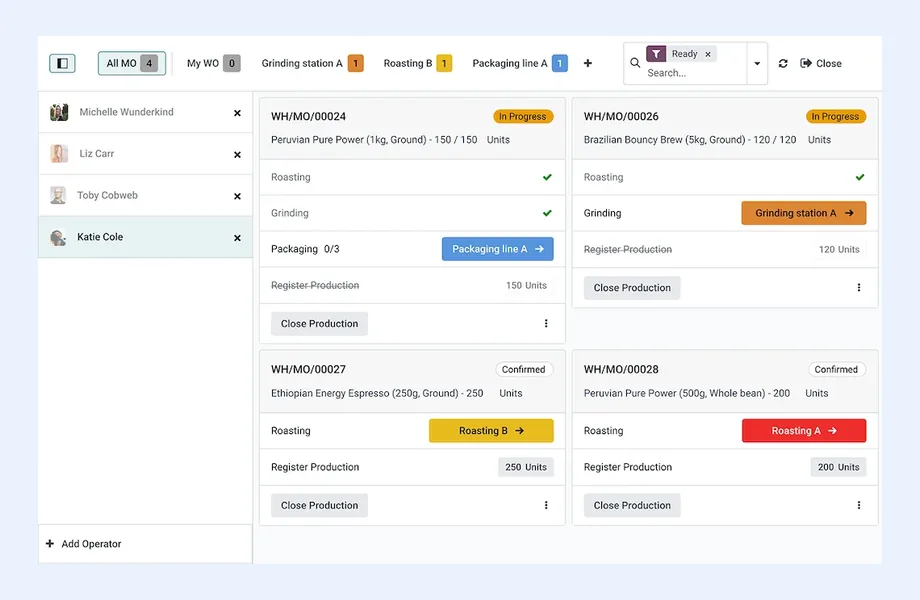
Make-to-order flows where a customer order or drawing creates a manufacturing order, with material bought against the job and actual hours recorded per operation.

Recipes with yields, by-products and packaging stages for food processors, with lot numbers on ingredients and finished batches and expiry dates calculated on production.

Work center calendars and capacity set so that planned outages, generator limits and shift changes are reflected, with a routine for replanning when schedules change.

Galvanizing, machining, heat treatment or contract packing sent to outside suppliers and tracked through subcontracting, so material at a supplier stays visible and costed.

Incoming, in-process and final checks set as quality points where your edition supports them, with test records and hold rules your quality manager signs off.

A costing method chosen with finance, imported steel or packaging costed with landed charges, and labor and overhead per work center reviewed against actuals each month.
How I Work
How orders really move through
 Order to dispatch walkthrough
Drawing and recipe samples
Outage impact on lines
Subcontractor list reviewed
Costing policy agreed
Order to dispatch walkthrough
Drawing and recipe samples
Outage impact on lines
Subcontractor list reviewed
Costing policy agreed
One family modeled end to end
BoMs and routings built
Capacity calendars set
Quality points trialed
Trial cost compared
Remaining lines and routines
Other families loaded
Planner replanning routine
Monthly variance review
Open issues owned
A fabrication or engineering shop supplying mining and heavy industry rarely makes the same thing twice. Work arrives as a purchase order with a drawing, sometimes a rebuild of a customer's worn component, and it has to be quoted, planned and costed per job. Odoo Manufacturing can run this as make-to-order: the confirmed sales order creates a manufacturing order, materials are purchased against it, and operations at cutting, welding, machining and painting work centers record actual time.
Design points I settle with your workshop manager:
Repair-heavy businesses may also use Odoo's repair features alongside manufacturing. The product overview is on the Odoo Manufacturing page, and broader job costing patterns are on job costing.
South African food processors, whether bakeries, meat and poultry processors, juice and beverage makers or fruit packers, deal with retailer audits and, for exporters, buyer traceability demands. Odoo holds the production and lot data that answers an auditor's question about where a batch came from and where it went. Food safety certification itself stays with your quality team and the certifying body.
How I usually model a batch plant in Odoo:
Two gaps come up repeatedly. Catch weight, where each case of meat or cheese has its own weight and price, is not native in Odoo and needs a module or scale integration. Disassembly, such as breaking a carcass into many cuts, works through by-products but needs careful costing design. I raise both before you commit. Related industry notes are on the food and beverage page.
Load-shedding turns production planning into a moving target. Lines without backup power stop; lines on generators may run at reduced capacity or only for priority products. Odoo plans manufacturing orders against work center calendars, so the plan is only as good as those calendars.
Approaches I discuss with your planner:
Hosting matters too. If Odoo runs on a server in the factory, an outage can stop recording just when it matters; cloud hosting with backup power on the network is often more dependable. The platform-level hosting discussion is on my Odoo consultant South Africa page.
Bills of materials, manufacturing orders and MRP planning are available in Community. Several features South African manufacturers ask for have been Enterprise apps in recent versions, each one to be verified for your version:
On costing, imported steel, packaging and components priced in dollars or euros make rand cost sensitive to exchange rates. Decisions I agree with your financial manager:
Import VAT and the ledger side of costing are covered on my Odoo Accounting South Africa page.
Specialist software deserves a serious look in these South African cases:
Often the answer is mixed: Odoo for sales, purchasing, inventory and finance, with a specialist system on the line. Because I am paid for advice rather than licenses, I compare these routes on their merits. For comparisons see ERPNext vs Odoo Manufacturing and best ERP for manufacturing; for system selection, the South Africa ERP consultant page. Stock design is covered on Odoo Inventory South Africa.

Tell me about your business and current systems. I’ll suggest the most sensible first step.
Book a Consultation
Not sure which ERP you need?
Share your business requirements with me and I will help you understand the right process, architecture and platform before implementation.
FAQ
Yes. A confirmed sales order can create a manufacturing order, with materials bought against the job and time recorded per operation, giving actual cost against the quote. One-off BoMs need a clear policy so records stay manageable. I model one job type end to end before wider rollout.
Odoo plans against work center calendars, so outages must be reflected there, and lines with backup power can be separate work centers. A planner still updates the plan when schedules change. I design the calendars, priority rules and downtime recording with your team.
Not natively. Products with variable weight per case need a third-party module, a scale integration or a specialist system. I raise this early and compare options, since it affects pricing, invoicing and stock valuation throughout the business, and the choice is harder to change later.
In recent versions, the shop floor interface, quality, PLM and maintenance apps have been Enterprise, while bills of materials and manufacturing orders are in Community. Because edition contents shift, the final list for your target version is checked with Odoo or your partner.
Every business is different. Share where you are today and what you want to fix, and I’ll tell you honestly whether and how I can help.
Book a Consultation
Insights
 Book a Consultation
Book a consultation to talk through your processes, systems and goals. I’ll reply with practical next steps - no obligation.