Contact Info

 Odoo Inventory in France
Which stock questions does Odoo Inventory raise for a French company?
For a French distributor, food or cosmetics producer or online brand, an Odoo Inventory consultant designs depots and routes, lots with use-by or best-before dates, links to logistics providers and dropship suppliers, intra-EU goods statistics data, and the year-end count your expert-comptable relies on. Localization and edition points need confirming with Odoo or the integrator. I handle the design remotely, tied to no vendor.
Last reviewed by Vikas Saroj
French companies that move to Odoo Inventory often hold stock in more places than they admit at first: a main depot, a showroom, a logistics provider handling e-commerce orders, perhaps goods shipped directly from suppliers. Each place needs a clear role in Odoo, or the on-hand figures stop meaning anything.
I map where stock really sits and how it moves, then design warehouses, routes and lot rules that the depot team, the logistics provider and finance can all work with.
The work is remote. A depot visit can be arranged when the layout is hard to understand from plans and photos.
 What I Do
These services concern stock and logistics in Odoo; VAT, FEC and invoice formats are handled through the accounting setup.

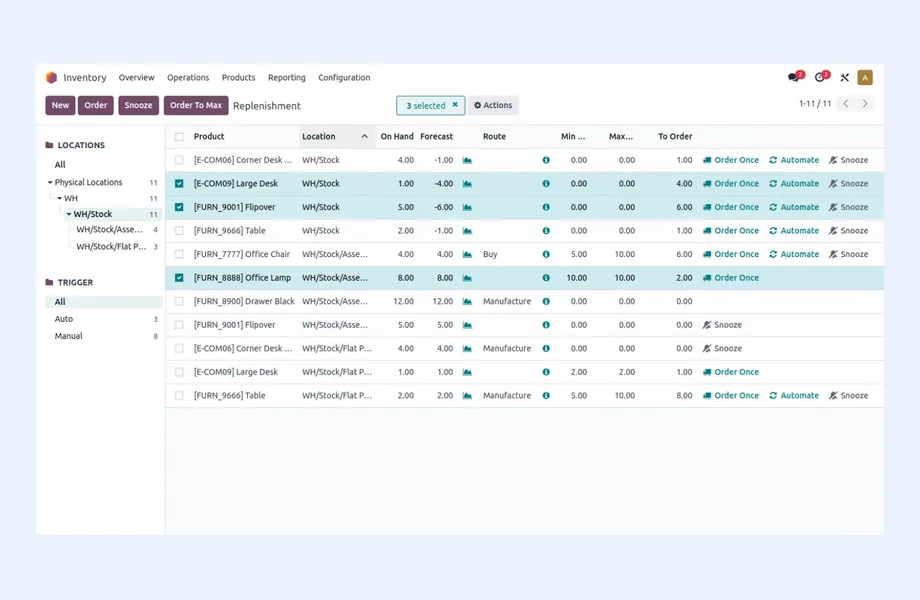
Warehouses, locations and routes for each depot, showroom and external warehouse, so on-hand figures show what is sellable and where it is.

Lot tracking with use-by or best-before dates for food, cosmetics and similar goods, with picking by earliest expiry and a tested withdrawal query.

Orders, shipment confirmations, returns and stock levels exchanged with a third-party warehouse, specified with data, timing and error handling.

Dropship routes for supplier-shipped goods and order flows from webshops and marketplaces, with connector edition and support confirmed in writing.

Valuation method and stock accounting agreed with the expert-comptable, plus a year-end counting procedure that leaves a clear audit trail.

Commodity codes, origin and transaction data on products and partners so intra-EU goods statistics can be produced where you must report.
How I Work
Every place stock sits
 Depots and showrooms
Third-party warehouses
Supplier-shipped goods
Returns and quarantine
Depots and showrooms
Third-party warehouses
Supplier-shipped goods
Returns and quarantine
Routes, lots and interfaces
Warehouses and routes
Lot and date rules
Provider data exchange
Valuation method
Proof before go-live
Opening stock reconciled
Withdrawal query tested
Provider files exchanged
Trial count reviewed
Odoo represents each physical site as a warehouse with its own locations and routes. In a French distributor that might mean a main depot near a logistics corridor, a regional depot, a showroom with display stock and a logistics provider's warehouse that ships online orders. Treating all of them as one location makes figures meaningless; treating each as fully separate can make transfers painful.
What I decide with operations:
For stock held by a logistics provider, Odoo needs to know what the provider holds, even if the provider's own system runs the warehouse. I define which system is the reference for quantities and how differences are investigated.
The general route concepts are on my Odoo Inventory consultant page. Here I focus on the multi-site reality many French companies have.
French food, drink, cosmetics and health product sellers distinguish between a strict use-by date and a softer best-before date, and customers in retail often expect a minimum remaining shelf life on delivery. Odoo can track products by lot and, with expiration settings enabled, carry several dates per lot, including an expiry date and an alert or removal date.
Points I settle with quality and sales:
A product withdrawal is the real test. Before go-live I select a lot and ask Odoo for its supplier, the receipt date and every customer who received it. The answer must arrive quickly and match the paper trail. If it does not, scanning discipline or configuration needs fixing.
Scanning lots at receipt and dispatch is far easier with the Barcode app, an app Odoo has historically placed in Enterprise; your integrator should confirm. If production consumes these lots, traceability continues in Odoo Manufacturing France.
Many French e-commerce brands and distributors hand part of their logistics to a third-party warehouse. Odoo stays the system where orders, stock value and invoices live, while the provider picks and ships. The interface between the two decides whether the arrangement works.
I specify each exchange:
Dropship routes let a supplier ship directly to your customer, with Odoo creating the purchase order automatically. Marketplace and webshop connectors exist for several platforms, but their scope, edition and support vary; I confirm each one in writing rather than assuming. Carrier connectors for French parcel services need the same check.
My ERP integration page explains how I write interface specifications, and e-commerce ERP covers the wider order flow.
Companies trading goods with other EU countries may have to file statistical declarations of those movements and recapitulative VAT statements, depending on their volumes and flows. Your expert-comptable confirms what applies. In Odoo, the data needed comes from product and partner records: commodity codes, country of origin, transaction nature, weight and the partner's VAT number. Odoo has offered intra-EU statistics reporting, historically as part of Enterprise; confirm scope and format for your version with Odoo or your integrator.
Delivery slips need their own review:
Invoices are created from orders and deliveries but follow the tax setup in Odoo Accounting. The move toward structured invoices in France, using formats such as Factur-X and exchanges through approved platforms, sits with the localization and the accounting configuration described on Odoo Accounting France. Inventory's role is accurate quantities and product data so invoices are correct.
Where the French localization does not provide something you need, such as excise movement documents for wine and spirits, a specialist add-on or separate software is usually required.
French companies count stock at year end, and the valuation feeds the annual accounts your expert-comptable prepares. Odoo supports periodic or automated stock valuation with standard price, average cost or FIFO. Which method you use, and how it posts, is a finance decision I implement and test.
For the year-end count I prepare:
Landed costs for goods imported from outside the EU, such as freight, customs duty and broker fees, can be allocated to receipts so product costs reflect reality. Import VAT is handled in accounting, not added to stock cost; your accountant confirms treatment.
Odoo Inventory reaches its limits with automated warehouses needing a specialist WMS, bonded or excise warehouses with regulatory movement records, or very high order volumes needing wave optimization. For simpler setups without manufacturing, Zoho Inventory in France may be enough. See Odoo consultant France for the platform decision and ERP consultant France for wider selection.

Tell me about your business and current systems. I’ll suggest the most sensible first step.
Book a Consultation
Not sure which ERP you need?
Share your business requirements with me and I will help you understand the right process, architecture and platform before implementation.
FAQ
Yes. With expiration settings enabled, Odoo lots can carry an expiry date plus alert and removal dates, and picking can favor the earliest expiry. I configure which date type applies to which products and test a withdrawal query before go-live so you can trace a lot to every customer.
Odoo remains the system for orders, stock value and invoices, while the provider picks and ships. An interface exchanges orders, confirmations, receipts and stock levels. I specify each flow, agree who owns differences and test the exchange with the provider before live orders go through it.
Odoo has offered intra-EU statistics reporting, historically in Enterprise and tied to version. Records must carry commodity codes, origin and transaction nature. Confirm scope and format with Odoo or your integrator, and ask your expert-comptable whether you must declare.
For stock, lots and sales, often yes. Excise duty and the movement documents tied to bonded warehouses usually need a specialist add-on or separate software. I check what your integrator proposes for that part before you commit to Odoo for the whole business.
Every business is different. Share where you are today and what you want to fix, and I’ll tell you honestly whether and how I can help.
Book a Consultation
Insights
 Book a Consultation
Book a consultation to talk through your processes, systems and goals. I’ll reply with practical next steps - no obligation.