Contact Info
 Odoo MRP in Australia
How do Australian manufacturers use an Odoo Manufacturing consultant?
Australian manufacturers use me to design Odoo Manufacturing around long import lead times, stock held in several states, the batch and use-by records that retailers and regulators expect, co-packers and outside finishers, and labor costs that change with shift loadings. I map the plant first, configure BoMs, work centers, replenishment and quality checks to suit, agree the cost method with your accountant, and work remotely across Australian time zones.
Last reviewed by Vikas Saroj
Australian manufacturers plan with a handicap many others do not share: key inputs such as packaging, resin, steel sections and ingredients often come from Asia or Europe, and a late vessel can stall a line weeks later. Odoo Manufacturing helps only if its replenishment logic is built around that distance, with lead times and buffers that reflect real arrivals.
Distance shapes the rest too. Finished goods move to warehouses in other states, food and cosmetics batches need use-by and best-before dates, and weekend or night runs cost more because of award loadings. Each of these is a configuration choice in Odoo, not something the defaults handle.
I work remotely with Australian manufacturers as an independent Odoo consultant, scheduling sessions inside your working day whether you are in Perth or Brisbane, and recording walkthroughs for shift leads who cannot attend live. You deal with me directly, from the first plant walkthrough to the first month after go-live.
 What I Do
Six pieces of Odoo Manufacturing design that matter most for Australian plants.

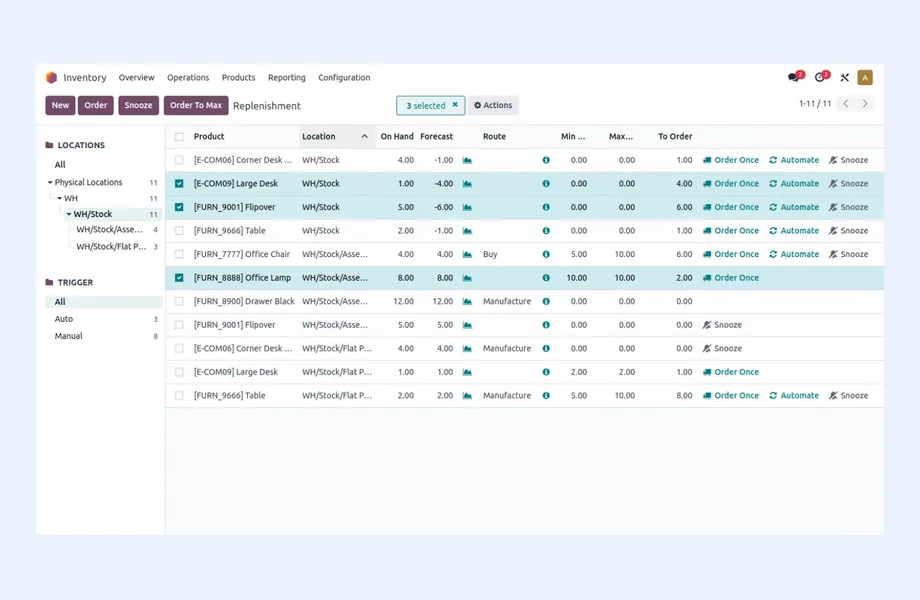
Supplier lead times, security days and minimum quantities set from real container arrivals, with planners working through the replenishment list and automating only items with reliable data.

Production in one warehouse with resupply routes to warehouses or third-party logistics sites in other states, so finished goods planning follows where demand actually sits.

Lots with use-by, best-before and removal dates, quarantine before release and quality checks at receipt and packing, designed with your food safety or QA lead.

Subcontracting BoMs for co-packers and contract blenders, and subcontractor locations for powder coating or galvanizing vendors, keeping material and stock at each third party visible in Odoo at any time.

Work center rates and labor cost rules that reflect night and weekend loadings where they matter to margins, agreed with your accountant while payroll stays in its own system.

Food recipes with yields and by-products, and fabrication BoMs for mining, agricultural and building products, structured so your own engineers can maintain and revise them after go-live.
How I Work
Supply chain and plant by video
 Supplier origins and transit
Warehouses across states
Batch and date rules
Third parties in the chain
Edition and hosting options
Supplier origins and transit
Warehouses across states
Batch and date rules
Third parties in the chain
Edition and hosting options
One product family, real data
Lead times from arrivals
Pilot BoMs and centers
Timed trace on pilot lots
Trial month cost check
Families added outside peak
Rollout outside peak season
Shift lead coaching
Monthly replenishment review
Ranked improvement backlog
In Odoo, purchase and manufacturing suggestions come from reordering rules, make-to-order routes and the lead times attached to suppliers and products. If those lead times assume a fortnight when the real figure is a long sea voyage plus port delays, planners see suggestions too late and stop trusting the system. For Australian plants I rebuild the planning data from evidence:
For seasonal products, such as food lines ahead of summer or agricultural equipment before planting, the Master Production Schedule in Enterprise lets planners set production by period and see component demand early enough to place import orders. Smaller ranges can manage with rules and manual orders. The mechanics are covered on my Odoo Manufacturing and Odoo Inventory pages.
Many Australian manufacturers make product in one location and hold it in warehouses or third-party logistics sites in other states. Odoo can model each site as a warehouse with resupply routes from the plant, so a reordering rule in Perth or Brisbane triggers a transfer from the factory warehouse, and the factory's own rules then trigger production. Set up well, the planner sees national demand driving production rather than guessing from the factory's stock alone.
Design points I settle with operations:
Where a logistics provider runs the remote warehouse, stock updates normally come through an integration or file exchange. I scope that with the provider early under ERP integration, because a manual daily spreadsheet quickly undermines the planning logic and puts planners back on guesswork.
Food, beverage, cosmetics and supplement makers in Australia work within the Food Standards Code or the relevant product regulator, and supermarket customers expect recognized food safety certification and fast recalls. Engineering suppliers to mining and infrastructure customers face their own inspection and certificate demands. The Odoo setup that supports this:
Allergen and specification management usually stays in a dedicated food safety system, with Odoo holding the operational record. During acceptance testing I run a timed trace from a finished batch back to ingredient lots and forward to customers; if it is slow in testing, it will be slower during a real recall. The approach is part of my testing and UAT work.
Australian brands often outsource part of production. A beverage or food company may use a co-packer, a cosmetics brand a contract blender, a fabricator a powder coater or galvanizer. Odoo's subcontracting handles this through a subcontracting BoM: you supply components, or have them delivered straight to the third party, and the receipt of finished goods records consumption and the service charge. For a finishing step between two in-house steps, I make the finished part its own item, so stock at the coater stays visible.
Labor costing is the other Australian specific. Award loadings make night and weekend production more expensive, and averaging that away hides which runs earn their margin. Odoo work centers carry an hourly cost, and depending on version employee costs can also apply to work order time. Options I discuss with your accountant:
Pay calculation and Single Touch Payroll reporting stay in your payroll system; Odoo only needs accurate hours by work order. The finance side is on Odoo Accounting Australia.
For Australian manufacturers, the Community versus Enterprise choice mostly comes down to manufacturing features. Quality, the Master Production Schedule, PLM, barcode scanning and the tablet shop floor screens are generally Enterprise, while BoMs, manufacturing orders, work orders and subcontracting are in Community. Check the current list on odoo.com, and if third-party modules are proposed to fill gaps, ask who maintains them through upgrades.
Odoo MRP is the wrong tool when:
In those cases I compare options neutrally before you commit, starting from ERPNext vs Odoo for manufacturing. The national Odoo picture is on Odoo consultant Australia, plant-level advice on manufacturing ERP Australia, and more on ERP consultant Australia and the Australia hub.

Tell me about your business and current systems. I’ll suggest the most sensible first step.
Book a Consultation
Not sure which ERP you need?
Share your business requirements with me and I will help you understand the right process, architecture and platform before implementation.
FAQ
Yes, if the data is right. Odoo uses vendor lead times, security days and reordering rules to time its suggestions. I set them from your actual purchase-to-receipt history and have planners review the replenishment list regularly, automating only the items whose lead times have proven reliable over several months.
Odoo can store use-by, best-before, removal and alert dates on lots and use them to avoid picking expired stock, provided the expiry features are active in your version. I configure the date rules with your QA lead and test them with real batches during acceptance testing.
Not automatically from award rules, which belong in payroll. Odoo costs work orders through work center hourly rates and, depending on version, employee costs. Where weekend loadings matter to margins, I set separate rates or work centers and agree the approach with your accountant.
Usually not as the production system. Blending, vessel tracking, volume changes and excise records are better served by specialist software, which can integrate with Odoo for accounting, sales and distribution. I assess which parts belong where before you commit to anything.
Yes. I work remotely and schedule live sessions within your working day across Australian time zones, with recordings for night shifts and other sites. Site visits are possible by arrangement, and I plan go-live outside your busiest trading weeks so the plant is not learning a new system under peak pressure.
Every business is different. Share where you are today and what you want to fix, and I’ll tell you honestly whether and how I can help.
Book a Consultation
Insights
 Book a Consultation
Book a consultation to talk through your processes, systems and goals. I’ll reply with practical next steps - no obligation.