
Contact Info

 ERPNext Accounting Singapore
When does a Singapore company need an ERPNext accounting consultant?
Usually when ERPNext must do more than record invoices: recognize subscription and support revenue over time, charge management fees to regional subsidiaries, revalue balances held in several currencies into Singapore dollars, apply GST templates your accountant has confirmed, and move cleanly off QuickBooks or Xero. I design and test that finance layer remotely, as an independent consultant.
Last reviewed by Vikas Saroj
Singapore technology firms, service providers and regional holding companies often pick ERPNext because it is open source and adaptable. Their accounting, though, is rarely simple: annual contracts billed upfront, costs shared with subsidiaries in Malaysia or Indonesia, and customers paying in US dollars while reporting happens in Singapore dollars.
I help finance leads configure ERPNext so those patterns are handled by the system rather than by month-end spreadsheets, then confirm the results with their external accountant. Delivery is remote, and I stay independent of developers, hosts and app vendors.
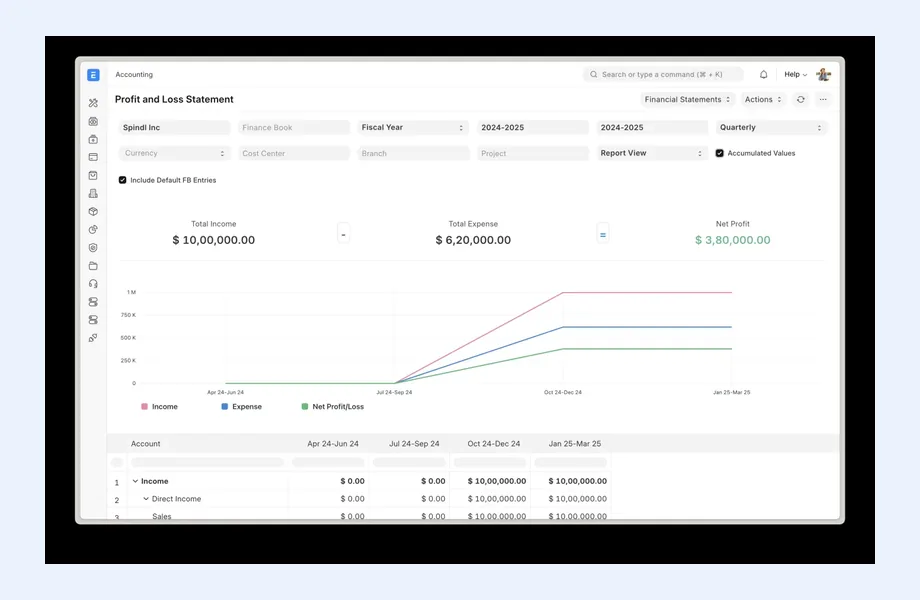
 What I Do
The work centers on revenue timing, group charges and currency, the areas where Singapore finance teams most often fall back on spreadsheets.

Subscription plans and schedules that raise invoices automatically for support, licenses or managed services, with renewals and cancellations handled without manual tracking in a separate list.

Items flagged for deferral so upfront invoices post to a deferred account and release monthly over the service period, with a schedule your accountant can review at any time.

Management fees, shared staff and software costs charged from the Singapore entity to its subsidiaries through intercompany invoices or journals, posted consistently on both sides each month.

Party accounts held in transaction currencies, actual bank rates applied on settlement, and a month-end exchange rate revaluation that restates open foreign balances into Singapore dollars.

Sales and purchase templates, item tax overrides and tax rules covering the GST cases your accountant confirms, with a trial return compared against an independently prepared version.

Chart, contacts, open invoices, deferred balances and fixed assets moved from QuickBooks Online or Xero, with each step reconciled and approved before the first live period.
How I Work
Contracts, entities and currencies
 Revenue streams catalogued
Recharge basis agreed
Currencies per entity
Accountant GST inputs
Revenue streams catalogued
Recharge basis agreed
Currencies per entity
Accountant GST inputs
Subscriptions, deferrals and templates
Subscription plans created
Deferral accounts set
Intercompany parties linked
Revaluation tested
GST trial return run
Cutover and a repeatable close
Opening balances reconciled
Deferred schedules loaded
First recharge cycle reviewed
Close calendar agreed
Singapore software companies, IT service providers and managed service firms commonly invoice annually or quarterly in advance. If ERPNext posts those invoices straight to income, revenue spikes in renewal months and the balance sheet understates what is owed to customers in future service.
ERPNext has two building blocks for this, and I combine them:
A few design questions need settling with your accountant: whether setup or onboarding fees are recognized immediately or spread, how mid-term upgrades and credits are handled, and how the deferred balance is reported by customer. GST timing generally follows the invoice or payment rather than the revenue release, though the accountant should confirm when GST becomes due on each kind of fee.
I test the full cycle on a few real contracts, including a cancellation and a mid-term upgrade, before go-live. The SaaS industry page covers the wider system landscape for these businesses.
A Singapore holding or regional headquarters company often pays for things that benefit the whole group: leadership salaries, software licenses, shared finance and HR teams, marketing. Those costs are then recharged to subsidiaries in Malaysia, Indonesia, Vietnam or elsewhere. The amounts, basis and documentation are matters for your accountant and tax advisors in each country; the bookkeeping is where ERPNext helps.
The pattern I set up:
Withholding, GST or local indirect tax on cross-border fees varies by country and arrangement; I capture what each advisor specifies in the templates rather than assume it. Wider group design questions are covered on multi-company ERP, and the platform view of regional subsidiaries on ERPNext in Singapore.
Singapore companies often hold receivables in US dollars, payables in euros or renminbi, and subsidiaries keep books in ringgit, rupiah or dong. ERPNext tracks each transaction in its own currency alongside the company currency, but the reporting view only works if revaluation and rates are disciplined.
The setup I agree with your finance lead:
For the group, each subsidiary reports in its own currency, and consolidated statements for the Singapore parent can be produced in Singapore dollars where charts are mapped consistently. I check those consolidated outputs on real data with your accountant before relying on them, especially when subsidiaries use different charts. Odoo's handling of the same questions is discussed on Odoo Accounting in Singapore.
ERPNext charges GST via transaction templates, with per-item overrides for exceptions and rules that pick a template from the party or address. The platform-level page already explains these building blocks; here the focus is the accountant's view.
Before go-live, I sit with your accountant and walk through every recurring transaction type: local sales, exports, overseas services bought in, imports, staff claims and intercompany recharges. For each we confirm the template, the GST account and where it should appear on the return. A trial return is then built from ERPNext test data and compared with one the accountant prepares independently. Where the standard reports do not match the return layout, I specify a custom report so filing does not depend on spreadsheet adjustments.
InvoiceNow, the Peppol-based network, is being phased into GST compliance by IRAS, and your accountant should confirm when it applies to you. For ERPNext the practical choices are an access point provider with an API, a regional or community app if a maintained one exists for your version, or a custom connector. Whichever route you take, clean UEN details and tax codes on customer and supplier records make the switch smaller. I evaluate the options with your developer rather than assume any one of them.
Many Singapore companies arrive at ERPNext from QuickBooks Online or Xero, often after adding a subscription billing tool or inventory app that no longer fits. The finance migration has a few Singapore-specific details on top of the usual steps.
Every step is reconciled to the source system's reports, with your accountant signing off the opening trial balance. The method sits on ERP data migration and QuickBooks migration. For product detail, see ERPNext Accounting. My wider Singapore work is on the Singapore hub and ERP consultant in Singapore.

Tell me about your business and current systems. I’ll suggest the most sensible first step.
Book a Consultation
Not sure which ERP you need?
Share your business requirements with me and I will help you understand the right process, architecture and platform before implementation.
FAQ
Yes. Items can be flagged for deferred revenue with a service period, so invoiced amounts post to a deferred account and are released monthly by a scheduled process. Combined with subscriptions for automatic invoicing, this removes most spreadsheet tracking. I test cancellations and mid-term changes before go-live.
Set each subsidiary up as an internal customer of the Singapore company, raise recharge invoices from Singapore and create the matching purchase invoice in the subsidiary from the same document. The basis and tax treatment of fees are for your accountant and advisors in each country.
I am not aware of built-in support in core ERPNext. Options include connecting to an InvoiceNow access point provider through its API, adopting a regional or community app only if someone actively maintains it for your release, or commissioning a bespoke connector. I compare them on maintenance, cost drivers and risk with your developer before choosing.
Yes, ERPNext offers consolidated reporting at parent level in the parent's currency, combining subsidiaries that keep their own books, provided charts are mapped consistently. Intercompany balances must agree first. I validate the consolidated output on real data with your accountant before you rely on it.
Every business is different. Share where you are today and what you want to fix, and I’ll tell you honestly whether and how I can help.
Book a Consultation
Insights
 Book a Consultation
Book a consultation to talk through your processes, systems and goals. I’ll reply with practical next steps - no obligation.


