Contact Info

 Saudi Arabia
How does a warehousing ERP consultant help Saudi warehouse operators?
I help Saudi distributors, retailers and 3PL operators design how large distribution centers receive, store, pick and count stock, including cold chain storage for regulated products, seasonal volume peaks and storage billing that must be e-invoiced. I map the floor processes, set requirements for locations and scanning, judge whether ERP warehouse features or a WMS fit, and support implementation remotely.
Last reviewed by Vikas Saroj
I work remotely with warehouse operators across the Kingdom: retailers and FMCG distributors running large distribution centers around Riyadh, Jeddah and Dammam, healthcare and food suppliers with cold chain storage, and contract logistics providers serving brands entering the Saudi market. Many of these buildings are new or recently expanded, and the system decisions made now will shape how they operate for years.
The pressures are specific. Demand swings with the religious calendar and the seasons, regulated products need batch and expiry control that holds up to inspection, workforce nationalization affects how teams are built and trained, and storage invoices must meet ZATCA e-invoicing requirements. I design the warehouse process around those realities first.
 What I Do
Each item reflects a recurring decision for warehouse operators in the Kingdom.

Zones, aisles, pick faces and reserve locations defined in the system to match a large building, with slotting rules that place fast movers near dispatch and replenishment triggers that keep pick faces filled.

Batch, expiry and serial capture for food, medicines and medical devices, hold and quarantine statuses, and the stock movement history that inspectors and principals expect to see on request.

Location capacity, overflow areas, pick strategy changes and temporary user setups prepared ahead of Ramadan, Eid and other peaks, so higher volumes run through the same scanned process.

System roles, guided scanner workflows and training material in Arabic and English, built so new operators become productive quickly and safely as teams grow and change.

Storage, handling and value-added charges defined as billable events per client and passed to invoicing that meets ZATCA requirements, so contract warehousing revenue is captured and issued correctly.

ERP warehouse functions and dedicated WMS options compared using scripted Saudi scenarios, with implementation proposals reviewed independently so the final decision rests on how your operation actually works.
What to Measure
An ERP for warehousing should make these numbers available without a spreadsheet. I design the data model and reports around them from the start.
Platform Fit
How I Work
Volumes, products and people
 Seasonal volume pattern review
Regulated product list
Zone and layout review
Team structure and shifts
Seasonal volume pattern review
Regulated product list
Zone and layout review
Team structure and shifts
Locations, controls and billing
Slotting and replenishment rules
Batch, expiry and hold rules
Billable events and e-invoice flow
WMS or ERP fit-gap
Remote rollout support
Arabic and English bin labels
Scanner UAT in each zone
Opening count by batch
Peak readiness rehearsal
Saudi retail and FMCG distribution centers often hold thousands of SKUs and serve store networks, wholesale customers and online orders from the same building. The floor layout usually includes bulk reserve racking, pick faces at ground level, a cross-dock area for store deliveries and dedicated zones for high-value or controlled items. The warehouse system needs a location model that mirrors this exactly, or pickers fall back on memory.
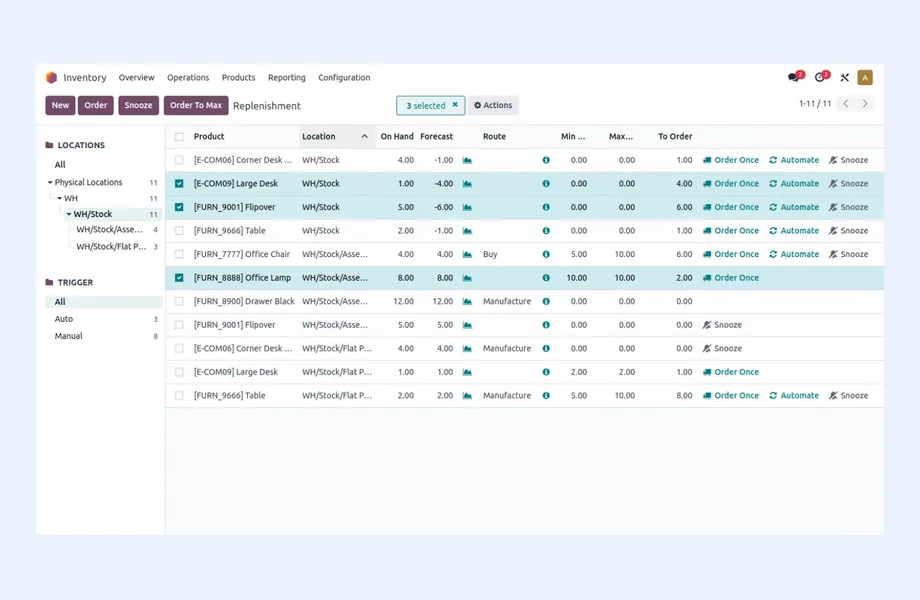
Slotting is where the system pays for itself. Fast-moving items belong close to the dispatch area at a comfortable picking height, slow movers further back and heavy goods low. Those positions change as demand changes, so I define slotting review as a recurring task driven by the system's own movement data. Replenishment from reserve to pick face needs triggers based on minimum quantities or on the next wave's demand; otherwise pickers find empty slots in the middle of a shift.
Store replenishment brings its own picking logic: orders for many branches released together, picked in waves and sorted by store at the dock. Online orders behave differently, with many small orders that suit batch picking. I map each order stream through process mapping before deciding which picking strategies the system must support. The Saudi distribution ERP page covers the commercial and route-sales side.
Food, medicines, medical devices and cosmetics stored in Saudi Arabia fall under SFDA rules on storage conditions, registration and traceability, and your regulatory or quality lead should confirm which apply to your products. Inside the warehouse, those requirements become concrete system behavior: every receipt captures batch and expiry, storage happens only in zones that match the product's temperature class, and picking follows first-expiry-first-out unless an authorized user overrides it.
The points I design and test for regulated warehouses include:
Principals and brand owners frequently audit their distributors' warehouses, and a clean answer to a batch trace request is one of the clearest signs of control. I include a mock recall in acceptance testing for that reason, run through testing and UAT with the quality team present. The Saudi pharmaceutical ERP page goes deeper on the regulatory side.
Saudi warehouses see demand swing with the calendar. Volumes for food and consumer goods build ahead of Ramadan and Eid, working hours shift during the holy month, and back-to-school and major shopping events add further peaks. Some operators also feel the pilgrimage seasons in the western region. Each peak tests whether the system can absorb more orders without more errors.
I plan peaks as a project: reviewing location capacity and overflow areas in advance, switching to wave or batch picking where order volume justifies it, preparing temporary user accounts with limited permissions and rehearsing a peak-day order load in the test environment. After each peak, a short review compares accuracy and throughput with normal weeks.
Workforce nationalization requirements and the growth of the sector mean many warehouses are hiring and training new operators continuously. That favors guided scanner workflows with Arabic and English screens, clear exception prompts and short task-based training rather than long classroom sessions. HR and compliance teams handle the employment rules themselves; I make sure system roles, training material and productivity reporting support the team you are building. Safety inspections, including civil defense requirements and racking checks, sit with your safety lead, but blocked locations should be reflected in the system immediately.
Brands entering the Kingdom often use a contract logistics provider before investing in their own facility, and many established distributors also rent space to principals. In both cases, storage and handling must be billed accurately from what happened on the floor. Rate structures commonly include pallet positions or area, inbound and outbound handling, order picking by line or unit, labeling and other value-added services, and premiums for cold storage.
I document each client's contract as a list of chargeable activities with their measurement basis, then decide where the calculation runs: in the WMS, in the ERP or in a billing layer between them. The calculated charges then flow into invoicing, which must meet ZATCA e-invoicing requirements. Whichever platform you choose, ask the vendor to show, in writing, how its e-invoicing solution handles your obligations, and have your tax advisor review the answer; the Saudi logistics ERP page looks at the invoicing questions raised by freight jobs.
Testing is practical: I take recent activity for a sample of clients, run it through the new rules and compare the result with what was invoiced. The gaps reveal both missing charges and contract terms that were never applied consistently. Clients also appreciate a stock report by batch and expiry on a regular schedule, which reduces queries and disputes.
Some Saudi warehouses operate in bonded areas or special logistics zones where goods can be held before customs clearance. If yours does, stock under customs control needs its own status and locations in the system, with clearance references captured as goods move into the local market. Your customs broker should confirm the documentation the authority expects.
On the platform question, a single-company distribution center with moderate complexity can often run on ERP warehouse functions with barcode scanning. A multi-client 3PL, a site with high e-commerce volumes or a building with automation tends to justify a dedicated WMS integrated with the ERP. I compare these using scripted Saudi scenarios, including a peak-day wave, a batch recall and a client storage invoice, as part of ERP evaluation.
Delivery is remote throughout, using video workshops, shared process maps and recorded walk-throughs of each zone. The general warehouse model sits in the warehousing ERP overview; Saudi engagement options appear under ERP consulting for the Kingdom, and the Saudi Arabia market section summarizes the wider business context.

Tell me about your business and current systems. I’ll suggest the most sensible first step.
Book a Consultation
Not sure which ERP you need?
Share your business requirements with me and I will help you understand the right process, architecture and platform before implementation.
FAQ
Start well before the season: confirm location capacity and overflow areas, decide whether picking switches to waves or batches at higher volumes, set up temporary users with limited permissions and rehearse a peak-day order load in a test environment. After the peak, compare accuracy and throughput with normal weeks to improve the next plan.
At minimum, batch and expiry capture at receiving, storage only in zones matching the product's temperature class, first-expiry-first-out picking, quarantine and recall statuses, and a trace report by batch. Your regulatory lead confirms the specific requirements for your products; I translate them into system rules and test them with a mock recall.
Yes, provided billable events are captured on the floor and the calculated charges feed an invoicing solution that meets ZATCA requirements. The design question is where the calculation happens: in the WMS, the ERP or between them. I define that, then test recent activity against what was actually invoiced.
It depends on your team. Many Saudi warehouses have mixed teams, and bilingual screens with short prompts and clear scan confirmations help new operators learn quickly. Check that the platform and any mobile app support Arabic properly, including right-to-left layouts on handheld devices, before committing.
Every business is different. Share where you are today and what you want to fix, and I’ll tell you honestly whether and how I can help.
Book a Consultation
Insights
 Book a Consultation
Book a consultation to talk through your processes, systems and goals. I’ll reply with practical next steps - no obligation.