Contact Info
 Odoo MRP in Poland
Is Odoo Manufacturing a good fit for Polish factories?
Odoo Manufacturing can suit Polish furniture makers, automotive part suppliers and contract manufacturers that need bills of materials, work orders, subcontracting and lot traceability linked to stock and accounting. The checks are how variants are modeled, how customer schedules arrive, which features need Enterprise, and how production cost posts to the Polish chart your accountant uses. I assess and design this remotely, independent of any implementer.
Last reviewed by Vikas Saroj
Much of Polish manufacturing builds to someone else's specification. A sofa plant makes models in dozens of fabric and color combinations for retailers abroad, a metalworking shop machines parts to a car supplier's drawing, and a contract manufacturer assembles goods under a foreign brand's label. Each of those models puts different pressure on Odoo's bills of materials, planning and costing.
I work remotely with Polish plant managers, production planners, quality engineers and controllers to decide whether Odoo Manufacturing fits their way of producing and, if it does, how it should be configured. The design starts from routing sheets, drawings and existing costing spreadsheets, not from Odoo's demo data.
I have no reseller agreement with Odoo and no tie to a Polish implementer, so I can tell you plainly when a specialist system would serve the shop floor better.
 What I Do
I focus on the parts of Odoo MRP where Polish plants tend to make costly early decisions.

Bills of materials structured for configurable products such as upholstered furniture, with variant-specific lines or separate BoMs chosen according to how many combinations you really sell.

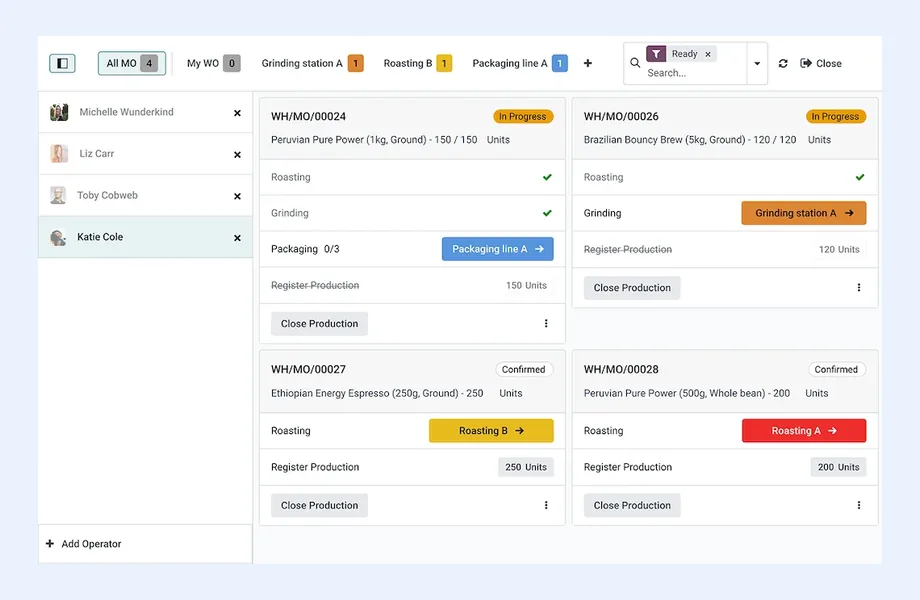
Cutting, CNC, sewing, painting, assembly and packing set up as work centers with operations, realistic capacity and cost rates that planners and controllers can both accept.

Outsourced coating, heat treatment or upholstery modeled with subcontracting BoMs, and work you do for others handled with customer-owned components, so stock and cost stay correct.

Lot tracking from raw material to shipped part, quality checks at agreed points and a recall trace your customers' auditors can follow, using Enterprise quality tools where licensed.

Standard or actual costing agreed with your accountant, work center rates, and variance posting designed so the Polish books and the group's margin reports read the same.

An honest view on whether Odoo, a Polish production system, a specialist MES or another ERP suits your plant, written up with the reasons before you commit.
How I Work
How each product family is made
 Routing sheets collected
Variant logic documented
Subcontract steps listed
Customer audit demands noted
Routing sheets collected
Variant logic documented
Subcontract steps listed
Customer audit demands noted
BoMs, work centers and costing
Pilot family BoMs built
Work center rates agreed
Traceability level chosen
Edition needs confirmed
Real orders through the plant
Pilot manufacturing orders run
Actual versus expected cost
Operator feedback gathered
Rollout by product family
Polish furniture producers face a modeling problem before any planning starts. A single sofa model can come in many fabrics, leg finishes and module arrangements. Creating a separate product and BoM for every combination quickly becomes unmanageable, while one generic BoM loses the detail the cutting room needs.
Odoo offers product variants with attributes, and a BoM can hold lines that apply only to certain variants. That works well when the number of attributes is moderate and each one changes a clear set of components. I test it against your real catalog, looking at:
If your configuration logic is very rich, for example with dimensions entered per order, standard variants may not be enough, and a configurator module or custom development must be weighed against upgrade cost. I put that trade-off in writing. Case goods plants with panels and edge banding raise similar questions about cutting optimization, which sits outside Odoo and usually stays in specialist software linked to it.
Polish suppliers to the automotive industry work to customer requirements that go well beyond a sales order. Buyers send delivery schedules electronically, expect part approval documentation, and audit traceability and quality systems against their own standards. Odoo can carry part of this load, but not all of it out of the box.
Where Odoo can help:
Where to plan extra work or another tool:
I map which requirements each customer actually imposes, then decide with you what Odoo holds and what stays in a specialist system. The general mechanics of BoMs and work orders are on the Odoo Manufacturing page.
Many Polish plants are on both sides of subcontracting. They make products for foreign brands, sometimes with materials the brand supplies, and they send their own parts out for galvanizing, powder coating, heat treatment or upholstery to nearby workshops.
For work you send out, Odoo's subcontracting BoM lets a purchase order to the subcontractor trigger the shipment of components and the receipt of the finished item, with the subcontractor's fee added to the product cost. I check with you:
For work you do for others, the key question is ownership. Materials supplied by the brand can be held with the customer as owner, so they are consumed in production without entering your valuation. Your fee becomes the sales price, and the cost report must separate your own components from theirs. Your accountant decides the VAT and accounting treatment of such arrangements; I make the stock and production records match it. The stock side of consignment is covered in more depth on Odoo Inventory in Poland.
Polish charts of accounts often record costs both by nature and by function, and finance teams may close the month with a cost of production calculation that predates any ERP. When Odoo starts posting production entries, controllers need to see how the system's figures connect to that routine, or they will keep the spreadsheet running in parallel.
With your chief accountant and controller, I agree:
Odoo values finished goods by the product category's method and posts consumption and production through the stock accounts. How those entries map to the Polish chart, and how they appear in JPK accounting data, is set with the localization described on my Odoo Accounting in Poland page. For job-level cost analysis see ERP for job costing.
A Polish plant evaluating Odoo should confirm the following with Odoo or the implementing partner before the scope is signed, because each changes the cost and the design:
I would look beyond Odoo when the plant needs finite scheduling across many interdependent machines, when a vehicle maker's supplier requirements dominate the system landscape, or when production is process-based with recipes and potency, as in chemicals or some food lines. A dedicated MES linked to Odoo, an ERP with a Polish production heritage, or a larger platform may fit better. The comparison of Odoo and ERPNext on production is on ERPNext vs Odoo for manufacturing. For Polish context, see Odoo in Poland, the Poland hub and ERP consultant in Poland.

Tell me about your business and current systems. I’ll suggest the most sensible first step.
Book a Consultation
Not sure which ERP you need?
Share your business requirements with me and I will help you understand the right process, architecture and platform before implementation.
FAQ
Often yes, using product variants with BoM lines that apply to specific attributes. It works best when attributes are moderate in number and each changes a clear set of components. Very rich configuration, such as dimensions per order, may need a configurator module, and I weigh that against upgrade cost.
Partly. Lot traceability, quality control points, PLM and maintenance can support audits, with Quality and PLM in Enterprise. Electronic delivery schedules need an integration, and approval packages or process control usually stay in specialist tools. I map each customer's demands before deciding what Odoo holds.
With a subcontracting BoM, a purchase order to the workshop drives component shipments and the receipt of the finished item, and the fee is added to product cost. I design whether components are sent per order or held at the subcontractor and how rejects are recorded.
It can, once costing methods, work center rates and variance postings are agreed with your accountant and mapped to the Polish chart. I run pilot orders and compare Odoo's cost with your existing calculation, so differences are explained before go-live rather than after the first close.
Every business is different. Share where you are today and what you want to fix, and I’ll tell you honestly whether and how I can help.
Book a Consultation
Insights
 Book a Consultation
Book a consultation to talk through your processes, systems and goals. I’ll reply with practical next steps - no obligation.