Contact Info
 Odoo MRP in Iraq
Can Odoo Manufacturing run an Iraqi bottling, milling or block plant?
Odoo Manufacturing can run many Iraqi plants, such as water and soft drink bottlers, flour mills, concrete block and precast yards, paint makers and packaging producers, when bills of materials, by-products, shift calendars, generator downtime and costing in dinars with dollar inputs are designed with care. Quality, PLM and shop floor screens need edition checks. I advise remotely and independently, and flag where a process system fits better.
Last reviewed by Vikas Saroj
Iraqi factories tend to make a few products in large volumes: bottled water and soft drinks, flour, blocks and precast elements, paint, plastic preforms and packaging. Their problems are rarely exotic. Packaging runs out before the line does, scrap is not recorded, the cost of a carton is guessed, and nobody can say how many hours were lost to power cuts last month. Odoo Manufacturing can bring those facts into one database with stock and accounts.
I advise from a distance and on my own account; Odoo is not my employer or my supplier, and no license or referral fee reaches me. I design production flows with the plant manager and the accountant, then test the implementer's configuration with your own recipes and shift patterns. The engagement runs in English, and Arabic or Kurdish labels and work instructions are approved by native speakers on site.
 What I Do
Each service below converts how a high-volume plant really runs into settings you can rehearse in a test copy before anyone relies on them.

Multi-level bills of materials for finished goods, semi-finished items such as preforms or syrup, and packaging, so every cap, label and film roll is planned and consumed.

Bran from milling, regrind from plastics and broken blocks recorded as by-products or scrap with a value, so real yields are visible instead of being absorbed quietly in stock counts.

Working hours per line that follow the real shift pattern, plus downtime reasons that include power loss, so planned capacity and reported output can be compared honestly each month.

Make-to-stock replenishment for fast movers, make-to-order for special sizes or colors, and realistic lead times for imported inputs arriving by sea or by road from neighboring countries.

Component, direct labor, energy and overhead costs agreed with the accountant, with dollar-priced imports converted at the rates finance maintains, then checked against the general ledger.

A list of the Enterprise-side tools your plant would actually use, from quality control points to tablet screens and demand scheduling, each verified with Odoo or the implementer.
How I Work
Lines, shifts and recipes
 Products and packaging listed
Lines and shifts recorded
Scrap and by-products named
Cost elements agreed
Products and packaging listed
Lines and shifts recorded
Scrap and by-products named
Cost elements agreed
Production cycles in staging
Semi-finished item produced
Finished run with packaging
Power downtime logged
Product cost reviewed
First live weeks
Opening stock by lot
Daily output reconciled
Downtime pattern reviewed
Cost variance explained
A water or soft drink bottler in Iraq often makes its own preforms, then blows, fills, caps, labels and shrink-wraps them on one line. A flour mill turns wheat into several grades of flour plus bran. In Odoo Manufacturing both fit a multi-level bill of materials: semi-finished items such as preforms or syrup are produced first, then consumed by the finished product order along with packaging.
The details that decide whether the plan works:
Master production scheduling, which plans demand by period across products, has been an Enterprise tool; ask Odoo or the implementer to confirm its status in your release. A smaller plant may manage with reordering rules alone. The food and beverage page covers the sector workflow, and stock design for inputs is covered under Odoo Inventory in Iraq.
Construction materials plants in Iraq, making concrete blocks, pavers, precast elements or paint, have different production logic from a bottling line. Output depends on molds and curing, batches are mixed rather than assembled, and a share of every run may be rejected. Odoo can model these if the routing reflects them.
The points I work through with the plant manager:
Units matter as well. Cement may be bought by the ton, aggregate by the truckload and blocks sold by the piece or pallet. I agree each conversion with purchasing and the yard, then run a full order from raw materials to pallets in staging. Customers on large projects may call off deliveries over months, which links to the sales and stock design. The manufacturing page outlines the general workflow.
Power supply shapes production in many Iraqi plants. Lines may run on the national grid, on site generators or a mix, and a switch-over can stop a filling line or a press. A production plan that assumes every scheduled hour is available will always look late. Odoo lets each work center carry its own working calendar, capacity, setup time and cost per hour, and operators can record downtime with a reason.
The design I propose:
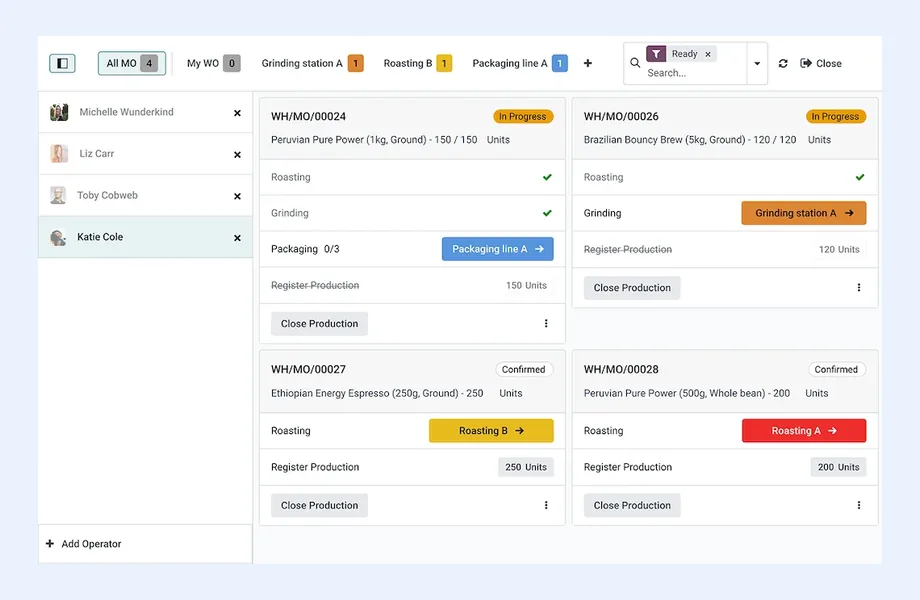
Tablet-based recording at the line belongs to the paid edition and only works while Odoo can be reached. A cloud database therefore needs two independent internet links at the plant, and an in-house server needs its rack, switches and wireless access points wired to the generator circuit. In either case I write a paper fallback so production during an outage is entered later. For groups with plants in both federal Iraq and the Kurdistan Region, each plant sits in its own company; semi-finished goods supplied between them follow intercompany rules set with finance.
Food and beverage producers, and any plant supplying international contractors or retailers, may be asked to show which input batches went into a finished lot. In Odoo, that works provided each raw material batch is numbered when it arrives and each production order logs which batches went in and which came out. The traceability report then follows a pallet of bottled water back to the resin, caps and water treatment batch, or a bag of flour back to the wheat lot.
Quality checks add control points along the way. The Quality app in Enterprise lets you define checks at receipt, during an operation or on finished goods, such as a measurement, a pass or fail result or a photo, and it can stop the order until the check is done. Without Enterprise, results are recorded through an added module or on paper with a reference on the order. Together with your quality lead I decide which checks cannot be skipped, who enters results and what a failed result triggers.
Certificates and labels often need Arabic, Kurdish or English, and some buyers ask for their own format. Template layout is the implementer's job. Wording in each language is signed off by plant staff who are native speakers, and the mandatory content comes from your quality lead, since it varies by product and destination.
Pharmaceutical production is a separate case. Where validated systems and controlled electronic records are expected, Odoo would need specialist review against the regulator's requirements before it could be relied on. The pharmaceutical page sets out those wider expectations.
Product cost in an Iraqi plant mixes dollar-priced imports, such as resin, concentrate, pigments or packaging film, with local costs in dinars, such as cement, labor and fuel. Odoo calculates cost from components, work center time and subcontracting, but imported components must arrive with freight and clearing already added through landed costs, or every finished item looks cheaper than it is. The company currency, the rate rules and the costing method, standard or an actual method such as average cost, are your accountant's decisions. I test a full month of production and confirm the valuation report agrees with the ledger.
Before choosing an edition, walk through each feature with Odoo or the implementer. Core production objects, meaning product structures, work centers, operations, by-products and outside processing, sit in the free edition of recent releases. Control and planning layers, such as inspection points, engineering change approval, operator tablets and period-based demand planning, have been paid features. Localization coverage for Iraq should also be confirmed, since it affects accounting rather than production.
Odoo may not be the best fit when:
The ERPNext and Odoo manufacturing comparison helps if the platform is still open. See Odoo in Iraq and the Iraq hub for wider context.

Tell me about your business and current systems. I’ll suggest the most sensible first step.
Book a Consultation
Not sure which ERP you need?
Share your business requirements with me and I will help you understand the right process, architecture and platform before implementation.
FAQ
Yes, with a multi-level bill of materials. Preforms are produced as a semi-finished item, then consumed by the finished product order along with caps, labels and film. I set up reordering rules for each level and test a full cycle so packaging shortages show up in planning before the line stops.
Operators record downtime against the work center with a reason such as power loss, using the shop floor tools your edition provides or a paper log entered later. Monthly reports then show lost hours by line. I agree the reason list and the fallback routine with your plant manager.
Yes. By-products are listed on the bill of materials with a share of the production cost, so they return to stock with a value. Your accountant decides the cost share. I test a production run and check that the main product and by-product costs add up to the total.
Inspection points, engineering change control, operator tablet screens and period-based demand planning have belonged to the paid edition. Product structures, work centers, by-products and outside processing are free. Because Odoo moves features between releases, I turn your plant's needs into a checklist that Odoo or the implementer signs off for the release you buy.
Every business is different. Share where you are today and what you want to fix, and I’ll tell you honestly whether and how I can help.
Book a Consultation
Insights
 Book a Consultation
Book a consultation to talk through your processes, systems and goals. I’ll reply with practical next steps - no obligation.