Contact Info
 Gurugram
Where does Odoo fit for Gurugram businesses?
Odoo fits Gurugram businesses that need stock, purchasing, sales and accounting tightly linked: component suppliers around Manesar working to kanban pulls with returnable bins, companies renting laptops and furniture to offices, cafeteria operators running kitchens inside corporate campuses, and distributors supplying offices with stationery and pantry goods. Working remotely as a freelance Odoo consultant, I design these flows and flag features that depend on the edition.
Last reviewed by Vikas Saroj
Gurugram has two large groups of customers: the vehicle and component plants around Manesar and the corporate campuses in the city. A whole layer of businesses supplies them, from component makers shipping parts in returnable bins to firms that rent out laptops, run office cafeterias or deliver stationery floor by floor. What they share is stock that must stay accounted for, wherever it sits.
As a freelance Odoo consultant working remotely, I design how Odoo's inventory, manufacturing, sales, point of sale and accounting apps should carry those flows, review what your implementer builds and point out early when a feature you need depends on the Enterprise edition or on custom work.
 What I Do
Each design starts from where the goods physically are, whether in your store, beside a customer's line, on a client's desk or in a campus kitchen.

Reordering rules, pull signals and dispatch planning for parts delivered to a vehicle maker or tier-one supplier several times a day, with stock at the customer's end tracked as its own location.

Bins, trolleys and pallets tracked as they leave with each dispatch and come back empty, with balances per customer, ownership recorded and losses visible before the customer's own reconciliation arrives.

Laptops, monitors, furniture and audio-visual kit rented to offices and events, with serial numbers, availability, pickups, returns, damage charges and refurbishment, using rental features that may depend on the edition.

Each client campus set up as its own location, with daily purchases, central kitchen transfers, point of sale for employee meals, client billing by meal count and food cost reported per site.

Client-specific catalogs and price lists, reorders placed through a portal by departments and confirmed by an approver, delivery to towers and floors, and consolidated monthly invoices per client entity.

I check which needs standard Odoo covers, which depend on the Enterprise edition and which would need custom modules, then review your implementer's proposal on that basis before you sign.
How I Work
Map every place stock lives
 Walk the store and dispatch bay
List customer and client locations
Note who owns what
Collect sample documents
Walk the store and dispatch bay
List customer and client locations
Note who owns what
Collect sample documents
Decide how Odoo models it
Set routes, locations and rules
Define rental or billing logic
Mark edition-dependent features
Keep custom work minimal
Run real cases before launch
Replay a week of dispatches
Test returns and losses
Check costs and invoices
Confirm reports with owners
The industrial belt running from Gurugram through Manesar toward Bawal supplies vehicle makers and their tier-one suppliers with stampings, castings, plastic parts, rubber components and small assemblies. Many of these customers run lean production and pull parts against kanban cards or electronic signals, expecting small, frequent deliveries timed to their lines. Schedule management for vehicle makers is a subject of its own; this section is about modeling pull-based replenishment and dispatch in Odoo.
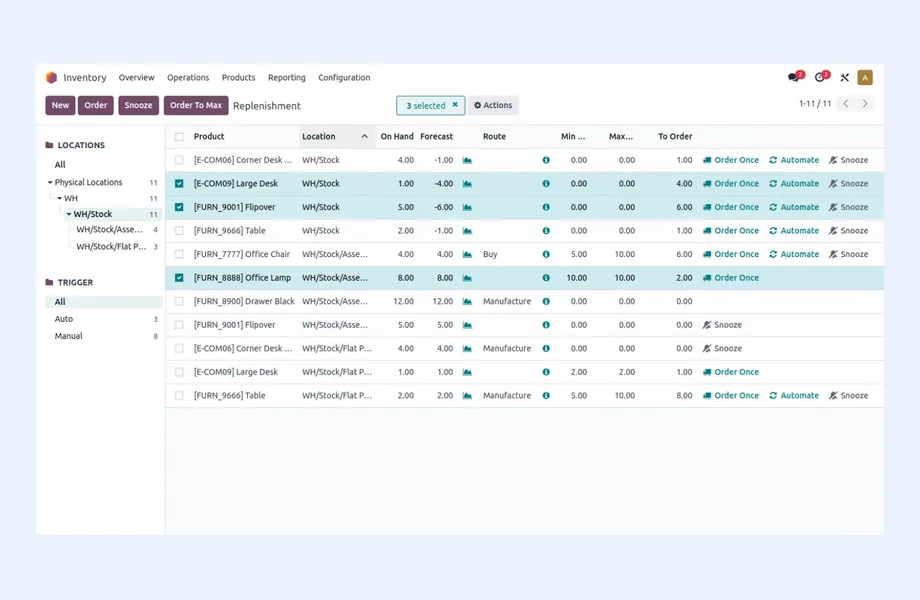
In Odoo's inventory app, the customer's line-side store or a warehouse near the plant can be set up as a location, with reordering rules that trigger production or picking when stock there falls to an agreed level. Dispatch can then be planned in waves that match the customer's delivery windows. For parts made in-house, manufacturing orders draw on bills of materials and routings; for parts sent out for plating or heat treatment, subcontracting flows keep track of material held at the vendor.
Barcode scanning at dispatch, which suppliers often rely on, may depend on the edition you choose, so I confirm it before the design is signed. I also check how invoices and delivery documents are produced per dispatch, how rejections returned by the customer are recorded and how a missed delivery window is logged, so the plant can see its delivery performance without a separate spreadsheet.
Parts for vehicle lines rarely travel in cartons. They move in plastic bins, custom trolleys, racks and pallets that go out full with each dispatch and are expected back empty. Some belong to the customer, some to the supplier and some to a packaging pool, and losses are charged to whoever cannot account for them. Many suppliers only discover a shortfall when the customer's reconciliation arrives, by which point nobody can say where the missing trolleys went.
Odoo can track this if packaging is designed as part of the flow rather than added later. Each packaging type becomes a tracked item, with stock locations for your premises, each customer's plant, and items in transit or under repair. Every dispatch records the packaging that left with it, every return records what came back, and a balance per customer is always visible. Where the customer owns the packaging, ownership is recorded on the stock so it never inflates your inventory value.
I define the counting points with your dispatch and security teams, because a trolley that leaves through the gate without a document is where discrepancies usually begin. Monthly statements to each customer then come from the system, and differences can be investigated while drivers and dates are still fresh. The wider supplier picture is set out under vehicle and component makers.
Gurugram's offices, co-working centers and event venues create steady demand for rented equipment: laptops and desktops for new joiners or project teams, monitors, furniture for a floor that opens before its own furniture arrives, and audio-visual kit for conferences and town halls. Rental companies serving them manage a fleet that is constantly moving between their warehouse, client sites and repair benches.
Odoo's rental features cover much of this, but rental is among the apps that may depend on the edition, so I confirm availability on your planned setup first. The design then covers:
The accounting question is separate: whether rental assets sit as fixed assets with depreciation or as stock is a decision for your chartered accountant, and the design follows it. Where clients buy as well as rent, sales and rental share one product catalog, so the same unit is never sold while it is out on hire.
Many of Gurugram's large offices hand their cafeterias to contract caterers, who run kitchens and counters inside client campuses and towers. The commercial models vary by client: a fixed rate per meal charged to the company, subsidized meals that employees pay for at the counter, a minimum billing commitment regardless of attendance, and separate orders for meetings and events. Each site has its own kitchen, stores and staff, sometimes supplied from a central kitchen.
In Odoo, I set each client site up as a warehouse with its own stores, so daily purchases and transfers from the central kitchen land where they are used. Manufacturing orders in Odoo can record central kitchen production against recipes where that level of detail is worth the effort; some operators prefer to record consumption by daily issue instead, and I help you choose. Point of Sale handles employee payments at counters, while client billing draws on meal counts, the contract rate and any minimum commitment.
The first report owners ask for is food cost per site against revenue per site, with wastage visible. That depends on disciplined daily issues and stock counts, so the design stays simple enough for kitchen staff to keep up. Food safety licensing and labeling are compliance matters for your advisors; the system holds whatever records they require. Related production questions are covered under food and beverage operations.
Distributors supplying Gurugram's offices with stationery, pantry goods, housekeeping consumables and printer supplies sell to corporate clients with rate contracts, many departments and strict approval rules. Odoo's customer portal and eCommerce apps can give each client its own catalog and prices, let departments place reorders that a client approver confirms, and keep delivery addresses down to tower and floor. Deliveries can then be invoiced together each month per client entity, which is how many corporate buyers prefer to be billed.
Odoo is a weaker choice in some Gurugram situations:
Features such as Studio, Quality, Rental, Field Service and barcode scanning may depend on the edition, so I list them against your requirements before you choose between Odoo Online, Odoo.sh and self-hosting. For India-wide tax, e-invoicing and Tally migration questions, see my Odoo work across India, and for the city overview, the Gurugram ERP page. I work remotely, with visits by arrangement.

Tell me about your business and current systems. I’ll suggest the most sensible first step.
Book a Consultation
Not sure which ERP you need?
Share your business requirements with me and I will help you understand the right process, architecture and platform before implementation.
FAQ
Yes, if packaging is designed into the flow. Each packaging type is tracked as an item with locations for your premises, each customer and goods in transit. Dispatches and returns record what moved, so a balance per customer is always available, and customer-owned packaging is kept out of your inventory value.
Odoo can treat the customer's line-side store as a location with reordering rules that trigger picking or production when stock falls to an agreed level. Dispatch can then be planned around delivery windows. I check barcode scanning and any other edition-dependent features before the design is agreed, so nothing is assumed from a demo.
It can be. Odoo's rental features handle availability, pickups, returns and damage charges, with serial numbers following each unit, but rental may depend on the edition, so I confirm it on your planned setup first. How rental assets are accounted for is decided with your chartered accountant.
Yes, if each site has its own stores and daily issues, purchases and central kitchen transfers are recorded consistently. Point of Sale covers counter sales, and client billing uses meal counts and contract rates. The design is kept simple enough for kitchen staff to maintain every day.
It depends on the features you need and how much customization you expect. Several useful apps may depend on the Enterprise edition, and Odoo Online does not accept custom modules. I list your requirements against each option, including Odoo.sh and self-hosting, so the choice is made before implementation starts.
Every business is different. Share where you are today and what you want to fix, and I’ll tell you honestly whether and how I can help.
Book a Consultation
Insights
 Book a Consultation
Book a consultation to talk through your processes, systems and goals. I’ll reply with practical next steps - no obligation.