Contact Info
 Odoo MRP in Denmark
Does Odoo Manufacturing suit Danish furniture and food producers?
Odoo Manufacturing can suit Danish furniture workshops and small to mid-sized food producers that need variant bills of materials or simple recipes, batch traceability, subcontracted production and costing linked directly to sales and stock. Edition matters, because quality checks and engineering change control have been Enterprise apps. Food production with variable yields or catch weights may need a process ERP. I assess and design this remotely, independent of Odoo.
Last reviewed by Vikas Saroj
Danish production includes upholstery and joinery workshops making designed furniture, and food businesses roasting coffee, brewing beer, baking or producing specialty foods. They differ in materials but share the needs Odoo Manufacturing addresses: a reliable bill of materials or recipe, a record of which batch went where and a product cost the finance team trusts.
I work remotely with production, quality and finance leads in Denmark. I map how a product is made before any configuration, then test Odoo with real production orders. Work instructions and labels in Danish are written by your own team, and the engagement runs in English.
 What I Do
Each item can be part of a fit assessment before choosing Odoo or of design work during a project.

One bill of materials per furniture model with variant-specific lines for fabric, finish and size, so the right materials and operations follow each chosen combination automatically.

Recipes for roasting, brewing, baking or blending set up as bills of materials with batch sizes, ingredient lots and expected output, reviewed with your production lead.

Spent grain, offcuts, rework or secondary products recorded as by-products of production orders, each with a cost share and a stock destination agreed in advance with finance.

Ingredient and component lots consumed into finished batches, so a complaint or recall can be traced back to suppliers and forward to every customer who received the batch.

Production at external factories or co-packers modeled as subcontracting, with the materials you supply, the finished goods you receive and their full landed cost captured in Odoo.

Material, labor and overhead per batch or piece, with the costing method and work center rates chosen by finance and variances reviewed after each production period.
How I Work
Production as it runs today
 Collect recipes and BoMs
Walk through one batch
List traceability needs
Agree costing principles
Collect recipes and BoMs
Walk through one batch
List traceability needs
Agree costing principles
Real orders in a sandbox
One product family loaded
By-products and lots tested
Subcontract flow tried
Cost checked with finance
Line by line
Remaining recipes validated
Operators trained on screens
Mock recall exercise
First period reviewed
A Danish furniture workshop may produce the same chair in dozens of fabric and finish combinations, often only after an order arrives. Frames are made or bought, upholstery and finishing are done in-house or by specialist workshops, and each combination consumes different materials.
Odoo handles this through bills of materials with variant-specific lines. The design questions I work through with production:
Fabric consumption per variant deserves care: meters per model differ, and waste matters for both cost and sustainability reporting. I test the structure on the most complex real orders before loading the full range. My Odoo Manufacturing page covers the product more generally.
For a Danish coffee roaster, brewery, bakery or specialty food producer, a recipe is a bill of materials with a twist: output varies, ingredients come in lots, and production often leaves something else behind. Odoo Manufacturing can model a good share of this when the design is deliberate.
Allergen and nutrition information belongs on product records and labels, maintained by your quality team in Danish and other languages. Odoo can store it, but label design and legal content are your team's responsibility.
I test with a full batch cycle, from ingredient receipt to packed product, including a batch where yield falls short, before recommending go-live.
Danish food producers supplying supermarkets, food service or export customers need to answer two questions quickly: which ingredient lots went into this batch, and which customers received it. Retail buyers and the food authorities may both ask, and the answer has to be reliable.
Odoo's lot tracking supports both directions when it is used consistently:
Quality checks add control. The Quality app, which has been Enterprise, can require checks at receipt, during production or before release, such as temperature, moisture or taste approval, and block a batch until it passes. On Community, a quarantine location and documented procedures can cover simpler needs.
Which checks and records your food safety system requires is defined by your quality lead and your food safety plan, not by the software or by me. My part is making sure Odoo captures the evidence and that a recall query can be answered quickly, which I prove with a timed exercise on pilot data.
A Danish brand may design products in Denmark and have them made elsewhere: furniture at a factory in Poland or Lithuania, lighting in Portugal, or food at a co-packer that produces under the brand's label. Sometimes the brand supplies key materials, such as fabric, special components or ingredients; sometimes the producer buys everything.
Odoo's subcontracting features fit the first case. A bill of materials marked as subcontracted names the producer and lists the components you supply. Buying the finished goods triggers a resupply of those components to the producer, and receiving the goods consumes them. The design questions I settle:
Where the producer buys everything, a normal purchase with landed costs is simpler and more honest than a subcontracting setup. I test each pattern with a real order, including a short delivery and a rejected batch, so the routine is clear before the first live run.
Product cost in Odoo comes from materials, operations and work center rates. For a Danish producer, finance should own the main choices: standard cost for stable recipes or models, average or FIFO where coffee, timber or textile prices move; labor and overhead rates per work center; and automated or periodic stock valuation. If the books also run in Odoo Accounting, these entries land in a ledger subject to Danish bookkeeping requirements, covered on the Odoo Accounting page for Denmark.
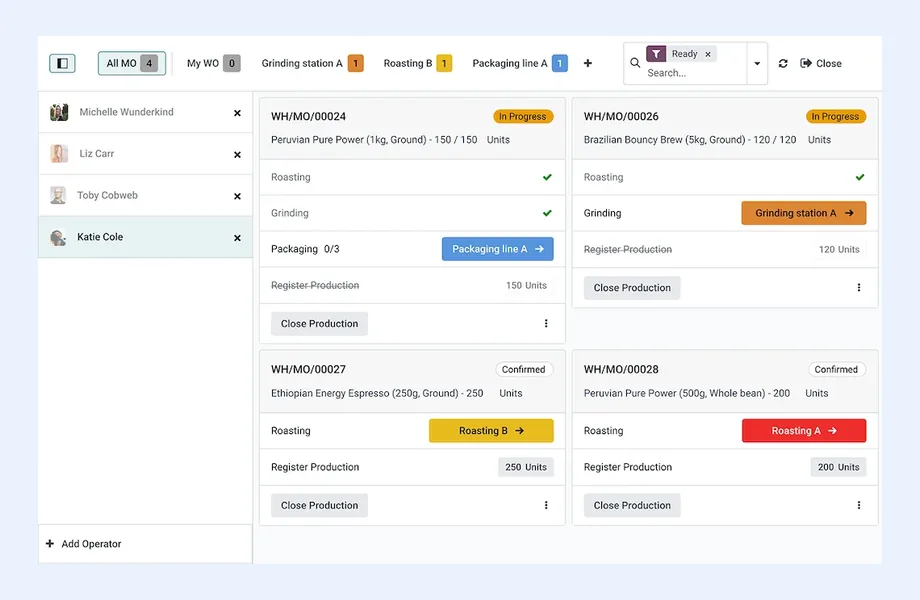
By-products, subcontracting, bills of materials and manufacturing orders are all available in Community. For quality control points, PLM, the operator tablet screens and the production schedule, recent releases have required Enterprise; Odoo or the partner can confirm where your release draws that line.
A different system is often a better fit when:
I have no tie to Odoo, so I can recommend against it. See Odoo consultant Denmark, the ERP consultant Denmark page, the Denmark hub and manufacturing ERP comparison.

Tell me about your business and current systems. I’ll suggest the most sensible first step.
Book a Consultation
Not sure which ERP you need?
Share your business requirements with me and I will help you understand the right process, architecture and platform before implementation.
FAQ
Yes. One bill of materials per model can carry variant-specific lines for fabric, finish and size, so each combination consumes the right materials. Semi-finished frames can be stocked and upholstered to order. I test the structure on your most complex models first.
Yes. Production orders can output by-products with a share of the cost, which can then be sold, reused or written off. Variable yields are recorded as actual output per order, though complex yield rules are not modeled natively, so I agree how variances are captured.
Odoo's lot tracking can trace a batch back to ingredient lots and forward to customers, provided lots are recorded at receipt, production and delivery. I prove it with a mock recall on pilot data. Your food safety plan defines what must be recorded.
Yes, through subcontracting when you supply some materials. Odoo tracks components sent to the producer, stock held there and finished goods received. When the producer buys everything, a normal purchase with landed costs is simpler. I design whichever pattern matches your agreements.
Every business is different. Share where you are today and what you want to fix, and I’ll tell you honestly whether and how I can help.
Book a Consultation
Insights
 Book a Consultation
Book a consultation to talk through your processes, systems and goals. I’ll reply with practical next steps - no obligation.