Contact Info

 Brisbane
When does ERPNext make sense for a Brisbane business?
ERPNext makes sense for a Brisbane business that wants an open-source ERP it can own and adapt, and has the discipline to maintain it. Here that often means equipment hire companies, family groups trading through several companies and trusts, or distributors with regional depots. I work remotely as an independent ERPNext consultant, testing the fit honestly and planning custom work so upgrades stay manageable.
Last reviewed by Vikas Saroj
Working remotely and independently, I advise Brisbane businesses that like the idea of an open-source ERP they control. I am not affiliated with Frappe or any implementer, so my job is to test whether ERPNext really fits your operation and, if it does, to design it so it stays maintainable for years.
The Brisbane cases that suit ERPNext tend to have something unusual about them: a hire fleet that needs rental logic, a family group with several entities, or depots spread across regional Queensland. Those are exactly the areas where careful design decides whether open source saves money or creates a maintenance burden.
 What I Do
ERPNext rewards careful design and punishes improvisation. These are the areas where I spend the effort before any code is written.

I write scenarios from your business and run them against ERPNext with you, recording where standard features work, where configuration is enough and where custom code would be needed.

For scaffolding, plant and equipment hire firms, I define the hire contract lifecycle and compare a rental app, a custom build or a specialist hire system linked to ERPNext.

I design companies, charts of accounts, inter-company transactions and consolidated reporting for family groups, working to your accountant's instructions on how each entity is treated.

I plan connectivity fallbacks, stock in transit, branch cost centers and role-based screens so depots across regional Queensland can work reliably on the same system.

I set rules for custom apps, version control, documentation and upgrade testing, then review your developer's work against them so the system stays upgradable over time.

I plan the move from your current accounting and stock tools, including open hires, inter-company balances and asset registers, with reconciliations agreed before cutover.
How I Work
Prove ERPNext against your scenarios
 Write business scenarios
Run them in a trial site
Log gaps and options
Identify custom work drivers
Write business scenarios
Run them in a trial site
Log gaps and options
Identify custom work drivers
Design the solution and its limits
Design entities and branches
Specify any custom apps
Agree coding and upgrade rules
Plan data migration
Keep it working after go-live
Test before every upgrade
Review custom changes
Track open issues
Refine reports with users
ERPNext, an open-source system on the Frappe framework, covers accounting, stock, buying, selling, manufacturing, projects, assets and support. There is no license charge for the software itself, although hosting, support and implementation still cost money. That combination draws a particular kind of Brisbane business: one that values control over its data and processes, does not mind owning some technical responsibility, and has needs that commercial packages would only meet through expensive add-ons.
Three patterns stand out. Equipment hire businesses, from scaffolding and formwork to plant, lifting gear and event equipment, need rental workflows that general ERPs rarely include, and ERPNext's openness makes adding them feasible. Family-owned groups that trade through several companies and trusts want consolidated visibility without paying for a separate license per entity. Distributors and service businesses with depots in regional Queensland want one stock and accounting system that branch staff can reach from a browser.
None of these makes ERPNext automatically right. The decision rests on whether the gaps can be closed with configuration and a modest amount of custom code, and whether you will have reliable support. I test both before you commit. The ERPNext platform page explains the software in more depth.
Brisbane's building and infrastructure activity supports a wide range of hire businesses: scaffolding, formwork and propping, plant and earthmoving equipment, access equipment, site sheds, lighting towers and event gear. Their core process is the hire contract: a booking or quote, delivery to site, an on-hire date, periodic billing for as long as the item stays out, off-hire notice, collection, inspection, damage or cleaning charges, and return to the yard. Items may be individual serialized assets, such as an excavator, or bulk stock counted out and back, such as scaffold components.
ERPNext does not include a full rental module as standard. It has strong building blocks: serial numbers and batches, asset records with depreciation and maintenance, stock movements between warehouses, and subscriptions or recurring invoices. Some community and commercial apps add rental features, and a Frappe developer can build a hire contract document that ties these pieces together. Each route has trade-offs in cost, ownership and upgrade risk.
My role is to define the hire process precisely, including partial returns, cross-hires from other companies, minimum hire periods and damage charging, and then compare the options: a rental app, a custom build, or a specialist hire system that passes transactions to ERPNext accounting. Sometimes the specialist system is the better answer, and I will say so. The job costing page covers how hire charges reach project costs.
Many Queensland family businesses operate through a structure of several entities: a trading company, a company or trust that owns the property, another that owns the equipment, and perhaps a separate entity for each line of business. Transactions between them, such as rent, equipment charges, management charges and loans, happen constantly and need to be recorded consistently on both sides.
ERPNext supports multiple companies in one installation, each with its own chart of accounts, and inter-company invoices and journal entries can create matching records in both companies. Reports can be run per entity or combined. Because the software carries no per-company license charge, adding an entity for a new venture is a configuration task rather than a commercial negotiation.
The design questions are about discipline. Which entity buys stock and which sells it? How are shared staff and overheads recharged? How are inter-company balances reconciled before each month-end? Trust distributions, tax consolidation and the treatment of related-party transactions are matters for your accountant. I make certain the ledger captures each transaction in the form your accountant asks for, and that the family can see the group's combined position without assembling spreadsheets. The multi-company ERP page covers the general pattern.
A Brisbane distributor or service company with depots in Toowoomba, Rockhampton, Mackay or Townsville needs every branch on the same system. ERPNext runs in a web browser, which simplifies access, but it also means a branch without a working internet connection cannot post transactions. In parts of regional Queensland, and during storms or floods anywhere in the state, connectivity can fail.
I plan for that explicitly. Hosting should be resilient and located where your advisors are comfortable with it. Each depot needs a reliable connection with a mobile backup. The point of sale module offers some offline capability for counter sales, which should be tested in your situation before you depend on it. For other tasks, a simple fallback procedure, such as paper delivery dockets entered when the connection returns, is often more dependable than a complex technical workaround. Stock transfers between Brisbane and the depots need clear in-transit handling, since a truck may be on the road for a long time.
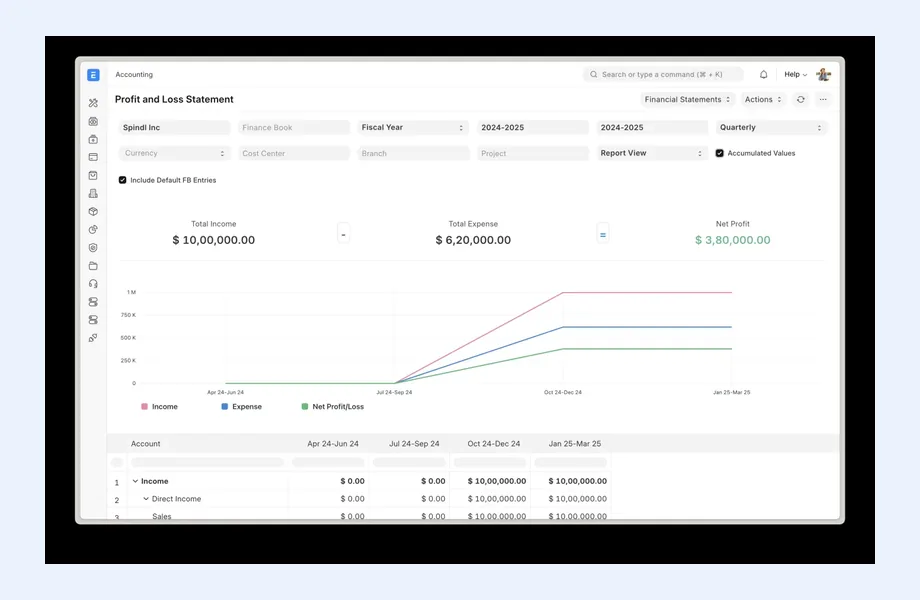
Branch reporting deserves its own design. Each depot manager should see sales, margin and stock for their branch, while Brisbane sees the whole network. Cost centers or accounting dimensions make that possible if they are set up before go-live rather than retrofitted later. The ERPNext Accounting page explains how branch transactions reach the ledger.
ERPNext moves quickly. New major versions bring improvements but also changes that can break customizations written against older ones. A Brisbane business that customizes heavily and never upgrades ends up stranded on an old version; one that upgrades without testing risks a broken system on a busy Monday morning.
I set rules for custom work from the start. Every customization sits in its own Frappe app tracked in a code repository; nobody edits the core code. Where configuration, custom fields, print formats or server scripts can do the job, they are preferred over new code. Every custom feature is documented with the business reason for it, so a future developer can judge whether it is still needed. Before each upgrade, the system is copied to a test site and your key processes are run through it using a written checklist.
This matters whether your developer is in Brisbane, elsewhere in Australia or overseas, and whether you host on Frappe Cloud or on your own servers. I help you agree these rules with whoever maintains the system and review their work against them. Where ERPNext would need so much custom code that upgrades become a burden, I will recommend a different platform. The ERPNext in Australia page covers GST, BAS and payroll, and the Brisbane ERP consultant page covers local industry needs.

Tell me about your business and current systems. I’ll suggest the most sensible first step.
Book a Consultation
Not sure which ERP you need?
Share your business requirements with me and I will help you understand the right process, architecture and platform before implementation.
FAQ
Not as a complete standard module. ERPNext has the building blocks, such as serial numbers, assets, stock movements and recurring invoices, and rental features can come from an add-on app or a custom build. I define your hire process first, then compare those routes with a specialist hire system that passes transactions to ERPNext accounting.
ERPNext supports several companies in one installation, with inter-company transactions and per-entity or combined reports. How each entity is treated for tax, distributions and consolidation is for your accountant to decide. I make sure the setup records transactions the way your accountant needs and that balances between entities reconcile cleanly.
Most of ERPNext needs a connection, so the plan combines a reliable primary link, a mobile backup and a simple manual fallback for things like delivery dockets. Point of sale has some offline capability for counter sales, which should be tested in your setting. I document the fallback so depot staff know exactly what to do.
Keep custom code in a separate app under version control, prefer configuration over code, document why each change exists, and test every upgrade on a copy of the live system with a written checklist of key processes. I set these rules with your developer at the start and review their work against them.
Every business is different. Share where you are today and what you want to fix, and I’ll tell you honestly whether and how I can help.
Book a Consultation
Insights
 Book a Consultation
Book a consultation to talk through your processes, systems and goals. I’ll reply with practical next steps - no obligation.