Contact Info
 Odoo in Manchester
Is Odoo a good fit for Manchester engineering firms and merchants?
Odoo can suit Greater Manchester engineering job shops, fabricators and trade merchants because it combines quoting, manufacturing, subcontracted operations, inventory, point of sale and accounting in one system. The fit depends on how jobs are quoted and costed, how outside processes and certificates are tracked, and how branch stock moves. As a freelance Odoo consultant, I test that fit remotely and oversee the implementer through rollout.
Last reviewed by Vikas Saroj
Around Trafford Park, Oldham, Rochdale, Ashton-under-Lyne and other industrial parts of Greater Manchester, many engineering firms make parts to customer drawings: machining, sheet metal, fabrication, welding and assembly, often in small quantities and with some operations sent out to specialists. Alongside them, builders' merchants and electrical and plumbing wholesalers serve the trades from counters and yards across the region.
Both kinds of business stretch an entry-level accounting package quickly. I work remotely as a freelance Odoo consultant to test whether Odoo fits how you quote, make, buy and sell, design the setup with you and keep the implementer focused on your real jobs rather than a generic demonstration.
 What I Do
Each piece of work below targets a point where engineering subcontractors and trade merchants need Odoo to behave differently from its default setup.

I walk through a sample of your recent jobs, from inquiry and drawing through quote, manufacture and dispatch, and show where Odoo handles each step as standard, where it needs configuration and where it struggles.

I design how estimates built from material, machine time, labor and outside work become sales orders and manufacturing orders, so actual costs can be compared with the quote once each job closes.

Plating, heat treatment, painting and other operations are often sent to specialist firms. I set out how Odoo subcontracting tracks what has gone out, what is due back and what each step costs.

Where customers ask for material certificates or conformity documents, I define how lot and serial tracking, inspection steps and attached documents link each delivered part back to its source material.

For merchants, I design Odoo Point of Sale for counter sales, account customer pricing and credit limits, branch-to-branch transfers and yard deliveries, all drawing on one stock position per location.

I plan which Odoo apps go live first, how long the old system runs alongside, and when to switch, avoiding month-end, stocktake and shutdown weeks so the business is not stretched at the wrong moment.
How I Work
Check fit against your real jobs
 Pick representative recent jobs
Map quote to dispatch
Review branch and counter flows
List gaps and workarounds
Pick representative recent jobs
Map quote to dispatch
Review branch and counter flows
List gaps and workarounds
Agree the Odoo setup and phases
Define routings and work centers
Set costing and pricing rules
Choose edition and hosting
Sequence the app rollout
Keep the implementer on track
Review configuration choices
Run job-based acceptance tests
Check migrated stock and balances
Support the first live jobs
A subcontract engineering firm rarely sells the same thing twice in the same way. A customer sends a drawing, the estimator works out material, machine time, setups, labor and any outside processes, and the firm quotes a price and lead time. If the order comes in, the job is planned across machines and people that are already busy, material is bought or cut from stock, and parts may leave the building for treatment before returning for inspection and dispatch.
That pattern is common across Greater Manchester's industrial estates, and it is exactly where cheaper systems run out. Stock-based ERPs expect a fixed catalog; job costing tools often lack proper inventory and accounting. Odoo sits between the two. Its Manufacturing app handles bills of materials, routings and work centers, and products can be created per job when needed, while Sales, Purchase, Inventory and Accounting share the same records.
Whether that is enough depends on your mix of repeat and one-off work, how detailed your estimating is and how much shop-floor data you want to capture. I test it against your own recent jobs rather than a sample company. UK-wide points, including Making Tax Digital and hosting, sit on the Odoo consultant UK page, and the platform overview is at Odoo consulting.
Job shops win or lose money in the gap between the estimate and what the job really took. The Odoo design has to make that gap visible. I work with your estimator to agree how a quote is built: material by weight or length, machine time by work center, setup time, labor, outside processes and any margin rules. That structure then carries into the sales order and the manufacturing order, so the same elements can be compared once the job is finished.
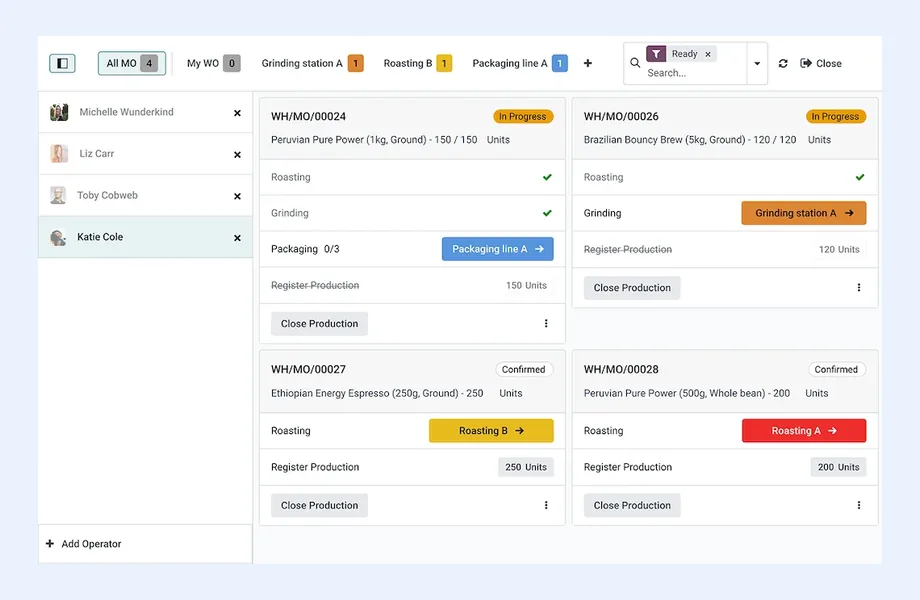
Capturing actual time is the harder part. Odoo's shop floor view lets operators start and stop operations on a tablet at each work center, which gives real times per job without paper timesheets. Some firms prefer to start with recorded times at the end of each shift and move to live capture later. Both approaches are workable if the routings are set up sensibly from the start.
I also define how quotes that never convert are stored, because a library of past estimates by customer and part is valuable when a drawing comes back with a revision. Reports then show margin by job, customer and work center, which helps the owners decide which work to chase. My Odoo Manufacturing page covers the module in more depth, and ERP for job costing looks at the problem itself.
Few engineering firms do everything in-house. Parts go out for plating, anodizing, heat treatment, galvanizing, powder coating or specialist inspection, and the job cannot ship until they come back. If those movements are tracked on a whiteboard or in someone's inbox, lead times slip without warning and the cost of outside work is easily missed on the job.
Odoo's subcontracting features can record parts sent to a supplier as a step in the job, raise the purchase order for the service, and receive the parts back into the right stage. I design how that works for your suppliers, including how partial returns, rejects and rework are handled and how the outside cost lands on the job.
Customers in demanding supply chains often ask for evidence: material certificates from the mill or stockholder, inspection records, and a certificate of conformity with each delivery. I define how lot or serial tracking links finished parts back to incoming material, which inspection points are recorded, and where documents are attached so they can be printed or sent with the dispatch note. Some quality features belong to the Enterprise edition rather than Community, so I check the current edition comparison with you before the design relies on them. What your customers' quality standards require is for your quality lead to confirm.
Builders' merchants and electrical, plumbing and heating wholesalers across Greater Manchester serve tradespeople who want to walk in, collect and go, or have materials delivered to site the same or next day. The system behind that has to handle counter sales with card payments, account customers with their own price lists and credit limits, quotes for larger jobs, deliveries from the yard and stock that moves between branches.
Odoo can bring these together. Point of Sale handles the counter, with sales flowing into the same inventory and accounting records as account orders. Pricelists can hold trade and customer-specific prices. Each branch can be its own warehouse, with transfers between them and replenishment rules per location. Deliveries can be planned from sales orders, and proof of delivery can be captured on a phone.
The points I test carefully are speed at the counter during the early-morning rush, how credit checks work when a known customer is over their limit, how returns of opened or cut goods are handled, and how supplier rebates are tracked. Rebates in particular can be complex, and I will say plainly if they need an add-on or a spreadsheet outside Odoo. The Odoo Inventory page and inventory and warehousing page cover the wider topic.
Neither a busy job shop nor a merchant can stop trading while a new system goes in, so the rollout is phased. A common sequence is to bring in sales, purchasing, inventory and accounting first, then manufacturing and shop-floor capture once the basics are stable. Merchants may start with one branch before extending to the rest. I plan go-live dates away from month-end, stocktakes and planned shutdowns.
The configuration itself is usually done by an Odoo implementer, who may be based in the North West, elsewhere in the UK or abroad. I write the scope, review their design choices and run acceptance tests built from your real jobs and counter transactions, so problems are found before go-live rather than by customers. I also check migrated stock quantities, open orders and opening balances against the old system.
I work remotely, with sessions in UK mornings, written notes in a shared workspace and shop-floor or yard walk-throughs over video. A visit to your site can be arranged ahead of time if it would help. If Odoo turns out not to fit, the ERPNext consultant in Manchester page and my ERP consultant in Manchester page cover other routes, and you can contact me to talk it through.

Tell me about your business and current systems. I’ll suggest the most sensible first step.
Book a Consultation
Not sure which ERP you need?
Share your business requirements with me and I will help you understand the right process, architecture and platform before implementation.
FAQ
It can, provided the setup is planned for it. Products and bills of materials can be created per job, routings define the operations, and costs from material, time and outside work collect against the manufacturing order. I test this with your recent jobs before you commit, because heavy estimating needs vary a lot between firms.
Odoo's subcontracting features can record parts leaving for a supplier as a step in the job, raise the purchase order for that service and receive the parts back at the right stage. I design how partial returns, rejects and the outside cost are handled so the job record stays complete.
Generally yes. Point of Sale handles counter sales, pricelists hold trade and customer prices, and each branch can be its own warehouse with transfers between them. I test counter speed, credit checks, returns and supplier rebates closely, since those are the areas where merchants most need to see Odoo working with their own data.
Usually with the core: sales, purchasing, inventory and accounting, because everything else depends on clean item, customer and stock data. Manufacturing and shop-floor time capture follow once that is stable. The right order for your firm depends on where the current pain sits, and I set it out in the rollout plan.
Every business is different. Share where you are today and what you want to fix, and I’ll tell you honestly whether and how I can help.
Book a Consultation
Insights
 Book a Consultation
Book a consultation to talk through your processes, systems and goals. I’ll reply with practical next steps - no obligation.