Contact Info
 Odoo in London
Why would a London consumer brand bring in a freelance Odoo consultant?
London brands and small-batch makers often hold stock in an outsourced warehouse beyond the city, sell online, in pop-up shops and to boutiques, and produce in small runs. Odoo can bring stock, orders, production and accounts together, but only if locations, channels and costing are designed carefully. A freelance Odoo consultant does that design independently. I work remotely and have no ties to Odoo or its resellers.
Last reviewed by Vikas Saroj
Floor space in London is expensive, so physical-product businesses here spread themselves thin. A fashion or beauty label designs in Hackney but stores stock with a third-party warehouse beyond Greater London. A coffee roaster or brewery produces in a railway arch and sells through its own taproom, online and to cafes. A homeware brand runs a seasonal pop-up in a market hall while wholesale orders go to shops across the country.
Each extra location and channel is another place for stock figures to drift. I work remotely as a freelance Odoo consultant, designing how Odoo should represent those locations, channels and small production runs so the numbers on screen match what is on the shelves.
 What I Do
Each offer deals with a place where a small London brand's stock, orders or margins tend to slip out of view.

I design how an outsourced warehouse appears in Odoo Inventory, how receipts, picks and returns are confirmed back from the provider, and how its stock reports are reconciled against Odoo on a fixed routine.

I map every sales channel, such as your web store, marketplaces, pop-up tills and wholesale orders, and decide which ones run inside Odoo and which connect to it, so each order lands once with the right price.

For roasters, brewers, cosmetics makers and food producers, I set up bills of materials, batch records and costing in Odoo Manufacturing at a level a small production team will actually keep up to date.

I plan how Odoo Point of Sale handles a temporary shop or market stall: moving stock in and out, closing the till each day and keeping retail sales separate from online and wholesale reporting.

For brands selling to boutiques and department stores, I design price lists, minimum orders, payment terms and sale-or-return arrangements so wholesale margin is visible separately from direct sales.

Where an Odoo implementer or freelancer builds the system, I write the scope from your requirements, review their configuration choices and test channels, stock and production flows before launch.
How I Work
Follow stock and orders
 List locations and channels
Follow one product end to end
Count where figures drift
Note seasonal and returns peaks
List locations and channels
Follow one product end to end
Count where figures drift
Note seasonal and returns peaks
Odoo apps and structure
Model warehouses and routes
Choose connectors and integrations
Set costing and price lists
Plan product and stock import
Prove it before peak
Test each channel's orders
Reconcile opening stock counts
Train warehouse and shop staff
Avoid launching in peak season
London is home to a large number of consumer brands and makers: fashion and accessories labels in the East End, beauty and wellness brands, homeware and furniture designers, specialty coffee roasters, craft breweries and distillers in areas such as Bermondsey and Hackney Wick, and food producers supplying delis and restaurants. Many are founder-led and grew online before adding wholesale and physical retail.
The city shapes how they operate. Storage inside London is costly, so finished goods often sit with a third-party logistics provider beyond Greater London, while samples, display stock and a small buffer stay in a studio or shop. Production happens in small runs, sometimes in-house in a railway arch unit and sometimes with a contract manufacturer. Sales come from a web store, one or more marketplaces, a pop-up or flagship shop and a list of stockists.
Each location and channel keeps its own idea of what is in stock. When the web store says an item is available but the warehouse has none, the brand pays twice: once in a refunded order and again in customer trust. That is the problem Odoo can solve well, provided the structure is right from the start. National topics such as Making Tax Digital and hosting are on my UK Odoo consultant page.
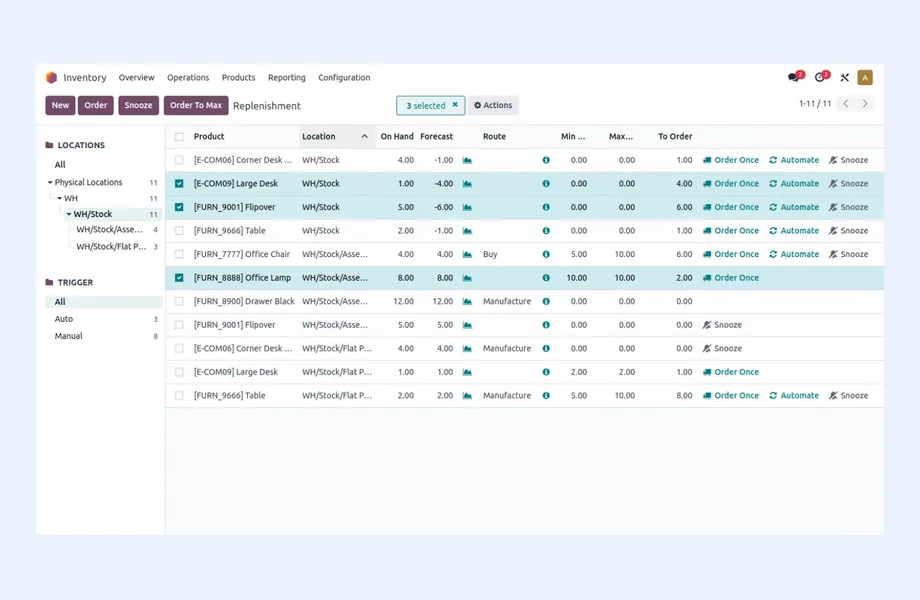
When stock sits with a third-party warehouse, Odoo must still know what is there. The cleanest approach is to model the provider as a warehouse or location in Odoo Inventory and agree how information passes in both directions. Odoo sends sales orders and expected deliveries; the provider confirms receipts, shipments and returns. That exchange might use a ready-made connector, a file transfer or a custom integration, depending on the provider's systems.
I write that integration as a short specification: which events must be confirmed, how quickly, what happens when a pick fails, how damaged returns are graded and how often full stock reports are compared with Odoo's figures. The routine reconciliation matters more than the technology. A weekly or monthly comparison with clear ownership catches drift before it reaches the accounts.
Stock held in the studio, a shop or a market stall becomes its own location with transfers in and out. Samples and display stock are tracked separately, so they do not inflate available quantities. When the brand later changes warehouse provider, which happens often as volumes grow, the design makes that move a change of location rather than a rebuild.
A London brand might sell through its own web store, a marketplace or two, a seasonal pop-up and a growing list of stockists. Some brands use Odoo's own website and eCommerce apps; many keep an existing online store platform and connect it to Odoo. I compare both routes honestly, based on how much the web store does today and how much effort a rebuild would take.
Pop-up shops and market stalls work well with Odoo Point of Sale: stock is transferred to the pop-up location, sales are recorded at the till, and anything unsold is transferred back. The design questions are practical. Who counts stock when the pop-up closes? How are card takings reconciled? Which discounts are allowed in person but not online?
Wholesale needs its own rules. I set up price lists by stockist type, minimum order quantities, payment terms, and where relevant sale-or-return arrangements, which leave stock owned by the brand while it sits in a shop. Department store accounts may require particular labeling, packing or invoicing formats, and those become requirements for the shipping and invoicing steps. My UK ecommerce ERP page covers the wider channel decisions.
Many London producers make things in small batches with small teams. A coffee roaster turns green beans into roasted coffee, with weight loss in the process and blends that change with the season. A brewery or distillery runs batches, packages into several formats and may sell from its own taproom. A cosmetics or candle maker works from formulations and must track ingredient batches.
Odoo Manufacturing can handle bills of materials, production orders, lot numbers and costing for these businesses. The risk is designing more process than a team of a few people will keep up with. I aim for the minimum that still gives you reliable cost per unit and traceability: one production order per batch, ingredients consumed by lot, expected yield recorded, and finished goods labeled with a batch reference.
Some producers carry specialist obligations, such as alcohol duty, bonded storage or cosmetics safety records. Those rules are interpreted by your advisors and may need specialist tools or add-ons. I check what Odoo can record natively, what needs an add-on or separate system, and how the data flows between them, before you commit. Requirements for production-heavy businesses are covered further on my London ERP business analyst page.
Timing matters for consumer brands. Launching a new system just before the gifting season, a major sale period or a big stockist order is risky, so I plan go-live for a quieter window and use the busy period beforehand for testing with real orders. Opening stock counts are reconciled at the outsourced warehouse and every other location before the switch.
Odoo can be delivered by an Odoo implementation firm, a freelance developer or, for a simple setup, your own team with guidance. I am a freelance Odoo consultant, independent of Odoo and of the firms that implement it, and I take no commission. I write the scope, review the configuration and test the flows; implementation is carried out by whoever you choose, or I guide your administrator directly where the setup is straightforward.
The engagement runs remotely. My working day in India covers London's morning and early afternoon, which leaves your warehouse and shop teams free for the busy hours. A visit to your studio or production unit can be arranged where it would genuinely help. For the broader platform view, see the Odoo platform page or the London ERP consultant overview.

Tell me about your business and current systems. I’ll suggest the most sensible first step.
Book a Consultation
Not sure which ERP you need?
Share your business requirements with me and I will help you understand the right process, architecture and platform before implementation.
FAQ
Yes, as long as the exchange of information is designed. The warehouse becomes a location in Odoo, orders are sent to the provider, and receipts, shipments and returns are confirmed back by connector, file or custom integration. A regular comparison of the provider's stock report with Odoo's figures keeps the two in step.
Not necessarily. If your current store works well and has apps your team relies on, connecting it to Odoo may be wiser than rebuilding. If the store is simple or due for a redesign anyway, Odoo's own eCommerce can reduce integration work. I compare both options against your catalog, channels and team.
It can be if it is over-designed. A simple setup with one production order per batch, ingredients tracked by lot and yield recorded gives reliable costing without much admin. Specialist obligations, such as alcohol duty records, are reviewed separately with your advisors to decide what Odoo holds and what stays in a dedicated tool.
After your busiest season, not before it. A quieter period gives time to count stock at every location, test each sales channel with live orders and train staff without pressure. Planning backwards from that window usually sets the rest of the project timetable.
Every business is different. Share where you are today and what you want to fix, and I’ll tell you honestly whether and how I can help.
Book a Consultation
Insights
 Book a Consultation
Book a consultation to talk through your processes, systems and goals. I’ll reply with practical next steps - no obligation.