Contact Info

 Bristol
How can a Zoho consultant help a Bristol engineering consultancy?
Around Filton, Abbey Wood and Aztec West, many firms sell engineering hours rather than products: design, stress analysis, systems engineering, technical publications and project support for aerospace and defense customers. An independent Zoho consultant designs how bids, skills, clearances, work packages and purchase orders run across Zoho CRM, Projects, People and Books, states plainly what must stay out of Zoho, and oversees the setup remotely.
Last reviewed by Vikas Saroj
North Bristol supports a sizeable community of engineering services firms. They supply stress engineers, designers, systems engineers and technical authors to aerospace manufacturers at Filton and to defense programs managed from Abbey Wood, often from offices on the business parks along the city's northern fringe, such as Aztec West.
Their systems problem is rarely stock. It is knowing which bids are live, which engineers hold which skills and clearances, how many hours remain on each purchase order and whether every timesheet ties to something the customer will pay for. Zoho can answer much of that without a heavyweight ERP, if it is designed around those questions.
As an independent Zoho consultant delivering remotely, I am explicit about the information that should never go into a commercial cloud application, whatever its features.
 What I Do
The aim is one customer record that links the bid, the people who deliver the work, the order that funds it and the invoice that closes it.

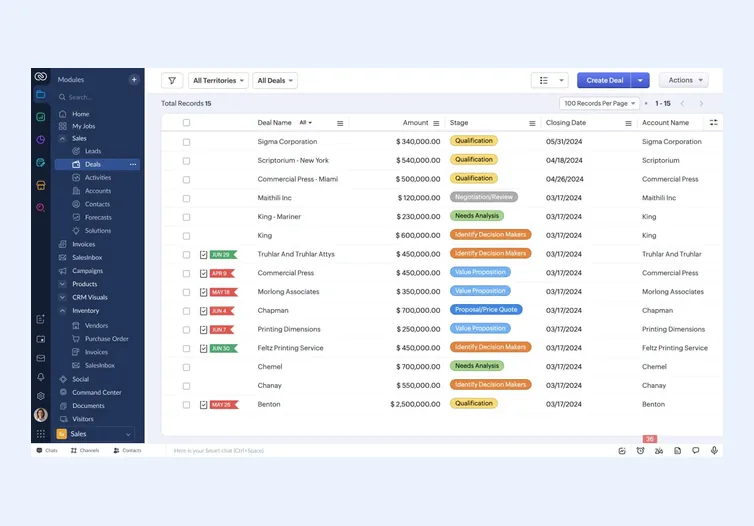
Opportunity stages from early capture through a bid or no-bid decision, teaming with a prime, submission and award, with decision reasons and competitors recorded so the next bid starts from evidence rather than memory.

A design for holding qualifications, training, site access needs and vetting status in Zoho People or a Creator app, with tight access rules agreed first with whoever is responsible for security in your firm.

Zoho Projects arranged so each customer work package or statement of work has its own hours budget, milestones and purchase order reference, and engineers can only book time where it is allowed.

Reports showing hours and value consumed against each customer purchase order, with alerts before a ceiling is reached, so a new order is requested in good time instead of after the work is done.

Approved time and milestones flowing from Zoho Projects into Zoho Books invoices that carry each customer's references and supporting breakdown, since a missing reference is a common reason large customers hold payment.

A buyer-side review of what a Zoho implementer proposes and configures, checked against the written design, with acceptance tests built from your own past bids, projects and invoices.
How I Work
Learn how hours become invoices
 Follow one bid to award
Trace a timesheet to payment
List skills and access records
Agree data security boundaries
Follow one bid to award
Trace a timesheet to payment
List skills and access records
Agree data security boundaries
Decide what each Zoho app holds
CRM stages and bid fields
Work package and approval rules
People records and access roles
Invoice templates per customer
Check the build before go-live
Review the configuration
Test with past projects
Import clean reference data
Train your administrator
The aerospace plants at Filton and the defense procurement organization based at Abbey Wood draw a wide circle of engineering services firms into north Bristol and South Gloucestershire. Some are large consultancies with teams embedded at customer sites. Many more are smaller specialists offering stress analysis, design, systems and safety engineering, verification, technical publications or project controls. Their customers include the big manufacturers, tier-one suppliers and public bodies, and much of the work arrives as packages of hours against a purchase order.
These firms tend to run on a mix of tools: a spreadsheet of bids, a separate timesheet system, an HR folder, an accounting package and a great deal of email. Each works on its own, yet nobody can answer simple management questions quickly. What is the weighted value of the pipeline? Which engineers with the right vetting are free next quarter? How much is left on the order that funds the current project? An integrated suite such as Zoho helps because CRM, projects, people records and invoicing share one customer record.
Zoho is not the only option. Professional services automation tools and full ERPs also fit this kind of firm, and some defense customers impose rules that limit what any cloud application can hold. National questions such as VAT returns and payroll belong on my Zoho page for the whole UK; the focus here is what Bristol's engineering consultancies need.
For an engineering consultancy, the sales pipeline looks different from a product company's. Opportunities often begin long before a tender appears, as conversations with a program team or a prime contractor. They pass through a bid or no-bid decision, sometimes a teaming arrangement in which you join a larger firm's bid, then a formal submission through a buyer's procurement portal, clarification questions and an award or loss. Others never become tenders and arrive directly as an extension to an existing order.
I design Zoho CRM stages to follow that path, with fields that matter to your directors: the customer program, the route to market, your role as prime or subcontractor, the capabilities required, the decision date and the reasons behind each bid or no-bid choice. Loss reviews are captured as data rather than buried in email, so patterns become visible over time. Non-disclosure and teaming agreements can be tracked as related records with their scope and expiry, while the legal documents themselves stay in your document system.
Pipeline reports then answer what a board asks: weighted value by customer and capability, bids due in the coming weeks and win rates by route to market. Because the same account record later holds projects and invoices, you can also see which customers and capabilities actually turn into profitable work. The Zoho CRM page covers the app's broader features.
Engineering consultancies sell people, so the most valuable data in the business is who can do what, and where they are permitted to do it. That includes professional qualifications, training records, experience with particular analysis tools, customer-specific inductions and, for defense work, national security vetting status.
Zoho People or a purpose-built Zoho Creator app can hold a skills matrix and training records well. Vetting status is more sensitive. It is personal data with extra handling expectations, and some firms decide it should live only in a restricted HR or security system. I put that decision to the person responsible for security in your firm and to your data protection lead before any field is created. Where status is recorded, access is limited to a small set of named roles, and the record shows status and expiry rather than any detail behind them.
The payoff is resourcing. When a new work package arrives, managers can filter for engineers with the right skills, access and availability without circulating spreadsheets of personal information. Over time the same data shows where training is needed to win the next kind of work, and which certifications or inductions are close to lapsing. The Zoho People and Zoho Creator pages describe each app in more detail.
Much of the work for large aerospace and defense customers is authorized in pieces: a purchase order or task order for a defined scope, a ceiling of hours or value, and a reporting requirement. Running past the order value without noticing means doing work that may never be paid for, while leaving value unused can mean losing it when the customer's budget year closes.
In Zoho Projects I set up each work package as its own project or milestone group, tagged with the customer purchase order, its value and its end point. Engineers book time only to open packages, the package lead approves timesheets on a fixed rhythm, and a burn-down report shows hours and value used against each order. Alerts warn the account manager before a ceiling is reached, so a variation or new order is requested in good time.
Approved time then flows to Zoho Books, where invoices carry the purchase order number and the supporting breakdown that large customers expect. A wrong or missing reference is one of the most common reasons an invoice stalls in a big organization's payables process, so the template is tested against each major customer's requirements before go-live. The Zoho Projects page explains the app's general capabilities.
Defense-related work comes with information security expectations that sit above any software choice. Many defense contracts expect suppliers to hold Cyber Essentials or to meet a cyber risk profile set for the contract, and controlled or classified information must stay in systems your customer and security controller approve. Zoho, like any commercial cloud service, should hold the commercial wrapper of a project, such as account names, purchase orders, hours and invoices, and not the technical data itself. Where even the name of a program is sensitive, an agreed code name in Zoho may be the right answer.
I document these boundaries before design starts, together with the hosting region your account will use and the access controls your security lead requires. If the rules leave too little for Zoho to do, I will say so and suggest an alternative.
Licenses are bought directly from Zoho or a provider you choose, and I earn nothing from them. I work remotely, either reviewing an implementer's work against the design or guiding your own administrator, with visits to Bristol by arrangement. For the wider picture of the city's manufacturers and suppliers, see the Bristol ERP consultant page.

Tell me about your business and current systems. I’ll suggest the most sensible first step.
Book a Consultation
Not sure which ERP you need?
Share your business requirements with me and I will help you understand the right process, architecture and platform before implementation.
FAQ
It can hold a status and expiry in a restricted record, but whether it should is a decision for the person responsible for security in your firm and your data protection lead. Some firms keep vetting information only in a dedicated HR or security system. I raise the question before design starts and build whichever answer they choose.
Yes. Each work package in Zoho Projects carries the purchase order reference, its value or hours ceiling and its end point. Engineers book time only to open packages, leads approve timesheets, and a burn-down report shows what remains. Alerts warn the account manager before the ceiling is reached, so a new order can be requested in time.
Adding any cloud service changes what your security policies and assessment must cover, so your security lead should review it before rollout. A sensible starting point is to keep controlled and technical information out of Zoho entirely, enforce strong sign-in and narrow access roles, and record the hosting region. Your contract terms decide what is acceptable, not the software.
For tracking opportunities, decisions, teaming and pipeline value, Zoho CRM is often enough. Dedicated bid tools add compliance matrices, answer libraries and collaborative writing for large submissions. If you write many complex tenders, a specialist tool can sit beside Zoho, with the opportunity record staying in the CRM as the single source of pipeline data.
Every business is different. Share where you are today and what you want to fix, and I’ll tell you honestly whether and how I can help.
Book a Consultation
Insights
 Book a Consultation
Book a consultation to talk through your processes, systems and goals. I’ll reply with practical next steps - no obligation.