Contact Info

 ERPNext Accounting in Sweden
What does an ERPNext accounting consultant do for a Swedish company?
An ERPNext accounting consultant for a Swedish company turns ERPNext's generic finance engine into books a Swedish accountant can sign off: a chart built on the BAS account plan, VAT templates traced to the return, an SIE file from a custom report or app, OCR payment references and Peppol through an access point. I scope and oversee that work remotely, independent of Frappe and any partner.
Last reviewed by Vikas Saroj
ERPNext gives a Swedish company a capable double-entry ledger, perpetual stock accounting and multi-company support with no license fee for the code. What it does not give you is a maintained Swedish package. The account plan, VAT mapping, SIE export and bank formats are things your project defines, builds or sources, and somebody has to keep them working after every upgrade.
I work remotely with finance managers and owners who are weighing ERPNext or already running it in Sweden. My role is to write down what the accountant needs from the system, check what Frappe and the community already offer for your version, and make sure every custom part has a named owner before go-live.
 What I Do
These are the finance pieces a Swedish ERPNext ledger needs, each scoped with your accountant and assigned to someone who will own it.

I help your accountant decide how the BAS-based account plan becomes an ERPNext chart: which groups drive the balance sheet and income statement, which accounts stay postable and how old account numbers map for history.

Sales and purchase tax templates for domestic sales, EU goods and services, reverse charge and imports, plus item tax templates for reduced rates, each traced to the VAT return box your advisor names.

A written specification for a custom report or Frappe app that produces the SIE file your accounting firm imports, covering dimensions, opening balances and a test comparing trial balances on both sides.

Defining how invoices carry a structured OCR reference, how incoming Bankgiro payments are matched against it and which file or integration route delivers statements and supplier payments for your bank.

Choosing an access point provider with an API, specifying the invoice and credit note mapping, buyer reference fields and rejection handling, then testing with a Swedish public buyer before go-live.

A register of every custom app and script that touches finance, with its maintainer, test steps and upgrade checks, so the books keep working when Frappe releases a new major version.
How I Work
What the accountant must receive
 Agree account plan approach
List VAT scenarios with advisor
Specify SIE file content
Inventory banks and payment routes
Agree account plan approach
List VAT scenarios with advisor
Specify SIE file content
Inventory banks and payment routes
Configuration plus custom finance apps
Import chart and tax templates
Developer builds SIE export
Trial OCR and Peppol flows
Accountant imports test file
First periods under review
Opening balances reconciled
First VAT period checked
Year-end routine documented
Upgrade checklist handed over
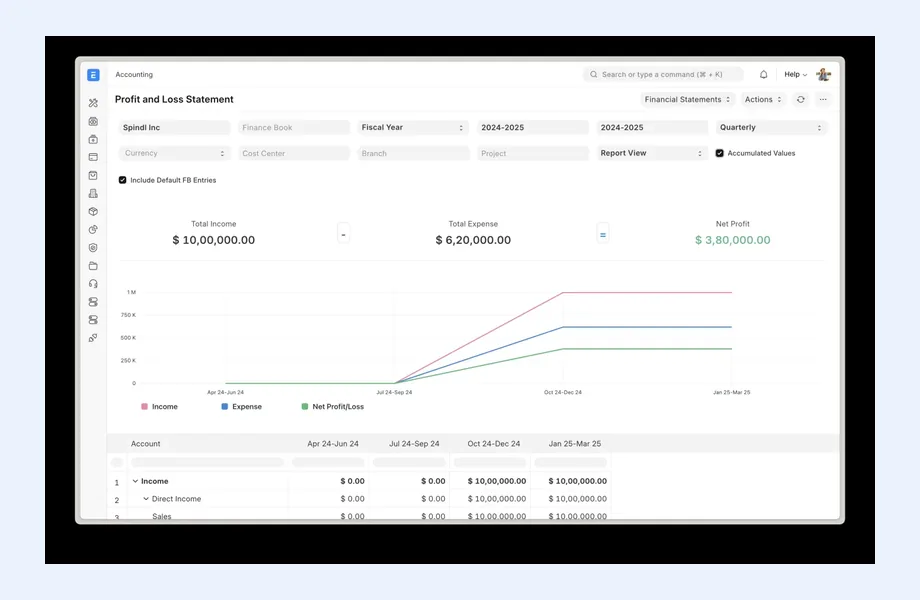
ERPNext's accounting module is generic by design. Out of the box you get a ledger with account groups, journal entries, payment entries, cost centers and accounting dimensions, plus sales and purchase invoices that post automatically from stock and selling. Multi-company and multi-currency are standard, so a Swedish entity can keep books in kronor and invoice in euros. That core behaves the same in every country.
The Swedish layer is a different matter. Frappe maintains regional modules for some countries and community developers publish others, but I would not assume a maintained Swedish app exists for the version you plan to run. Before any estimate I check what ships with ERPNext, what the Frappe app marketplace and community repositories offer, and what any Swedish implementer can show working, then confirm the result with Frappe or the partner involved.
Whatever is missing goes into a short gap list with an owner per line:
That list, not the absence of a license fee, decides whether ERPNext is cheap or expensive for your Swedish books. The wider platform question is covered on my ERPNext consultant Sweden page.
Swedish accountants think in the BAS account plan. Account classes, number ranges and the link from accounts to annual report lines are second nature to them, so an ERPNext chart that ignores that structure creates friction at every close. ERPNext imports a chart of accounts as a tree, with group accounts above postable ledger accounts, and can show account numbers alongside names. I work with your accountant to decide which BAS accounts you actually need, rather than loading the whole plan and letting users guess.
VAT is handled through templates. Sales Taxes and Charges Templates and Purchase Taxes and Charges Templates hold the tax accounts and rates, item tax templates override them for goods or services taxed differently, and tax rules pick the right template by customer, supplier or address. For a Swedish company the scenarios usually include domestic sales, goods and services sold to EU businesses, reverse charge purchases, imports and sales outside the EU. Your advisor confirms the treatment of each; I make sure each lands on its own tax account.
Why separate accounts? Because ERPNext has no Swedish VAT return form in a standard install. The figures for each box normally come from a custom report reading those accounts, so careful account design now keeps the return report simple later. I post test documents for every scenario and compare the report with the accountant's expectations before anyone relies on it.
For a Swedish accounting firm the SIE file is usually the handover point. They load it into their own tools for VAT checks, year-end adjustments and the annual report, and a clean file saves a long round of questions. As far as I can confirm, ERPNext does not produce SIE in a standard install, so treat the export as a small custom app or report until Frappe, the community or your partner shows a maintained one for your version.
The specification I write for the developer covers:
Acceptance is practical. We close a test period in ERPNext, export it, the accounting firm imports it and both sides compare trial balances account by account. Differences point to mapping errors to fix before go-live.
The format helps at migration too: an SIE export from Fortnox, Visma or another current package can feed opening balances into ERPNext through a conversion script. Either way the app goes into the custom app register with a maintainer and an upgrade test, because a broken export tends to surface at year-end, exactly when it hurts most.
Swedish payment habits put specific demands on ERPNext. Customers paying through Bankgiro expect a structured OCR reference on the invoice, with a check digit their bank validates. ERPNext does not generate that format natively as far as I know, so a small server script or app usually creates the reference when the invoice is submitted and prints it on the invoice layout. The harder half is the return trip: incoming payment files or statements must carry the reference back, so the Bank Reconciliation Tool or a matching script can clear the right invoice without anyone reading remittance notes.
Supplier payments follow the same pattern. Your bank defines the payment file or API it accepts, and ERPNext reaches it through an export app, a community integration or a payment service. I define one route per bank account and test it with small real payments before cutover.
Peppol completes the picture for anyone selling to Swedish public bodies, which generally require electronic invoices through that network. ERPNext needs an access point provider for this. I specify which fields leave ERPNext, where the buyer's reference is captured on the sales order, how credit notes are sent and how a rejected invoice returns to the person who can fix it. Incoming supplier e-invoices can arrive the same way and become draft purchase invoices for review.
Every one of these routes depends on an outside party, so each gets a named owner on your side and a fallback for the day it stops working.
ERPNext is released under an open-source license, which gives a Swedish company real choice about where its books live. Frappe Cloud is the hosted service run by Frappe itself; check the regions on offer and note the decision in your GDPR records. Self-hosting on your own EU cloud account means total control, plus sole responsibility for backups, security patches and upgrades. A Swedish implementation partner may offer a third option with hosting and support bundled. Swedish bookkeeping law also sets expectations for how records are kept and accessed, so ask your accountant what the archive must look like and confirm the hosting plan meets it.
Upgrade discipline matters more in accounting than anywhere else. Custom apps for SIE, OCR and Peppol need retesting on a copy of production before each major version change, and someone must own that test.
ERPNext accounting is probably the wrong choice if your finance team wants a Swedish package the accounting firm already supports, if nobody will maintain the custom apps, or if group reporting across several Nordic entities dominates the finance agenda. Then Odoo Accounting in Sweden or a dedicated Swedish accounting system may cost less over time. I am not a Frappe partner and earn nothing from either outcome. See also ERPNext accounting, the ERP consultant Sweden page and the Sweden hub.

Tell me about your business and current systems. I’ll suggest the most sensible first step.
Book a Consultation
Not sure which ERP you need?
Share your business requirements with me and I will help you understand the right process, architecture and platform before implementation.
FAQ
Not one I would assume exists for your version without checking. ERPNext includes regional modules for some countries and the community publishes others. For Sweden I review what Frappe ships, the app marketplace and what partners can demonstrate, then confirm with Frappe or the partner. Anything missing, such as an SIE export or OCR references, becomes configuration or a custom app with a named maintainer.
ERPNext stores tax amounts correctly when templates and accounts are designed well, but it has no Swedish VAT form in a standard install. The usual answer is a custom report that totals the tax and base accounts for each return box, reviewed by your accountant. Filing itself normally stays with the accountant or your own submission routine.
Usually through files rather than daily logins. Most Swedish firms are happiest with an SIE export they can import into their own tools, plus read access to reports when they need detail. I agree the handover with the firm early and test it on a closed period before go-live, so year-end is not the first trial.
Frappe Cloud suits companies without operations staff, since backups and updates are handled for you. Self-hosting suits teams with a developer who wants full control of data location and deployment. Either way, record where data is stored for GDPR, confirm retention with your accountant and keep a tested restore procedure. I compare the options and have no stake in the choice.
I write the specifications, review the work and run acceptance tests with your finance team. The code for apps such as an SIE export is typically written by your own developer, a freelance Frappe developer or a partner, who then owns it through upgrades. That keeps maintenance responsibility clear and my advice independent of who builds.
Every business is different. Share where you are today and what you want to fix, and I’ll tell you honestly whether and how I can help.
Book a Consultation
Insights
 Book a Consultation
Book a consultation to talk through your processes, systems and goals. I’ll reply with practical next steps - no obligation.