Contact Info

 Odoo in the Netherlands
What should a Dutch company check before implementing Odoo?
A Dutch company should check four things before committing to Odoo: whether its warehouse and order flows fit standard Odoo inventory, what the Dutch fiscal localization delivers for BTW and EU listings in the target version, how Peppol invoices would be sent and received, and which edition and hosting model it can support long term. Working remotely as a freelance Odoo consultant, I put each point to the test before any partner starts building.
Last reviewed by Vikas Saroj
I work remotely with Dutch businesses whose margins depend on moving goods accurately: wholesalers, webshops selling across Europe, importers clearing goods for other EU markets and firms running their own warehouse next to a logistics partner. Their pain usually shows up as stock that disagrees with the shelf and invoices that trail shipments.
Odoo can join purchasing, inventory, sales channels and accounting in one database, and its warehouse features go further than many small-business tools. The question I answer first is whether your specific flows fit standard Odoo, because the cost of an Odoo project depends far more on customization than on the subscription.
 What I Do
My Odoo work in the Netherlands centers on stock accuracy, tax correctness and keeping custom code out of the core.

Each inbound, storage, picking, packing and shipping step compared with standard Odoo inventory, with every gap classified as configuration, process change, existing module or genuine development.

BTW scenarios, the intra-EU listing and reverse charge flows run through the Dutch fiscal package in your target version, with your tax advisor confirming which results are correct.

A tested route for sending and receiving structured invoices from Odoo, covering whether Odoo's own access point or a third-party provider is used and which partner data must be complete.

Community or Enterprise and Odoo Online, Odoo.sh or self-hosting weighed against your custom module plans, support model and data protection requirements, written up as a decision note.

Webshop, marketplace, carrier label and third-party warehouse connections designed with clear ownership of orders, stock and tracking data, plus monitoring for failed messages.

Independent review of proposals from Odoo implementers, estimates and module lists, then acceptance testing against your requirements so the delivered system matches what was contracted.
Workflow
Fit and risks before contracts
 Warehouse walk-through on video
Fit-gap matrix completed
Localization test on trial
Edition and hosting chosen
Partner shortlist briefed
Warehouse walk-through on video
Fit-gap matrix completed
Localization test on trial
Edition and hosting chosen
Partner shortlist briefed
Configured and integrated
Routes and locations set
Tax and Peppol tested
Channel connectors verified
Data loads reconciled
Acceptance scripts executed
Live operations settled
Opening stock counted
First BTW period checked
Warehouse staff trained
Issue log closed out
Dutch distributors rarely run a simple single-location stock room. Goods arrive by container or truck, are received against purchase orders, put away into racking, sometimes repacked, then picked and shipped to customers across Europe. Some stock sits in a third-party logistics warehouse, some in transit, some reserved for marketplace orders.
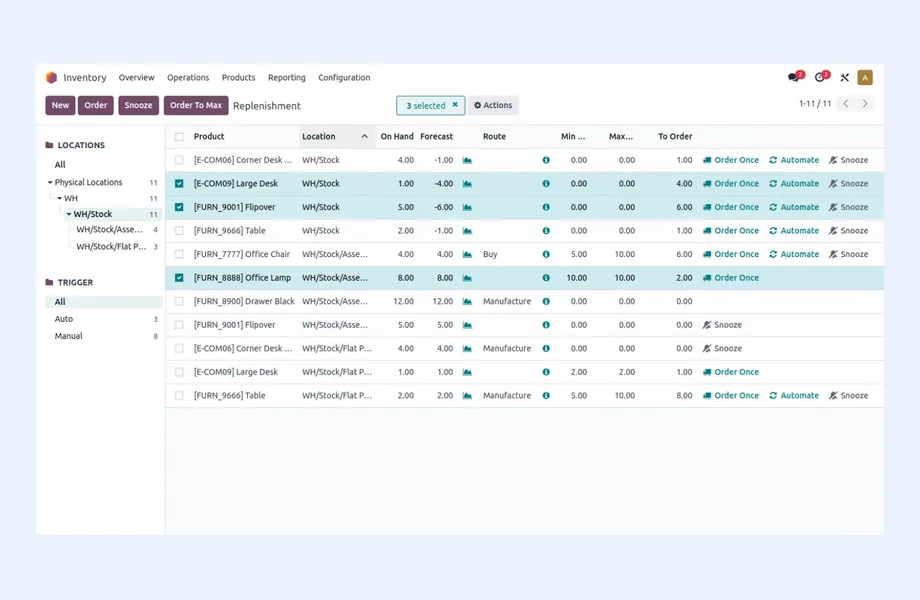
Standard Odoo handles a lot of this through warehouses, locations, routes, multi-step receipts and deliveries, lots and serial numbers, and reordering rules. The risk lies in the details that make your operation different: cross-docking, consignment stock, customer-specific labeling, or a third-party warehouse that sends stock updates in its own format.
I walk through each flow with your operations lead on video, using real orders, and record a fit-gap matrix. Each gap is labeled as configuration, a process change, an existing module or real development, with the effect on upgrades noted. That matrix becomes the brief for partners and keeps estimates honest. The Odoo Inventory page explains the inventory features, and my gap analysis service describes the method.
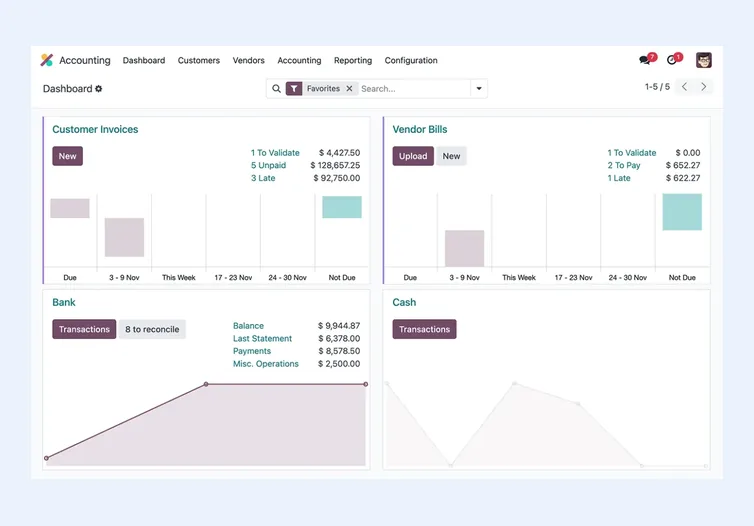
Odoo maintains a Dutch fiscal package that sets up a chart of accounts, tax definitions and tax reports, and its contents evolve from version to version. I do not rely on a feature list. I install the version you plan to use on a trial database and run your advisor's scenarios through it.
For a Dutch trading company those scenarios typically include domestic sales at different rates, intra-EU supplies of goods to business customers, acquisitions from other EU countries, imports, reverse charge flows and distance sales to private buyers elsewhere in the EU. For non-EU groups using a fiscal representative, the question of who reports what must be settled with your advisor before configuration. Each scenario is checked on the invoice, in the ledger and in the tax report and intra-EU listing.
If an import VAT arrangement or fiscal unity affects your returns, I record how your advisor wants it reflected and test that too. Anything the package cannot produce becomes a configured workaround or a documented month-end step. The finance side is covered more fully on my Odoo Accounting page.
Structured e-invoicing is already expected by Dutch public sector buyers, and the EU direction points toward wider use between businesses. Recent Odoo versions can exchange invoices over Peppol, but the route, whether through Odoo's own service or a third-party access point, and the conditions attached depend on version, edition and hosting. I confirm the current position and test sending and receiving with real partner data before go-live.
The edition choice deserves a written decision. Community has no subscription but leaves out several Enterprise features, and parts of some localizations and e-invoicing tooling may only be available in Enterprise. For Dutch companies the decisive questions are usually accounting depth, bank synchronization, Peppol handling and whether the partner will support Community at all.
Hosting follows. Odoo Online is simplest, Odoo.sh suits companies with custom modules, and running your own server with a European host means every update and backup is yours to manage. GDPR applies in all three, so I record where data is held, who can access it and what the processing terms say. The Odoo overview compares these options more generally.
Odoo is implemented mainly through partners, and Dutch companies can choose among firms in the Netherlands, Belgium and other countries. Proposals differ in how much they customize, how they phase delivery and how they price support. Comparing them is hard without a shared brief.
No Odoo subscription or development invoice pays me anything, which keeps me firmly on your side. I prepare the requirements and fit-gap matrix, brief shortlisted partners, script demos around your hardest flows and score the responses. During the build I review configuration decisions, challenge new customization requests and run acceptance tests with your warehouse and finance teams.
All of this runs remotely in English. Dutch-language work instructions, labels and floor training are prepared by your own staff or the partner, and I check them against the design. The Dutch working morning overlaps my afternoon in India, which suits workshops, while document review fills the rest. My Dutch ERP consulting page puts Odoo in the context of other platforms, and the Netherlands hub summarizes my wider services.
Odoo is a strong candidate for many Dutch traders, but not for every company. I would advise a harder look in these cases:
These are not reasons to avoid Odoo by default; they are reasons to test properly, with your own order lines, stock movements and tax cases rather than demo data. A Dutch company that hits one of these limits after go-live usually pays for it in custom code or a second system. My ERP evaluation compares Odoo with alternatives using your own scenarios, so the decision is grounded in evidence.

Tell me about your business and current systems. I’ll suggest the most sensible first step.
Book a Consultation
Not sure which ERP you need?
Share your business requirements with me and I will help you understand the right process, architecture and platform before implementation.
FAQ
Odoo maintains a Dutch fiscal package with tax definitions and reports, and its contents change between versions. I test your advisor's scenarios on a trial database in the version you plan to use, so you know what works as delivered and what needs configuration or a manual step.
Recent versions can exchange invoices over Peppol, but the route and conditions depend on version, edition and hosting. I confirm the current position, test sending and receiving with your real customer and supplier data, and check which identifiers must be complete. Ask your advisor which e-invoicing duties apply to your company.
For many distributors, yes, provided the flows are tested against standard features first. Very high-volume or automated warehouses often need a dedicated warehouse system alongside the ERP. A fit-gap matrix built from your real orders shows which situation you are in.
Yes. Many clients bring me in after choosing a partner, to review the design, keep scope under control and run acceptance testing. I work transparently with the partner, and my recommendations are shared with both sides so decisions are recorded and understood.
Every business is different. Share where you are today and what you want to fix, and I’ll tell you honestly whether and how I can help.
Book a Consultation
Insights
 Book a Consultation
Book a consultation to talk through your processes, systems and goals. I’ll reply with practical next steps - no obligation.