Contact Info
 Toronto
What does an Odoo consultant do for a Toronto-area business?
An Odoo consultant helps a Toronto-area company decide whether Odoo fits its production, warehouse and sales flows, then designs the setup before anyone configures it. Around the city that often means made-to-order millwork and fabrication for construction projects, barcode-driven warehouses near the airport and online brands selling through several channels. I do this remotely and independently, alongside or ahead of an Odoo implementer.
Last reviewed by Vikas Saroj
Drive through Concord, Vaughan, Etobicoke or the industrial parks of Mississauga and you pass a great many businesses that build things to order, store goods for others or ship products bought online. Many of them run on accounting software plus spreadsheets, and Odoo comes up often when they look for one system covering production, stock and sales.
I work remotely as an independent Odoo consultant for these companies. I map how work really flows, test whether Odoo's manufacturing, inventory and sales apps fit, design the setup and review what an Odoo implementer proposes. I sell no licenses and I am not an Odoo partner.
The aim is a design your team and your implementer can build from with confidence.
 What I Do
I design and verify; the build is done by your team or an implementer, with my review at each stage.

For millwork, cabinetry, window and metal suppliers to condo and commercial projects, I design how Odoo links bills of materials, production orders and deliveries to each project, floor and unit type.

For machine shops and fabricators, I set up work centers, routings and operation tracking so quotes, capacity and actual hours on the floor can finally be compared job by job.

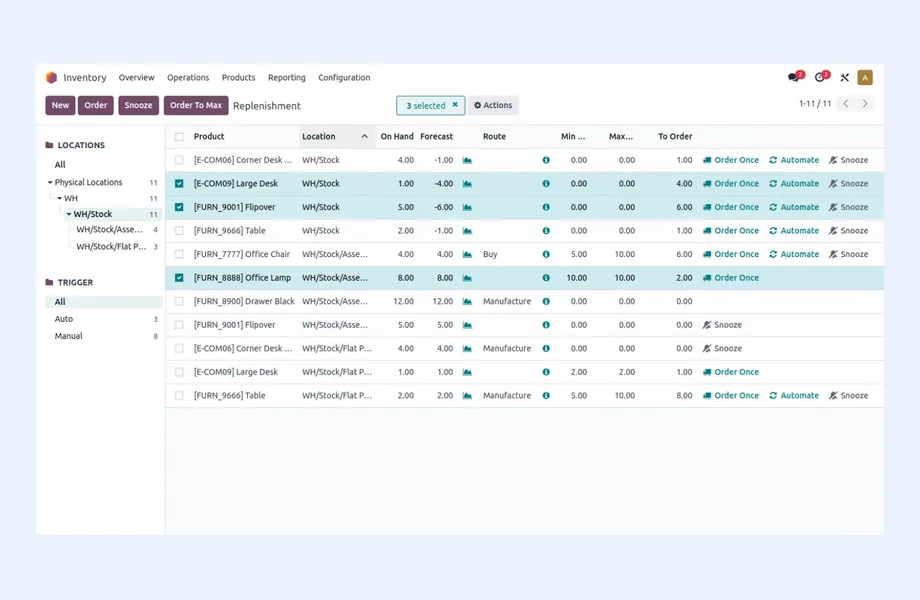
For distributors and third-party warehouses near the airport, I design locations, put-away rules, picking methods and scanning steps, then test them with your busiest order profiles.

Odoo lets each user work in their own interface language. I plan which languages your floor staff need, and have translated labels and instructions checked by fluent people on your team.

For direct-to-consumer brands, I decide whether Odoo's own store or a connector to your existing storefront fits better, and design order flow, returns and stock allocation across channels.

When an Odoo implementer quotes the project, I check scope, custom module plans, edition and hosting choices and data migration effort before you sign.
How I Work
See production and stock flows
 Video tour of floor and racking
Trace one project end to end
Collect drawings, BOMs and picks
List workarounds and pain points
Video tour of floor and racking
Trace one project end to end
Collect drawings, BOMs and picks
List workarounds and pain points
Test Odoo against your cases
Prototype key flows in Odoo
Decide edition and hosting
Mark gaps and custom needs
Write the design document
Check the build before launch
Review implementer configuration
Run scanning and production tests
Check opening stock by location
Coach supervisors for go-live
Toronto's steady stream of condo towers, rental buildings and office fit-outs supports a large supply chain of manufacturers just outside the city: kitchen cabinet and millwork shops, window and door fabricators, metal and glass suppliers, stair and railing makers. Their work is rarely made to stock. Each order belongs to a project, often with many unit types, revisions to drawings and deliveries timed floor by floor to the builder's schedule.
Generic manufacturing setups struggle with this. I design Odoo so each sales order is tied to a project, bills of materials reflect unit types and finishes, and production orders can be grouped by floor or delivery wave. Drawing revisions need a clear rule: which version was produced, and what happens to work in progress when the architect changes a dimension.
Deliveries are just as important. A builder may hold a cabinet supplier to a tight window on a site with limited loading space, so I plan delivery scheduling and proof of delivery alongside production. Costing then compares quoted and actual cost by project, which is the number owners in this trade most want and rarely have. Odoo Manufacturing covers the base features I work from.
The region's industrial belt also holds many machine shops, fabricators and contract manufacturers serving automotive, aerospace, food equipment and general industry customers. They tend to run high-mix, low-volume work where every quote is slightly different and capacity is the real constraint.
For these businesses I start with the routings. Which work centers exist, and which are the bottlenecks? How long do setups really take? Who records time on each operation, and how? In Odoo, work centers, operations and shop floor tablets can capture actual times against each step, but only if the routing reflects how the floor really works. I design routings with your production lead rather than from a template, then test them on a handful of recent jobs.
Once actual times are flowing, quotes can be compared with reality, and the estimator can see which kinds of jobs consistently run over. That feedback loop is often worth more than any other feature. If the shop also needs quality records or certificates for customers, I scope how those attach to each production order and shipment, and whether a standard Odoo app or a small custom addition is the better route.
The area around Pearson and along the highways in Mississauga and Brampton holds a dense cluster of distribution centers and third-party warehouses. Teams there are often multilingual, and staff turnover in busy seasons can be high, so a warehouse system must be simple to learn and hard to misuse.
Odoo's barcode app helps here, and each user can work in their own interface language, which reduces training time for staff more comfortable in Punjabi, Tagalog, Spanish or another language than in English. I plan which languages are needed and have labels and on-screen instructions checked by fluent supervisors, since standard translations do not always match warehouse vocabulary.
The design covers locations and bin naming, put-away rules, picking method by order type, packing and carrier labels. For carriers, I check whether a connector exists for the ones you use or whether labels come from a separate shipping tool. Then I test with your real peaks: a Monday morning wave of retail orders, a container receipt, a cycle count. Odoo Inventory describes the core features involved.
Toronto also has a lively community of direct-to-consumer brands in apparel, beauty, food, home goods and accessories, many of which also sell wholesale to retailers. As they grow, stock gets split across a storefront, marketplaces, wholesale orders and sometimes a third-party warehouse, and oversells become regular.
The first decision is whether to move the storefront into Odoo's own e-commerce app or keep the current storefront and connect it. For a brand with an established, heavily customized store, connecting is usually the safer route; for a simpler catalog, running everything in Odoo can reduce moving parts. I compare both with your marketing and operations leads before recommending one.
Then I design the flows that matter: how orders land in Odoo, how stock is reserved per channel, how returns are inspected and restocked, how wholesale price lists and payment terms differ from retail, and how fees and payouts reconcile in accounting. National questions such as sales tax across provinces and French documents are covered on my Odoo consultant page for Canada.
There are Odoo implementers in the Toronto region and many more working remotely. I do not compete with them for configuration and development. My role is to make sure the design is right before they start, and that what they build matches it. I review proposals for scope, the number of custom modules, edition and hosting choices and migration effort, and I stay on as your reviewer during the build if you want that.
Odoo is not always the answer. A supplier deeply embedded in automotive customer schedules and quality systems may need a platform with stronger industry support. A business with very complex pricing, rebates and approvals may face more custom work than it expected. And an organization without anyone internally to own the system after launch may struggle with Odoo's pace of change between versions.
All of my work is remote. Live sessions sit in the Toronto morning, which overlaps with my evening in India, and floor walk-throughs happen by video. If seeing the floor in person would help, we can schedule a visit by arrangement. For the broader ERP picture, see my Toronto ERP consultant page, or compare with the ERPNext option for Toronto.

Tell me about your business and current systems. I’ll suggest the most sensible first step.
Book a Consultation
Not sure which ERP you need?
Share your business requirements with me and I will help you understand the right process, architecture and platform before implementation.
FAQ
Yes, with careful design. I link each sales order to a project, structure bills of materials by unit type and finish, group production by floor or delivery wave, and set rules for drawing revisions. Testing with a recent real project shows whether the standard apps are enough or a small custom addition is needed.
Odoo lets each user choose their interface language, which helps a mixed-language team. Standard translations do not always match warehouse vocabulary, so I have fluent supervisors check labels and scanning instructions. Training then focuses on a few short scanning routines per role rather than the whole system.
It depends on the store. A heavily customized storefront with many apps is often better kept and connected to Odoo, while a simpler catalog may run well inside Odoo's own e-commerce app. I compare both with your team, including how orders, stock, returns and payouts would flow, before recommending.
Yes. I check whether the scope matches your processes, how much custom development is planned and why, which edition and hosting are assumed, and how data migration is handled. You get a short list of questions and risks to raise with the implementer before signing.
Every business is different. Share where you are today and what you want to fix, and I’ll tell you honestly whether and how I can help.
Book a Consultation
Insights
 Book a Consultation
Book a consultation to talk through your processes, systems and goals. I’ll reply with practical next steps - no obligation.