Contact Info

 Ottawa
Which Ottawa organizations are a good fit for Zoho?
Zoho suits Ottawa organizations whose work is mostly relationships, deadlines and documents rather than stock or production: consultancies tracking federal solicitations from notice to debrief, government relations practices logging meetings with officials, and small resource firms matching consultants to call-ups. Working remotely and with no tie to Zoho, I design CRM, Recruit and Books around those workflows and say plainly when material is too sensitive for a general cloud service.
Last reviewed by Vikas Saroj
A large part of Ottawa's private sector earns its living from proposals, relationships and people placed on government work. Those firms need a dependable record of which solicitations are open, who has met which officials and which consultants are free for the next call-up far more than they need a warehouse module. Zoho's CRM, recruiting and finance apps can cover much of that for a small or mid-sized firm.
My Zoho work for consultancies, public affairs practices and resource firms in the capital is delivered remotely and independently. I map how the work moves before choosing apps, keep custom code to what the process needs, and tell you where Zoho should not be used at all. I am not a Zoho partner and do not sell licenses.
 What I Do
Each setup starts from one real bid, mandate or placement, and only the Zoho apps that serve it are switched on.

A custom CRM module for federal and institutional solicitations, with stages from notice to bid decision, questions, submission and debrief, plus reminders for closing dates and the documents each bid needs.

A short, consistent bid or no-bid record for each opportunity, covering fit, likely competitors, teaming partners, resources required and pricing approval, so leadership can see why the firm pursued or passed.

For public affairs and government relations practices, linked records of mandates, officials, meetings and subjects discussed, so registrants can find what they need when preparing lobbying registry reports.

Roles, profiles and sharing rules that keep each mandate's strategy notes visible only to the team working on it, which matters when one practice advises clients whose interests may collide.

For resource firms, consultant records with skills, availability and current resumes in the formats departments request, linked to each call-up, with any screening status field approved by your security officer.

Placements and approved time flow into Zoho Books invoices that quote contract references, with subcontractor bills recorded against the same placement, and a clear point where a full ERP would serve better.
How I Work
Follow a bid, a meeting, a placement
 Walk one opportunity end to end
List records, owners and deadlines
Mark what must stay outside Zoho
Agree what a good result is
Walk one opportunity end to end
List records, owners and deadlines
Mark what must stay outside Zoho
Agree what a good result is
Choose apps and shape the records
Select the Zoho apps that fit
Define modules, fields and stages
Set roles and sharing rules
Plan imports from spreadsheets
Launch, train and trim
Test with real past opportunities
Train users by role
Review actual usage after launch
Remove fields nobody uses
Consultancies and technology firms in Ottawa put real effort into bids: watching CanadaBuys and other tender sources, deciding which notices are worth pursuing, assembling teams, answering mandatory and rated criteria, and asking for a debrief when a bid fails. In many small firms that knowledge sits in an inbox and a shared drive, so nobody can say how many bids are open, what the last loss taught the team, or which teaming partner holds the resume you need.
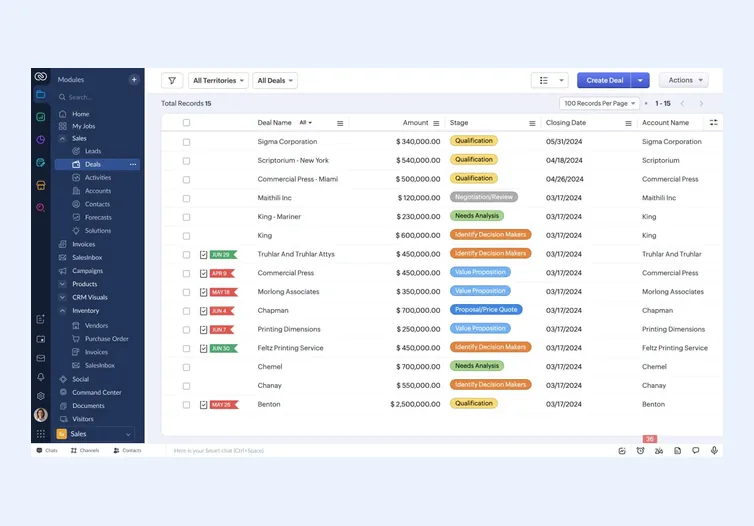
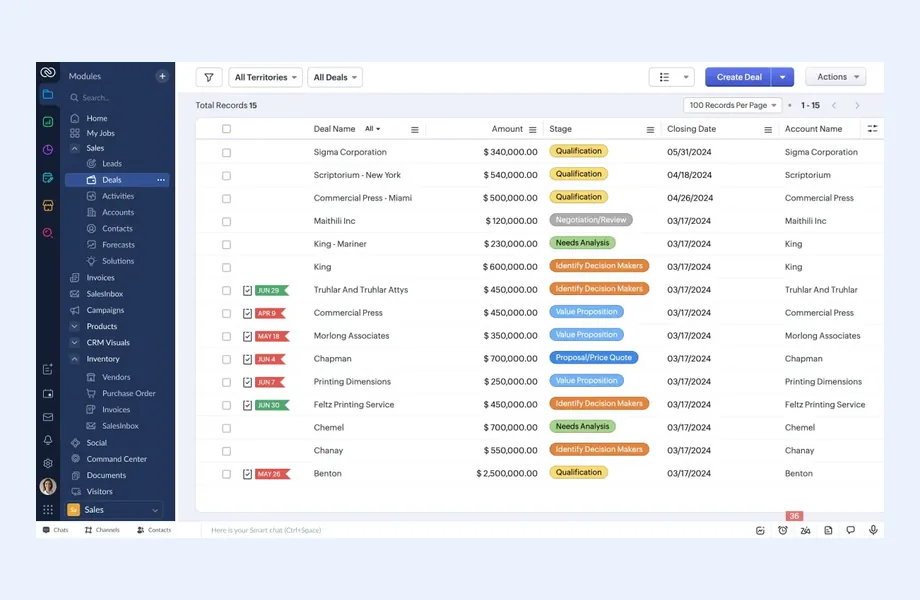
Zoho CRM handles this well with a custom module for solicitations. Each record carries the issuing organization, closing date, question period, mandatory requirements and the people assigned, and a Blueprint moves it through screening, bid decision, drafting, submission and outcome. Reminders fire ahead of deadlines. Proposal documents stay in Zoho WorkDrive with version history, linked from the record. Where an export of tender notices is available, it can be imported; otherwise someone screens notices and logs only the relevant ones, which keeps the pipeline clean.
The value shows after a few bid cycles: win and loss reasons recorded the same way every time, debrief notes searchable, and leadership able to see the effort each opportunity consumed. I keep the design deliberately small, since a pipeline that is tedious to update is soon abandoned. General notes on the product itself are on the Zoho CRM page.
The capital is home to government relations firms, public affairs consultancies and in-house advocacy teams at national associations. Their working record is a web of mandates, officials, meetings, committee appearances, consultations and briefing notes. Registered lobbyists also carry reporting duties: federal rules require certain communications with designated public office holders to be reported, and provincial and municipal registries can set rules of their own.
A CRM built for sales pipelines fits this work poorly out of the box, but Zoho CRM can be reshaped around it. The design defines modules for mandates, officials and interactions, with each meeting linked to the client, the official, the subject matter and the people who attended. Reports then give a registrant the material needed to check filings, and the history of a file survives when a consultant moves on.
Two cautions apply. Whether a particular meeting must be reported is a question for the registrant and their counsel, not for the software; the CRM only makes the record complete and searchable. Confidentiality between mandates also matters, because one practice may advise clients whose interests collide. Roles, profiles and sharing rules limit each mandate's notes to the team working on it, and that design is tested with dummy records before any real files are loaded. The CRM consulting page explains how I approach record design generally.
Firms that supply consultants to federal departments compete on speed and fit. When a call-up or a request for a named resource arrives, the firm has little time to propose someone with the right skills, experience and availability, with a resume in the layout the department asks for. That is a recruiting problem as much as a sales problem, which is why Zoho Recruit, with its staffing-oriented features, deserves a look alongside Zoho CRM.
The design I propose keeps one record per consultant: skills described in the department's own vocabulary, availability dates, current and past placements, resume versions and the subcontracting arrangement. Each request is logged against the client department, matched to candidates and tracked through submission and award. A field for screening status can exist, but what it holds, if anything, is decided by your company security officer, and detailed screening records stay out of Zoho entirely.
Billing then moves to Zoho Books. Placements become invoices that quote contract references, and subcontractor bills are recorded against the same placement so the margin is visible. Approved timesheets have to come from a dependable source, and choosing it is part of the design. Where pass-through billing grows complicated, the Ottawa ERP business analyst page describes the deeper requirement work involved.
An honest fit assessment matters a great deal here, because some Ottawa work carries obligations a general cloud service may not meet. Protected or classified government information, controlled goods data and anything covered by a contract's security clauses should not go into Zoho, or any comparable platform, unless your company security officer has approved it in writing. Some contracts and funding agreements also say where data must be hosted. Check those terms, and see the Canadian Zoho page for the data location questions worth asking.
Zoho is also a weaker choice once the finance side outgrows it. A firm with many concurrent contracts, ceilings per task, layered subcontracting and project accounting that auditors examine closely may find Zoho Books and Zoho Projects stretched, and a full ERP with stronger project costing may serve it better. National associations with complex membership categories, chapters and continuing education rules may be better served by a dedicated association management system connected to the ledger.
In each case I say so early, before money goes into configuration. Recommending against Zoho costs me nothing, because I earn nothing from licenses. The Zoho platform page sets out the broader strengths and limits of the suite.
The engagement is remote, with visits by arrangement. It begins by following one real item from start to finish: a solicitation from notice to debrief, a mandate from first meeting to registry report, or a consultant from request to placement and invoice. That walk-through shows which Zoho apps are needed and which are not, and it reveals the data that must stay outside the system.
I then write a short design covering modules, fields, stages, roles, automations and imports, with the reason for each. Configuration and any Deluge scripts follow the design and are documented so your team or another consultant can maintain them later. Testing uses genuine past examples, such as last quarter's bids or a mandate that recently closed. The engagement runs in English; where staff need French layouts or email templates, the French text comes from a native speaker of French in your firm or at a local partner and is checked inside Zoho before launch.
After launch, I review how people actually use the system and remove what nobody needs, because a lean setup is the one that stays current. The Ottawa ERP consultant page gives the wider context, and the city's Odoo and ERPNext pages cover the alternatives.

Tell me about your business and current systems. I’ll suggest the most sensible first step.
Book a Consultation
Not sure which ERP you need?
Share your business requirements with me and I will help you understand the right process, architecture and platform before implementation.
FAQ
Yes, with a custom module for solicitations and a Blueprint for the stages from screening to debrief. Each record holds the closing date, question period, mandatory requirements and assigned team, with reminders before deadlines. Where a notice export is available it can be imported; otherwise someone logs the relevant notices by hand, which keeps the pipeline focused.
It can hold the records a registrant draws on: mandates, officials, meetings, dates and subjects, all linked and searchable. It cannot decide which communications must be reported; that judgment belongs to the registrant and their counsel. I design the records and reports so the information is complete and quick to retrieve when filings are prepared.
It is worth evaluating. It can hold consultant records, skills, availability and resume versions, and track submissions against each request, while billing runs through Zoho Books. Detailed security screening records should stay out of it, and your company security officer decides what status information, if any, it may contain.
Not without explicit approval from your company security officer, and often not at all. Protected or classified material, controlled goods data and information covered by contract security clauses generally belong in systems approved for them. I design Zoho setups that keep such material out and hold only the business records the officer accepts.
Sometimes. Zoho CRM can manage a straightforward membership with renewals invoiced through Zoho Books. Associations with many member categories, chapters, continuing education tracking and a busy event program may fit better on a dedicated association management system linked to the ledger. I compare both against your actual rules before you commit to either.
Every business is different. Share where you are today and what you want to fix, and I’ll tell you honestly whether and how I can help.
Book a Consultation
Insights
 Book a Consultation
Book a consultation to talk through your processes, systems and goals. I’ll reply with practical next steps - no obligation.