Contact Info

 Zoho in London
How does an independent Zoho consultant help a London service firm?
London agencies, studios and recruiters often run on a pile of separate subscriptions for sales, projects, freelancers, invoicing and chat, with hybrid teams switching between them all day. An independent Zoho consultant decides which Zoho apps can replace that pile, designs the client-to-cash flow across them and keeps out what should stay specialist. I do this remotely, with no ties to Zoho or its resellers.
Last reviewed by Vikas Saroj
Clerkenwell design studios, Soho post-production houses, Shoreditch digital agencies, recruitment firms in the City and West End, event producers and boutique consultancies share a pattern. Their work is sold, staffed and delivered client by client, often with freelancers in the mix and a hybrid team that is rarely all in one room.
Over time these firms collect tools: one for pipeline, one for projects, one for timesheets, one for freelancer invoices, another for chat and file sharing. I work remotely as an independent Zoho consultant to decide whether Zoho can bring that work under one roof, which apps actually earn their place, and how a brief becomes an invoice without retyping.
 What I Do
Each item addresses a point where London service firms tend to lose time, margin or visibility between tools.

I list every subscription the firm pays for, what each one does and who uses it, then show which jobs Zoho apps can take over, which tools should stay and what the switch would involve.

I design how a new brief moves from a Zoho CRM deal into a Zoho Projects job with budget, tasks and timesheets, then into Zoho Books invoices on the agreed fee basis, without anyone retyping it.

Creative and production firms depend on freelancers. I set out how bookings, purchase orders, freelancer bills and project costs connect, so the margin on each job reflects outside spend as well as staff time.

For agencies, I compare Zoho Recruit and Zoho CRM against specialist recruitment software, covering candidates, client roles, submissions, placements and fee invoicing, and say plainly when a specialist tool fits better.

For teams split between home, studio and client sites, I plan how chat, shared files, approvals and client communication sit inside Zoho, with permissions that match who should see each client's work.

If a Zoho implementer does the build, I write the scope, review their design and test the finished flows against your real jobs, so what is delivered matches what the firm needs.
How I Work
Tools, flows and handoffs
 List subscriptions and owners
Trace one job end to end
Find retyping and double entry
Agree what must stay specialist
List subscriptions and owners
Trace one job end to end
Find retyping and double entry
Agree what must stay specialist
The Zoho app plan
Choose apps and edition
Map deal, job and invoice fields
Define roles and permissions
Plan data moves and cutover
Switch and settle in
Test with live client jobs
Retire old tools in sequence
Train by role, not by app
Review usage after first month
London has a very large population of small and mid-sized service businesses: design and branding studios, advertising and digital agencies, film and post-production companies, event producers, executive search and recruitment firms, and specialist consultancies. Many began with a handful of founders and a set of free or cheap tools, then grew into teams of dozens with each department picking its own software.
The result is familiar. Pipeline sits in one tool, resourcing in a spreadsheet, projects in another tool, timesheets in a third, invoices in the accounting package and conversations in chat. Each subscription is reasonable on its own, but together they cost a noticeable sum, and nobody can see a job's profitability without exporting data from several places.
Zoho is attractive here because one suite covers most of these jobs, and the apps share users and customer records. That does not mean every London firm should move everything into it. My starting point is an honest audit: which of your tools does Zoho genuinely replace, which ones are specialist enough to keep, and whether the savings and simplicity outweigh the effort of switching. The national topics, including VAT filing, data center choice and payroll links, are covered on my UK Zoho consultant page.
A London agency or studio sells work in many shapes: fixed-fee projects, retainers, day-rate production, usage fees and pass-through costs like media, printing or location hire. The system has to keep the commercial agreement attached to the work from the first conversation to the final invoice.
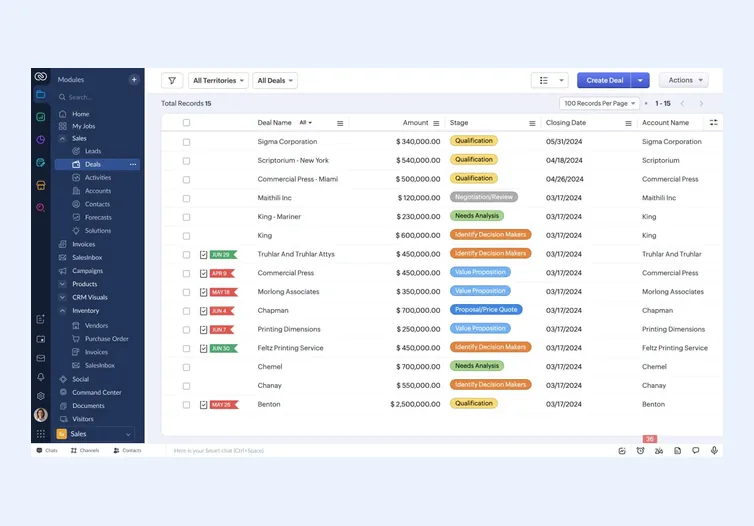
In Zoho, that chain typically spans three apps. A deal in Zoho CRM holds the brief, estimate and fee basis. When it is won, a job is created in Zoho Projects with phases, a budget and timesheets for staff and freelancers. Zoho Books then raises invoices against milestones, retainers or time, and records supplier bills against the same job. The design decisions are in the details: how estimates are versioned, when a change order becomes a new budget line, how retainers roll over and which costs are recharged to the client with or without markup.
Freelancers deserve particular attention because London's creative sector relies on them. I map how a freelancer is booked, how their costs are approved and how their invoices reach the right job, so a project that looks profitable on staff hours does not quietly lose money on outside spend.
London has a dense recruitment market, from high-volume temporary staffing to executive search for the City. Recruiters often ask whether Zoho can run their whole business, because it would let them combine candidate management, client sales and invoicing in one suite.
Zoho Recruit is Zoho's applicant tracking product, and it can handle candidates, client job orders, submissions and placements, with Zoho CRM and Zoho Books alongside for business development and fee invoicing. For a growing permanent recruitment or search firm, that combination can be a sensible fit. I test it against the firm's real process: how roles are taken, how candidates are sourced and shortlisted, how interviews are scheduled, how placement fees and rebates work and what the consultants' commission reporting needs.
For temporary and contract staffing, timesheets, pay and bill rates and the payroll side add complexity, and specialist recruitment software built for that model may serve better. I say so where it applies, and design a clean link between the specialist tool and Zoho Books if that is the right answer. Candidate data protection obligations are set by your own advisors, and I make sure the system supports their retention and consent rules. My UK recruitment ERP page covers the wider sector options.
Many London firms now work in a hybrid pattern, with people in the studio on some days, at home on others and regularly on client sites. Their clients may sit in New York, Dubai or continental Europe. That affects how a Zoho setup should be organized.
I plan where conversations and files live, so client context is attached to the deal or job rather than buried in personal inboxes and chat threads. Approvals for estimates, purchase orders and freelancer costs are designed to work from a phone. Permissions follow client confidentiality: a team working on one brand should not see a competitor's brief, which matters to agencies holding rival accounts.
International clients bring currency and paperwork questions. I design how quotes and invoices in dollars or euros are raised, how exchange differences are handled in the books and which client entities and billing contacts are held where. Tax treatment of cross-border services is confirmed with your accountant, and the system is configured to follow their advice. If a firm also needs project costing in more depth, my project costing page explains the options beyond Zoho.
The work runs remotely. London mornings fall inside my working day in India, a pattern that suits creative teams whose own days often run late. Workshops are short and focused on one flow at a time, such as estimate approval or freelancer booking, because a long session with a busy studio rarely holds attention.
I am an independent Zoho consultant. I do not resell Zoho licenses and take no commission, so I can recommend fewer apps, a cheaper edition or keeping a specialist tool when that is the better answer. Where your firm prefers a Zoho implementer to configure the system, I write the scope and act on your side during the build; for simpler setups, I guide your own administrator through the configuration.
After go-live, I review how the team is actually using the system and remove steps that people are working around. A visit to the studio can be arranged where it would genuinely help, such as a launch session with the whole team. For more on the suite itself, see the Zoho platform page, or start from the London ERP consultant overview.

Tell me about your business and current systems. I’ll suggest the most sensible first step.
Book a Consultation
Not sure which ERP you need?
Share your business requirements with me and I will help you understand the right process, architecture and platform before implementation.
FAQ
Often it can replace several, such as the CRM, project tool, timesheets and invoicing, but not always all of them. Specialist tools for creative review, media buying or resourcing may still be worth keeping. I audit each tool against what Zoho actually offers and recommend only the switches that make the firm simpler, not just smaller on paper.
It depends on your model. For permanent recruitment and search, Zoho Recruit with Zoho CRM and Books can work well. For high-volume temporary or contract staffing with timesheets and pay and bill rates, a specialist recruitment platform may fit better. I compare both against your real process before you commit.
By linking every freelancer booking to a job and a budget line. In Zoho, that usually means a purchase order or approved booking against the project, freelancer bills matched to it in Zoho Books, and a job report that shows staff time and outside spend together, so overruns are visible while the job is still running.
Either. For smaller firms, I design the setup and guide your administrator through configuration. For larger builds or custom development, a Zoho implementer usually does the work, and I act as your independent advisor: writing the scope, reviewing their design and testing the result against your jobs.
Every business is different. Share where you are today and what you want to fix, and I’ll tell you honestly whether and how I can help.
Book a Consultation
Insights
 Book a Consultation
Book a consultation to talk through your processes, systems and goals. I’ll reply with practical next steps - no obligation.