Contact Info

 Riyadh
How does a Zoho consultant help businesses in Riyadh?
A Zoho consultant helps Riyadh businesses fit Zoho to teams that sell and serve across a very large city. I design CRM territories and visit tracking by district, plan service desks for summer maintenance peaks, set a sensible Zoho One adoption order for growing firms and decide how regional offices share data with a parent's CRM. The work is remote and independent of any vendor.
Last reviewed by Vikas Saroj
Riyadh stretches a long way in every direction, and a sales or service team can spend much of its day on the road between districts. Companies that sell, install or maintain things across the capital need a system that shows where people are, what they promised and what is still open, and many look at Zoho for that reason.
As an independent Zoho consultant working remotely, I help Riyadh businesses decide which Zoho apps they really need, how to set them up around territories, visits and service calls, and where Zoho is not the right answer. I am not a Zoho reseller, so the advice stays on what fits your operation.
 What I Do
The work starts from how your people move around the city and serve customers, then maps that onto the Zoho apps that fit.

I design CRM territories around the districts your team actually covers, with visit logging, follow-up tasks and manager views, so leadership can see coverage across north, east and central Riyadh without a weekly spreadsheet.

For maintenance and after-sales businesses, I plan how tickets, technician assignment and service contracts are handled in Zoho Desk or Zoho's field service app, with the summer peak in mind.

I recommend which Zoho One apps to switch on first, which to leave until the team is ready, and who owns administration, so a growing Riyadh company avoids a sprawl of half-used apps.

Where a Riyadh office belongs to a group that runs another CRM elsewhere, I assess whether Zoho should be the local tool, how pipeline reaches the parent and what should stay in one place.

I specify small Zoho Creator apps for internal requests that do not fit standard apps, such as site material requests or compound work orders, with the approval rules your business already uses.

If a Riyadh Zoho implementer is building the system, I review their design, test the scenarios that matter to you and keep a written list of open issues until handover.
How I Work
Understand how teams move and sell
 Map territories and routes
Review current lead sources
List service and contract types
Note peak season pressures
Map territories and routes
Review current lead sources
List service and contract types
Note peak season pressures
Choose apps and shape the setup
Select Zoho apps to adopt
Define stages, fields and layouts
Plan visits and ticket flows
Agree admin ownership
Test with real Riyadh scenarios
Script visit and service tests
Review implementer configuration
Train managers on dashboards
Track issues to closure
A sales team covering Riyadh works differently from one in a compact city. Customers may sit in the business towers of Olaya, in the new residential and commercial districts to the north, in industrial areas to the south and east, or in older central neighborhoods. A salesperson might manage only a handful of visits a day once traffic is counted, so each visit should be planned and recorded.
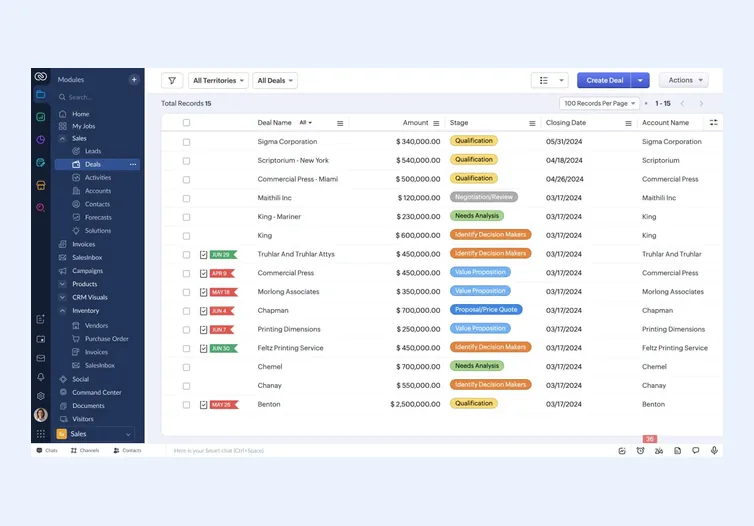
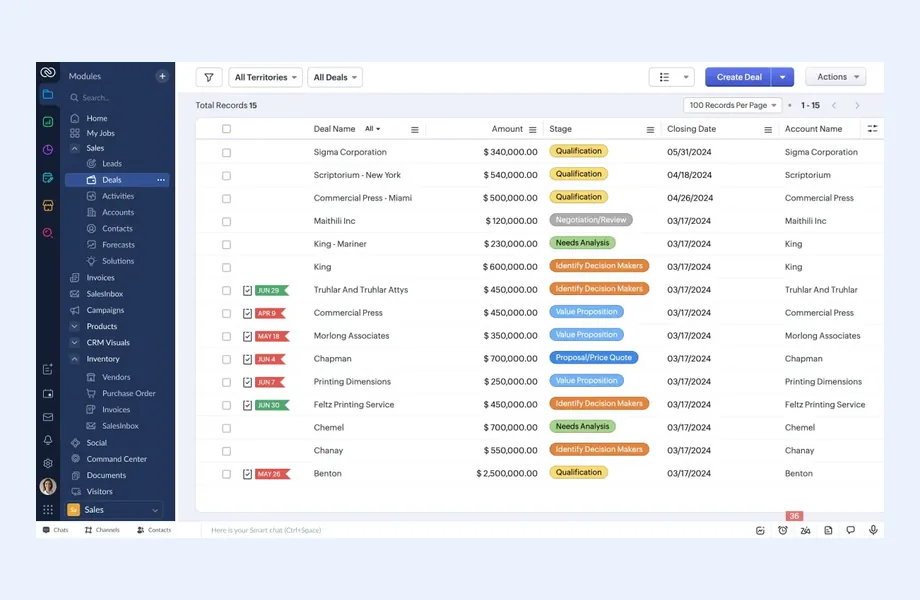
In Zoho CRM I start by agreeing territories that reflect how your team really divides the city, rather than an abstract list of postcodes. Accounts and leads are assigned to a territory, and managers see pipeline and activity by area. Visits are logged from the mobile app, follow-up tasks are created on the spot, and a simple weekly view shows which important accounts have not been seen recently.
I also check how leads arrive. In Riyadh many come by phone, WhatsApp, referrals or walk-ins at a showroom, not only through web forms. Each source needs a defined route into the CRM, or the most valuable conversations never get recorded. Zoho offers messaging and telephony integrations; which suit you depends on your providers, and I test them with real scenarios before rollout. The global Zoho CRM page covers the product itself.
Many Riyadh businesses sell a service as much as a product: air conditioning installation and maintenance, elevator and building systems, facility management for residential compounds and office towers, appliance after-sales, or security systems. For several of these, demand rises sharply in the hottest months, when a failed cooling unit becomes urgent and every technician is booked.
That seasonal pressure shapes the system design. A service desk has to capture each request quickly, assign it to a technician who can reach the area, track response against the terms of the customer's contract and show managers where the backlog is growing. Zoho Desk handles ticketing and service levels, and Zoho also offers a field service app for scheduling and work orders. Which combination fits depends on how many technicians you have, how contracts are priced and whether parts are tracked in inventory.
I write those requirements from your real call patterns, test the setup with a simulated busy day before go-live and make sure contract renewals and preventive visits are scheduled for the quieter months. The facility management industry page describes the wider process, from contract to invoice.
Riyadh's startup and growth company scene has expanded, and many young firms choose Zoho One because a single subscription opens a wide range of apps. That breadth is useful, but it brings a predictable problem: within a few months, a dozen apps are switched on, each used by a few people, with overlapping data and no one responsible for the whole.
I help growing Riyadh companies plan Zoho One adoption in a deliberate order. Usually that means a solid CRM and finance base first, then the apps that support the core operation, such as projects, desk or inventory, and only then the wider set. Each app gets a named owner, a short list of fields and a reason to exist. Users are added and removed through a defined process, which matters when headcount changes quickly.
I also look ahead to the point where a growing company might outgrow parts of the suite, for instance when manufacturing or complex project costing becomes central. Planning for that early keeps data clean if one area later moves to another platform. The Zoho One page explains the suite in general terms.
International groups with a regional base in Riyadh often already run a CRM elsewhere, sometimes Salesforce, Dynamics or HubSpot. The Riyadh team may still choose Zoho because it is quick to deploy and suits a small local team, while the parent wants consolidated pipeline reporting.
This is a design decision, not a technical detail. If the Riyadh team runs Zoho CRM, someone must decide which records flow to the group system, how often, in what currency and with which stage definitions. If the group insists on its own CRM, Zoho might still serve the local office for service desk or finance. Running two CRMs for the same customers without clear rules creates duplicate contacts and conflicting forecasts.
I document the options, including the cost drivers of each, the integration approach and who owns which data, so local and group leadership decide with the same facts. Saudi tax, e-invoicing and Arabic document checks for Zoho are covered on my Zoho consultant in Saudi Arabia page, so I do not repeat them here.
Some Riyadh processes do not fit any standard Zoho app. A contractor may need a site material request that passes through a site engineer, a project manager and a store. A compound operator may want residents' work orders tied to specific units. These are good candidates for small Zoho Creator apps, as long as they stay small, are documented and have an owner.
I write the specification for each app: the form, the approval steps from your authority rules, the reports and the link to CRM or Books. That gives your developer or implementer a clear brief and gives you a way to judge what they deliver.
Riyadh has a number of firms that implement Zoho, and many Riyadh companies already work with one. I work alongside them rather than replace them. I do not configure the system on your behalf beyond what the engagement agrees, I take no commission and I resell no licenses. My role is to make sure what gets built matches what you need. To see how this sits within broader ERP planning, read the Riyadh ERP consultant page or contact me.

Tell me about your business and current systems. I’ll suggest the most sensible first step.
Book a Consultation
Not sure which ERP you need?
Share your business requirements with me and I will help you understand the right process, architecture and platform before implementation.
FAQ
Yes. Territories can be set up around the districts your team covers, visits can be logged from the mobile app and follow-up tasks created on the spot. I design the territory structure and manager views so leadership can see coverage and pipeline by area, and I test it with your team before rollout.
It can be. Zoho Desk handles tickets and service levels, and Zoho also offers a field service app for scheduling and work orders. Whether it fits depends on technician numbers, contract types and how parts are tracked. I test the setup against a simulated summer peak before you commit.
It depends on what the group needs to see and how independently the Riyadh office operates. I compare running Zoho locally with a defined data flow to the group, against using the group CRM directly, and set out the integration effort, data ownership and reporting implications of each option.
My role is advisory and oversight: requirements, app selection, design review, testing and handover. A Zoho implementer or your own team usually does the configuration and any development. I work alongside them, I take no commission and I resell no licenses, so my view of their work stays independent.
Every business is different. Share where you are today and what you want to fix, and I’ll tell you honestly whether and how I can help.
Book a Consultation
Insights
 Book a Consultation
Book a consultation to talk through your processes, systems and goals. I’ll reply with practical next steps - no obligation.