Contact Info

 Zoho Inventory in the Netherlands
Can Zoho Inventory run stock for a Dutch trading company?
For a Dutch trading or ecommerce company, Zoho Inventory works as the stock system when the setup reflects how goods move: imports arriving through Rotterdam or Schiphol, stock held at a third-party logistics provider, orders from a webshop, bol.com or Amazon, and parcels shipped across the EU. Import VAT, OSS and invoice tax belong in Zoho Books or your ledger, set by your advisor. I design and review the setup remotely.
Last reviewed by Vikas Saroj
Dutch trading companies often never touch their own stock. Containers land in Rotterdam, air freight comes through Schiphol, and the goods go straight to a logistics provider in Venlo, Tilburg or Waalwijk that picks and ships on their behalf.
That changes what an inventory system has to do. Zoho Inventory still holds the item master, orders and stock figures, but the warehouse work happens elsewhere, and the stock count is only right if messages between you and the logistics provider are right.
I work remotely with Dutch importers, wholesalers and online sellers to design that flow and to say honestly when it calls for more than Zoho Inventory.
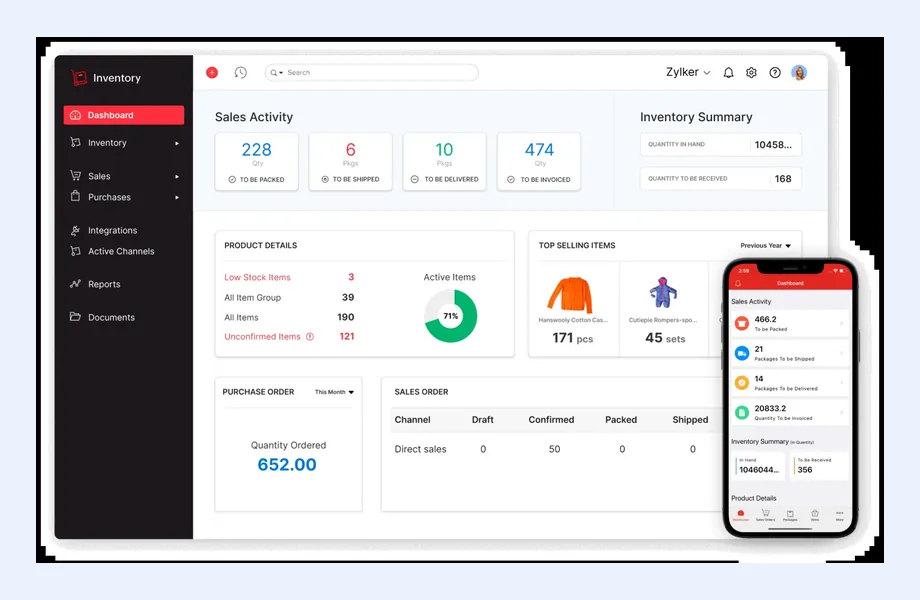
 Inventory Services
The Dutch setup decisions differ from a classic own-warehouse project. These are the pieces I work through.

Design of how purchase orders, inbound notices, shipments and stock reports pass between Zoho Inventory and your logistics provider, with one side clearly owning the physical count.

SKUs, barcodes, units, dimensions and weights set up to match what your logistics provider and each marketplace require, so items are not rejected at intake or picked wrongly.

A way to add freight, duty, handling and broker costs to item cost, tested against your edition's landed cost features and agreed with your accountant.

Orders from bol.com, Amazon and your own webshop brought into a single order flow with one stock figure, using native integrations where Zoho offers them for your region and tested third-party connectors where it does not.

Return reasons, inspection outcomes and restocking rules for webshop and marketplace returns, so the stock figure reflects only what can actually be sold again at full price.

The link to Zoho Books or another ledger for valuation and invoicing, with BTW, import VAT and cross-border consumer sales handled under your advisor's rules.
How I Work
Trace goods from supplier to customer
 Import routes and documents
Logistics provider interfaces
Sales channels and volumes
Returns and damage handling
Import routes and documents
Logistics provider interfaces
Sales channels and volumes
Returns and damage handling
Items, channels and costs
Item master cleanup
Warehouse and provider setup
Import cost method tested
Marketplace and webshop links
Stock ownership rules
Start with agreed stock
Count reconciled with provider
Channels switched on in order
Team training
First month stock review
Many Dutch importers and online sellers outsource warehousing to a logistics provider, often in the corridor between Rotterdam and the German border. Their own office handles buying and selling; the provider receives containers, stores pallets, picks orders and ships parcels. In that model, Zoho Inventory is the commercial stock record and the provider's warehouse system is the physical one.
The design work is in the messages between them. When a purchase order is placed, does the provider receive an inbound notice? When goods arrive, who books the receipt and how do differences get reported? When a sales order is released, how does it reach the provider, and how does the shipment confirmation come back with tracking numbers? Each of these can run through an integration, a file exchange or a manual step, and each needs an owner.
I also agree which count wins. In most cases the provider's count is the physical truth, and Zoho Inventory is reconciled to it on a fixed rhythm with differences explained by reason code. Without that rule, two stock figures drift apart and nobody trusts either. If you use several providers, or a mix of your own warehouse and an outsourced one, each becomes its own warehouse in Zoho with transfers between them. General integration methods are on ERP integration.
A Dutch importer's margin depends on what it really costs to land goods. Ocean freight, terminal charges, customs clearance, duty on goods from outside the EU, inland transport and the logistics provider's inbound fees all add up, and they arrive on different invoices at different times.
Zoho includes landed cost handling of some kind, though what it can do depends on the edition, so I run a few real shipments through a trial organization first. Will a single container invoice split over three supplier orders? Is the split by value, volume or weight? If the customs broker invoices weeks later, what happens to items already shipped to customers? And does Zoho Books show the corrected stock value? Where the built-in tool copes, I set it up and write a one-page procedure. If not, I agree a periodic adjustment method with your accountant.
VAT on imports is a separate matter handled in the ledger, not in Inventory. Some Dutch importers use a deferral arrangement for import VAT or work through a fiscal representative when the importing company is foreign. Your tax advisor determines whether either fits your case. My part is making sure the customs documents and broker references are stored against the purchase so finance can match them. The Zoho Books in the Netherlands page covers the accounting side.
Dutch online sellers commonly sell through their own webshop and through marketplaces such as bol.com and Amazon, sometimes across the Netherlands and Belgium at once. Every channel keeps its own count, so a fast seller can be sold twice over unless one system is in charge.
Zoho Inventory offers native connections to a number of store platforms and marketplaces, but which ones are available depends on region and changes over time. I check what is offered for a Dutch account rather than assume. Where a channel such as bol.com has no native connector that meets your needs, a third-party connector, Zoho Flow or the API can carry orders in and stock out. Whatever the route, I write down where stock levels, prices and listing content are mastered.
Fulfillment by the marketplace itself adds another layer. Stock sent to a marketplace warehouse is still your stock, so I set it up as a separate location with transfers, so valuation stays complete and you can see what is sellable where. Marketplace fees and payouts are reconciled in finance, not in Inventory. Product titles and descriptions in Dutch are written by your own team, since they drive conversion on Dutch marketplaces. For the broader picture, see ecommerce.
Parcels leave Dutch warehouses for customers across the Netherlands, Belgium, Germany and further into the EU. Carriers such as PostNL and DHL dominate domestic delivery, while cross-border parcels may go through several networks. Zoho Inventory supports shipping integrations, but which carriers and platforms are connected varies by region and edition. Where no native option fits, your logistics provider usually generates labels, and tracking numbers flow back to the package record.
Returns are where Dutch ecommerce stock figures go wrong. Consumers return a meaningful share of some product types, and every return needs a reason, an inspection result and a decision: back to sellable stock, to a refurbish or outlet location, or written off. I design those steps with your customer service and warehouse teams and connect them to the refund flow in finance.
Sales to consumers in other EU countries bring VAT questions, such as when the EU one-stop shop scheme applies and which rate goes on the invoice. Those rules are applied in Zoho Books or your ledger as your accountant directs; Inventory passes the order, customer country and shipment details. I test domestic, Belgian, German and non-EU orders with your accountant before go-live, so the tax and the stock both come out right.
For Dutch traders and online sellers who buy finished goods and sell them on, Zoho Inventory is a reasonable base, whether from their own warehouse or through a logistics provider. It runs short in a few situations that come up often in the Netherlands.
Logistics providers themselves need a warehouse management system with client billing, slotting and scanning at scale, which Zoho Inventory is not. Wholesalers running their own large warehouses with directed putaway and wave picking need similar depth. Food and flower traders working with fresh product, short shelf lives and auction or clock purchases may need specialist trading software. Manufacturers that blend, assemble or pack to order need production orders and costing.
Group structure is another trigger. A European headquarters in the Netherlands with sales companies in several countries, each holding stock and needing consolidated margin reporting, often outgrows separate Zoho organizations. In each case I compare Zoho Inventory with suitable ERPs, using your volumes and processes, and say plainly where the line is. The ERP consultant in the Netherlands page sets out how that comparison runs, the Zoho Inventory page lists the product limits, and best ERP for distribution compares alternatives.

Tell me about your business and current systems. I’ll suggest the most sensible first step.
Book a Consultation
Not sure which ERP you need?
Share your business requirements with me and I will help you understand the right process, architecture and platform before implementation.
FAQ
Often, but rarely out of the box. Most logistics providers accept orders and return confirmations through their own API, EDI or file exchange. I design that interface, choose a connector or custom integration with your provider, and agree which system owns the physical stock count.
Check current availability, because native marketplace connections change by region and over time. If no native connector meets your needs, orders and stock updates can travel through a third-party connector, Zoho Flow or the API, and I weigh those routes before any build.
In Zoho Books or your accounting system, not in Zoho Inventory. Whether your company uses an import VAT deferral arrangement or a fiscal representative is a decision for your tax advisor. I make sure customs documents and broker references are stored against each purchase so finance can match every import bill to the goods it covers.
It can, if the process is designed. I set return reasons, inspection outcomes and locations for refurbished or written-off stock, and connect them to refunds in finance. Without those steps, returned items that cannot be resold tend to inflate the sellable stock figure.
Usually not. A logistics provider needs a warehouse management system with multi-client stock, slotting, scanning workflows and storage billing. Zoho Inventory is designed for companies managing their own stock. I can help you define requirements for a proper WMS instead.
Every business is different. Share where you are today and what you want to fix, and I’ll tell you honestly whether and how I can help.
Book a Consultation
Insights
 Book a Consultation
Book a consultation to talk through your processes, systems and goals. I’ll reply with practical next steps - no obligation.