Contact Info

 Zoho Projects Kuwait
How should a Kuwaiti group or consultancy set up Zoho Projects?
In Kuwait the first Zoho Projects decision is usually structural: whether the companies in a family group share one portal or keep separate ones. After that come templates for public-sector work that is paid on formal acceptance, client access for Arabic- and English-speaking client teams, and the handoff to Zoho Books for invoices in dinars. I advise remotely and independently, including when a contracting arm needs an ERP instead.
Last reviewed by Vikas Saroj
In a Kuwaiti family group, project work rarely belongs to just one company. The contracting arm builds, an engineering or IT company designs and integrates, a facilities business maintains what was delivered, and staff move between them. Each company tends to manage projects its own way, so the owners never get one view of what is running, late or unbilled.
I help Kuwaiti groups and independent consultancies set up Zoho Projects so delivery follows a shared method while each company keeps its own clients, billing and books. That includes public-sector work, where formal acceptance usually decides when an invoice can go out.
The engagement is remote: workshops with the owners and project leads, configuration reviews online and written decisions your teams can follow. Zoho pays me nothing, and I take no cut of the subscription you buy, which leaves me free to recommend a smaller setup or a different tool.
 What I Do
I begin with how your group is organized and how your clients approve work, then shape Zoho Projects to fit.

A documented decision on whether group companies share one Zoho Projects portal or run separately, weighing shared staff, client confidentiality, reporting needs and how each company's Zoho Books organization will connect.

Common templates, statuses and naming across companies, so owners can compare projects from the contracting, engineering and services arms without each manager inventing a new structure.

Payable stages on public and semi-public contracts that close only with documented client acceptance, giving finance a clear signal for billing and leaving a dated trail if payment is delayed.

Client users invited with limited views, document folders split between issued and internal, and naming conventions that work in Arabic and English where your clients expect both.

Rules for staff who work on another group company's projects, so hours are logged, approved and recharged consistently instead of disappearing into one company's overhead.

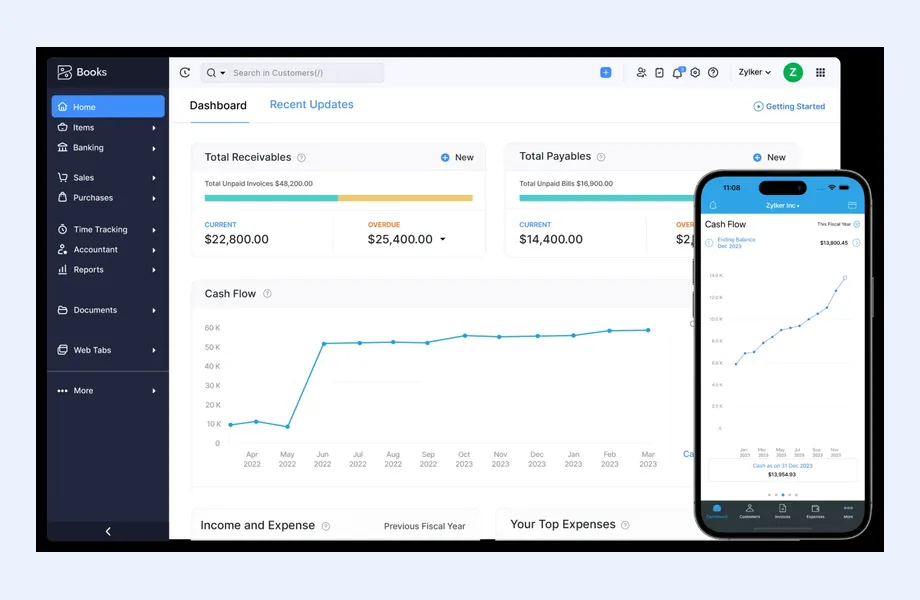
Each project tied to the right Zoho Books organization, with accepted stages, approved hours and recharges flowing to invoices in dinars and foreign costs converted correctly.
How I Work
Structure, standards and owners
 Group companies and roles listed
Portal structure agreed
Shared staff identified
Billing entities confirmed
Group companies and roles listed
Portal structure agreed
Shared staff identified
Billing entities confirmed
Templates, roles and recharges
Group templates configured
Acceptance milestones set
Client roles tested
Recharge rules documented
Books links verified
Company by company
First company goes live
Lessons applied to others
Owner dashboard reviewed
Standards kept under review
This is the question I settle first with Kuwaiti family groups, because it is awkward to change later. A Zoho Projects portal holds its own users, templates, projects and settings. Groups can run one shared portal or a separate one per company, and both have real consequences.
| Option | Suits groups where | Risks to manage |
|---|---|---|
| One shared portal | Staff work across companies, owners want one view, templates should be identical | Client confidentiality between companies, billing links to several Books organizations, permissions complexity |
| Separate portals | Companies have distinct clients, managers and processes | Duplicate users and licenses for shared staff, group reporting needs an extra layer |
A middle path often makes sense: one portal for companies that genuinely share delivery staff, such as engineering and facilities, and a separate one for a business with very different work, such as retail fit-out or food service projects. Owner reporting across portals can then come from Zoho Analytics.
Licensing, integration options and how each portal connects to Zoho Books differ by plan, so I check those details against your exact subscription before recommending a structure. The decision is written down with its reasons, so that when a new company joins the group, the answer is already known.
Kuwaiti consultancies and integrators delivering to ministries and government bodies usually work to a defined scope, with payment released stage by stage once the client accepts each deliverable or installation. Acceptance may come from a named client engineer or a committee, sometimes after a long review. Invoices raised before that point tend to sit unpaid.
In Zoho Projects I set templates for this kind of work around a few principles:
The view becomes the agenda for the weekly meeting with the client. It also gives management an honest pipeline of cash that is earned but not yet billable, which is often the largest working capital question in a Kuwaiti consultancy. Zoho Projects does not connect to government procurement or approval systems, so the team records each acceptance as it happens.
Many Kuwaiti clients, particularly in the public sector, work in Arabic, while delivery teams often work in English. A client-facing project space has to respect both without becoming cluttered.
The practical choices I agree with project leads:
I test each client role by logging in as it before anyone is invited, because a permission mistake that exposes internal notes is hard to undo with a government client. Formal correspondence and contractual letters should still follow your client's official channels; the portal supports the relationship, it does not replace the paperwork the client's procedures require.
When an engineer from the group's consultancy works on the contracting company's project, someone should pay for that time. Without a rule, the cost stays with whichever company employs the person and project margins in both companies are wrong.
I agree a recharge method with group finance and reflect it in Zoho Projects and Zoho Books for Kuwait:
External billing follows the same discipline. Accepted stages and approved hours become invoices in Kuwaiti dinars, with amounts held at fils precision through every step. My understanding is that Kuwait has not introduced a general VAT, which leaves these invoices without sales tax for now; check that with a tax advisor, particularly if a group company also trades in a GCC country that applies VAT. Subconsultant or software costs billed in dollars or euros are converted at the agreed rate so project cost stays meaningful.
The contracting company in a group is usually where Zoho Projects meets its limit. Scheduling, site coordination, punch lists and client communication fit well. The commercial side of construction contracts does not.
Items that standard Zoho Projects and Zoho Books are not built to carry:
Some groups build these as Zoho Creator applications beside Zoho Books. Others give the contracting company an ERP with construction project accounting and keep Zoho for the rest of the group. My Kuwait construction ERP page looks at that choice, the Zoho overview for Kuwait covers the wider suite, and ERP consulting for Kuwait explains how I evaluate platforms without a vendor interest.

Tell me about your business and current systems. I’ll suggest the most sensible first step.
Book a Consultation
Not sure which ERP you need?
Share your business requirements with me and I will help you understand the right process, architecture and platform before implementation.
FAQ
Not always. A shared portal suits companies that share staff and want identical methods. Separate portals suit companies with distinct clients and processes. Many groups combine both, with group reporting through Zoho Analytics. I compare the options against your licensing, client confidentiality needs and Zoho Books setup before recommending one.
It cannot speed up the client's review, but it can make the delay visible. Each payable stage closes only with an attached acceptance document, and a standing view lists everything delivered but not yet accepted, with submission dates. That becomes the agenda for client meetings and a clear picture of earned but unbilled work.
My understanding is that Kuwait currently applies no general VAT, so dinar invoices go out without sales tax. A group company registered in a neighboring country that does apply VAT is a different case and needs its own settings. Your tax advisor has the final word; I set the system up to follow it.
Staff log hours on the project they worked on, whichever company owns it. Approved hours are summarized monthly at an agreed internal rate, and the employing company invoices the receiving company in Zoho Books. Group finance checks that both sides agree. I document the method so it survives staff and manager changes.
Yes, often. Some groups use me before hiring an implementer, to define structure and requirements. Others bring me in to review an implementer's design for project templates, permissions and the Zoho Books link. Everything is done remotely, and my only client in the arrangement is you: no referral fees, no reseller deal with Zoho or with the implementer.
Every business is different. Share where you are today and what you want to fix, and I’ll tell you honestly whether and how I can help.
Book a Consultation
Insights
 Book a Consultation
Book a consultation to talk through your processes, systems and goals. I’ll reply with practical next steps - no obligation.